Cloud security startup Native has come out of stealth with $42 million in funding and a platform aimed at one of the toughest problems facing large enterprises today: how to enforce security policies consistently across multiple cloud providers. The company said its platform is designed to translate a company’s security policy into provider-native controls across Amazon Web Services, Microsoft Azure, Google Cloud and Oracle Cloud Infrastructure.
The funding includes a $31 million Series A round led by Ballistic Ventures, with continued participation from General Catalyst, YL Ventures and Merlin Ventures. Native also said Phil Venables, the former chief information security officer of Google Cloud and now a venture partner at Ballistic Ventures, has joined its board.
That combination of funding, board backing and product positioning gives Native an early profile in a market where enterprise cloud security has become more urgent and more complicated. Instead of pitching itself as yet another detection or monitoring layer, the startup is making a different argument: security teams should be able to define policy intent once and have it enforced through the cloud providers’ own built-in control systems.
That distinction matters. As companies spread workloads across several cloud environments, each provider brings its own policy model, identity framework and pace of service change. Native’s pitch is that the real challenge is not the absence of security controls, but the difficulty of using those controls consistently and safely in production environments. The company said that misconfigurations can disrupt operations, and that this risk becomes even harder to manage in multi-cloud setups.
The timing of the launch is also notable. Native cited Google’s Mandiant data showing that the average time to exploit vulnerabilities fell to minus one day in 2024, meaning attackers were, on average, exploiting flaws before patches were publicly available. In practical terms, that makes the old security model of spotting problems and responding later look increasingly fragile.
This is the broader gap Native is trying to address. The company is aligning itself with the growing push toward secure-by-design cloud architecture, where the emphasis shifts from reacting to threats after they appear to preventing problems through infrastructure design and enforcement.
Co-founder and CEO Amit Megiddo framed the issue in plain terms, saying cloud providers already invest heavily in security controls, but enterprises often struggle to use them effectively across multiple clouds. He said Native was built so that security teams can define policy intent and have it enforced across environments while staying aligned as those environments change.
To reduce the risk of disruption, Native said its platform includes pre-deployment impact simulation, staged rollout tools and approval workflows. The company said these features are meant to help enterprises introduce new controls more carefully and keep enforcement aligned as cloud services and internal requirements evolve.
Venables described the company’s approach as part of a larger change in how cloud security is being understood. He said the industry is moving toward a model where the real unit of work is no longer just finding problems, but safely enforcing the right architecture at speed.
Investors echoed that view. According to the company’s statements, the rise of AI-assisted attacks is compressing the window between the appearance of new vulnerabilities and their exploitation, making preventive controls more critical.
Ballistic Ventures’ Jake Seid said the idea that businesses must choose between moving fast and being secure is a false tradeoff. YL Ventures’ Ofer Schreiber said reactive detection alone is no longer enough, while Merlin Ventures’ Shay Michel said enterprise AI adoption will require security that is built directly into cloud infrastructure rather than added externally.
Native also said it is already working with Fortune 100 companies across finance, technology and media. While it did not name customers, the claim suggests the company is aiming squarely at large enterprises with sprawling cloud operations and high tolerance for neither outages nor security lapses.
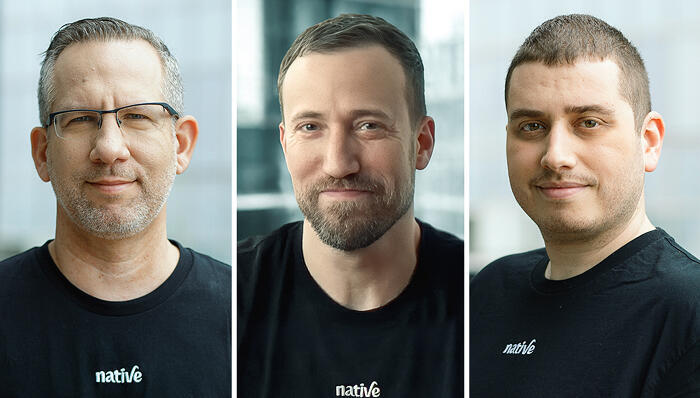
Its founding team brings deep cloud security credentials. Megiddo previously led Amazon GuardDuty at AWS, Chief Product Officer Gal Ordo led AWS Security Hub, and Chief Technology Officer Eyal Faingold served as vice president of cloud security at Check Point.
Native said it currently has 41 employees across Tel Aviv and the United States and plans to grow to 90 by the end of 2026. The company added that its workforce includes people from major cloud providers, Israeli military cyber units and cybersecurity firms such as Palo Alto Networks, Lacework, Axonius and Cyera.
For now, Native’s debut lands at a moment when cloud security buyers appear to be rethinking what they actually need. For years, security tooling has often focused on visibility, alerts and post-incident response.
Native is making a more ambitious case: that the next phase of cloud security will be defined not by seeing risk faster, but by enforcing the right controls before that risk turns into damage. Based on its launch message, funding backing and team pedigree, that is the market it wants to own.