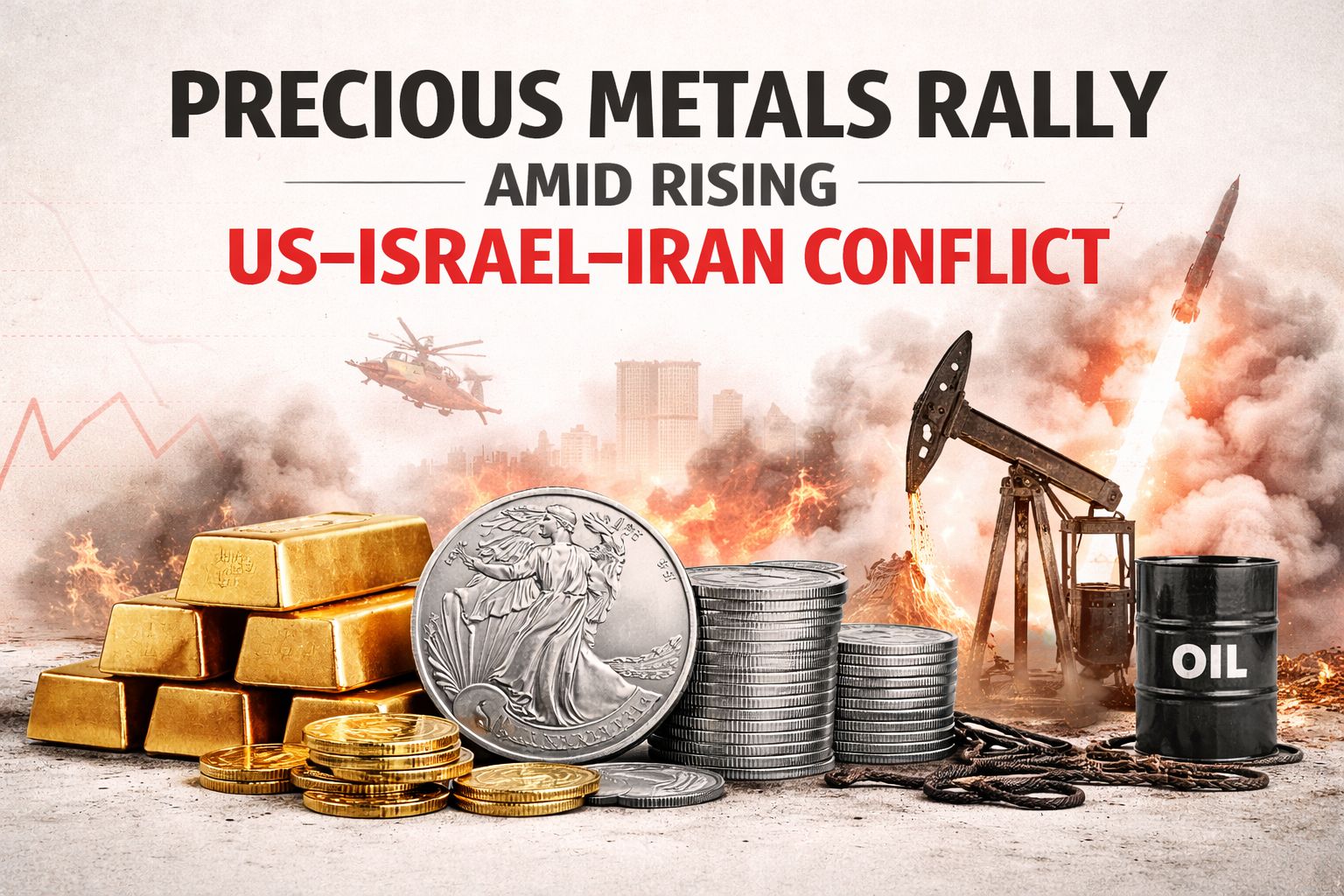
Monday saw a drastic increase in the price of gold and silver as escalating tensions between the US, Israel, and Iran rattled international markets. Investors sought refuge in precious metals as uncertainty grew. Silver increased by around 2% to hover at $96 per ounce, while gold traded close to $5,400 per ounce on international markets.
The reaction was swift but not surprising. Whenever geopolitical risks increase, investors often pull money out of equities and other risk-driven assets and park it in gold and silver. These metals have long been seen as reliable stores of value during uncertain times.
A Familiar Pattern in Uncertain Times
Gold’s move toward $5,400 per ounce reflects strong demand for security. When political tensions rise or conflict intensifies, confidence in financial markets can weaken quickly. In such moments, gold typically benefits because it is not directly tied to the performance of any single country, company, or currency.
Silver followed the same direction, rising around 2 percent. While it often tracks gold’s movements, silver can experience sharper swings because its market is smaller and more sensitive to sudden changes in demand.
The latest gains came after developments over the weekend increased concerns about stability in West Asia. Markets responded at the start of the trading week, with investors adjusting their positions almost immediately.
Also Read: India and Canada Finalise $2.6 Billion Uranium Supply Pact
Oil, Stocks, and the Bigger Market Picture
The impact of rising tensions was not limited to precious metals. Oil prices also moved higher as traders considered the possibility of disruptions in energy supply from the region. The Middle East remains central to global oil flows, and even the risk of supply interruptions can influence prices.
Higher oil prices can fuel inflation concerns. In such scenarios, gold often gains additional support because many investors view it as a hedge against rising prices.
As investors decreased their exposure to risky assets, stock markets in a number of regions displayed indications of deterioration. Capital has a tendency to move toward more stable assets during uncertain times.
Strong Ripple Effect in India
The rally in global bullion prices was quickly reflected in India. Domestic gold rates moved higher in line with international benchmarks. Silver prices in India also rose, tracking global trends.
24-carat gold (per 10 grams) is trading around ₹1,73,090, up about ₹4,030-₹4,380 compared to yesterday and Silver is trading around ₹2,94,900 per kilogram,
India is one of the largest consumers of gold in the world, and international price changes usually influence local markets without much delay.
Silver’s Unique Position
Silver’s performance is noteworthy because it accomplishes two goals. It is extensively utilized in manufacturing, electronics, and renewable energy systems in addition to serving as a store of value. Because of its dual function, industrial demands as well as demand from safe havens can influence silver prices.
As a result, during turbulent sessions, silver frequently exhibits larger percentage movements than gold. When markets become uneasy, sentiment may quickly elevate the metal, as evidenced by the nearly 2 percent increase to almost $96 per ounce.
Markets Watching Every Move
Geopolitical issues are directly affecting precious metals. Although silver’s increase to about $96 per ounce and gold’s rise to $5,400 per ounce indicate substantial purchasing demand, markets are still susceptible to fresh information.
Investors will keep an eye on changes in oil prices, geopolitical developments, and general market trends. Price fluctuations might be severe in either way during these times.
For present, a straightforward truth is reflected in the spike in gold and silver prices. Investors look for stability when there is increased global uncertainty. The most recent shift in precious metals serves as a stark reminder of how swiftly global events may impact investor behavior and financial markets.
Also Read: When India Was the ‘Golden Bird’: A Look at Its Dominant Global Economy