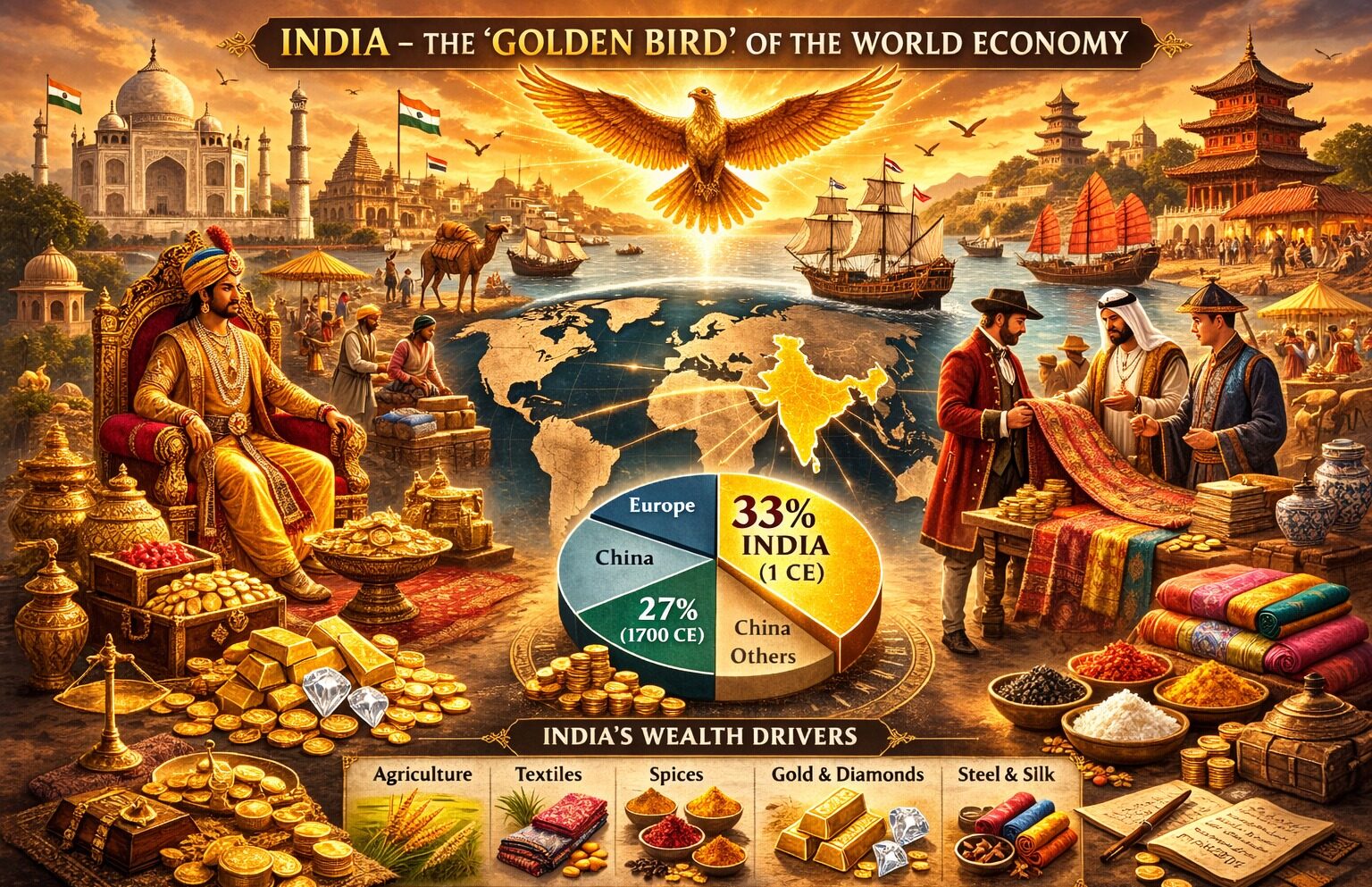
For centuries, India was widely known as the “Golden Bird,” a term used to describe its immense prosperity and economic strength. This reputation was not symbolic alone. Historical economic research shows that India was one of the world’s leading economic powers for nearly two thousand years. Its wealth, advanced production systems, and strong trade networks made it a central hub for global commerce. Merchants from Europe, the Arab world, and Asia traveled long distances to trade in Indian goods, reinforcing its importance in the global economy.
India’s economic prominence was closely tied to its ability to produce and export valuable goods that were in high demand worldwide. Its manufacturing and agricultural output supported large populations and sustained vibrant internal and external trade. This economic strength shaped global trade patterns and influenced the ambitions of foreign traders and explorers.
India’s Massive Share of Global GDP
According to research by economic historian Angus Maddison, India held the largest share of global GDP for much of ancient and medieval history. Around 1 CE, India accounted for approximately 33 percent of the world’s total economic output. This meant that nearly one-third of all goods and services produced globally originated in India.
India’s economic influence remained strong for many centuries. By 1000 CE, its share of global GDP stood at about 28 percent, maintaining its position among the top economic powers. Even in 1700 CE, India still contributed roughly 27 percent of the world’s GDP. These figures indicate that about one out of every four units of economic output worldwide came from India during that period.
This sustained level of economic dominance highlights India’s long-standing productivity and the scale of its industries. Its economy remained resilient and influential across multiple historical eras.
Also Read: How a Tribal Student from Navsari Built a Bamboo Brand from Scratch
Industries That Built India’s Prosperity
India’s wealth was rooted in a wide range of productive sectors. Agriculture formed the backbone of the economy, supporting large populations and enabling surplus production for trade. Beyond farming, India was globally renowned for its textile industry, especially cotton fabrics, which were exported in large quantities.
Spices were another major export, attracting traders from distant regions. Indian spices were valued for their quality and variety, making them essential commodities in international markets. The country was also known for producing gold, diamonds, silk, and Wootz steel, a high-quality form of steel recognized for its strength and craftsmanship.
These industries gave India a strong manufacturing base long before the Industrial Revolution began in Europe. Indian goods were traded extensively across Asia, the Middle East, and Europe, contributing significantly to global commerce.
Global Trade Routes Shaped by India’s Wealth
India’s economic importance influenced the development of major trade routes. European traders were especially eager to reach India directly to access its valuable commodities. The demand for Indian textiles and spices encouraged exploration and maritime expansion. Sea routes were developed to facilitate faster and more efficient trade between India and distant markets.
Trade networks connected Indian ports with regions across the Indian Ocean, strengthening economic ties between continents. These exchanges helped spread goods, technologies, and cultural influences, further enhancing India’s global role.
How Other Regions Compared Economically
During much of this period, European economies were smaller in comparison to India’s vast economic output. Many European nations, including England, France, Spain, and Germany, had not yet reached the industrial capacity that would later define their growth. Their economic structures were still developing, and their global trade influence was limited compared to India’s established networks.
The United States did not exist as an independent economic power during most of this period and was still undergoing colonization, with minimal contribution to global GDP. China was one of the few regions with a level of production and trade comparable to India. At various points in history, China and India were the two largest economies in the world, though India frequently held a leading position.
The Legacy of the ‘Golden Bird’
India’s long period of economic strength explains why it earned the title “Golden Bird.” Its industries, agricultural productivity, and extensive trade networks allowed it to dominate global economic output for centuries. With a share as high as one-third of the world’s GDP at its peak, India played a defining role in shaping global trade and economic history.
This historical economic leadership reflects the scale and sophistication of India’s production systems and its importance as a center of global commerce for nearly two millennia.
Also Read: CapitalG Leads Reported $200 Million Investment in European Fintech Focused on Cross-Border Payments