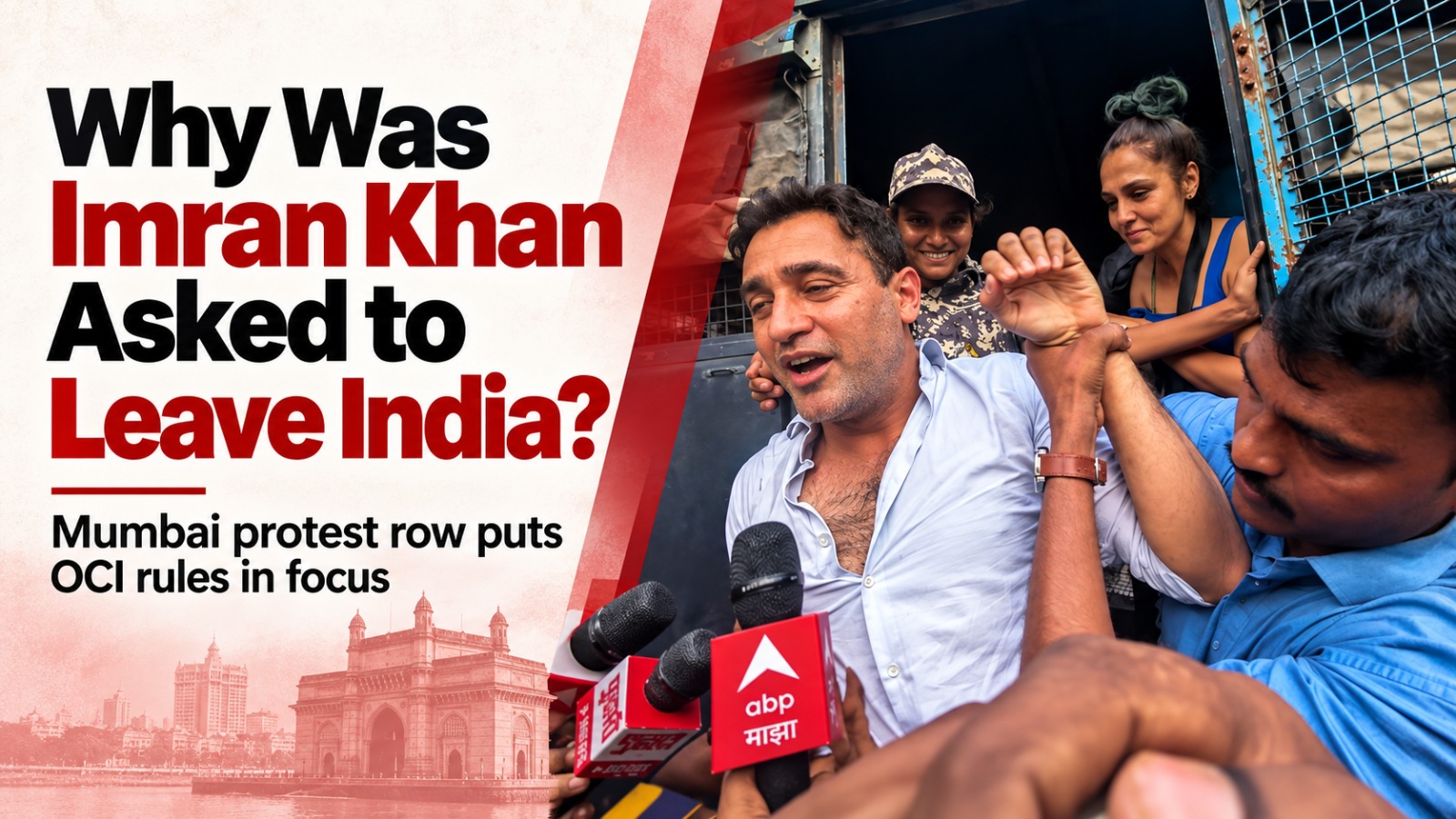
Imran Khan has been told to leave India by October 28, 2026, due to his involvement in a protest against Chief Election Commissioner Gyanesh Kumar in Mumbai on October 10.
Imran Khan, who is a nephew of Bollywood actor Aamir Khan, has the nationality of America and an Overseas Citizen of India (OCI) card.
Participation in a protest has caused immigration officials to ask him to leave India, although an OCI card allows the holder to reside in India if they are a foreign citizen of Indian origin.
Imran Khan was issued the order by Foreigners Regional Registration Office (FRRO) on account of a complaint lodged by BJP member Kirit Somaiya against Khan’s alleged violation of Indian laws.
The notice reportedly invokes Sections 7 and 29 of the Immigration and Foreigners Act, 2025, which give the government powers to regulate the presence of foreign nationals and order their removal under specified circumstances.
What Did Imran Khan Do at the Mumbai Protest?
The controversy began on October 10 when Khan joined a demonstration at Mumbai’s August Kranti Maidan organised by the Cockroach Janta Party (CJP), a Gen Z-led protest movement demanding electoral reforms.
The protesters were calling for the resignation of Chief Election Commissioner Gyanesh Kumar over allegations of electoral irregularities. The Election Commission has denied allegations of vote fraud.
Khan was among those briefly detained by Mumbai Police during the demonstration. He later shared a photograph from inside a police detention van on Instagram, writing, “Apparently I’m going for a drive.”
Speaking to reporters during the protest, Khan explained why he had joined the gathering.
“I don’t have demands. I’m here as a citizen, as a person who lives in this city. I’m here to see why freedom of movement is being restricted, why people’s voices are being suppressed,” he said.
He also clarified that he was not representing any organisation.
Despite Khan’s explanation, his participation attracted scrutiny because he is legally a foreign national rather than an Indian citizen.
Why Did Authorities Ask Imran Khan to Leave India?
The central issue is Khan’s American citizenship and whether his participation in a political protest violated conditions governing foreign nationals in India.
Police confirmed on Thursday, October 15, that immigration authorities had issued him a notice.
“Imran Khan participated in the agitation at Mumbai’s August Kranti Maidan, demanding the resignation of Chief Election Commissioner Gyanesh Kumar,” police said in a statement.
Officials also pointed out that Khan joined the agitation despite not holding Indian citizenship.
A police official maintained that foreign nationals are prohibited from participating in political protests or political activities on Indian soil under the relevant immigration provisions.
The complaint that preceded the action was filed by BJP leader Kirit Somaiya, who accused Khan of being “involved in a conspiracy to spread anarchy in India”.
Somaiya also demanded action against other foreign nationals whom he accused of damaging India’s reputation.
Khan has not publicly responded to the notice, according to the information available on October 15.
What Is an OCI Card, and Why Does Imran Khan Hold One?
The Overseas Citizen of India scheme allows eligible foreign citizens of Indian origin to maintain long-term ties with India.
An OCI card provides several privileges, most notably a lifelong, multiple-entry visa allowing the holder to travel to India without repeatedly applying for a visa.
However, despite the term Overseas Citizen, OCI status is not equivalent to Indian citizenship.
An OCI cardholder cannot vote in Indian elections, contest parliamentary or state assembly elections, or claim the same political rights available to Indian citizens.
OCI holders must also comply with Indian immigration laws, and their permission to remain in the country is subject to applicable legal conditions.
Although he has worked in the Indian film industry and lives in Mumbai, his American citizenship places him within the legal framework applicable to foreign nationals.
Can OCI Cardholders Participate in Political Protests in India?
This is the question that makes Khan’s case particularly significant.
While police have maintained that foreign nationals cannot participate in political demonstrations, the legal position on an OCI cardholder’s attendance at a peaceful gathering requires closer examination.
Supreme Court advocate Amitraj Kaushal has explained that Indian law does not expressly impose a blanket prohibition on OCI cardholders attending peaceful gatherings.
Article 19 of the Indian Constitution protects several freedoms available to Indian citizens, including the right to assemble peacefully without arms.
Article 14, which guarantees equality before the law, and Article 21, which protects life and personal liberty, apply to all persons, including foreigners.
The distinction matters because participation in a protest and the government’s authority to regulate a foreign national’s stay are separate legal questions.
An OCI cardholder may not automatically commit an offence simply by attending a peaceful gathering. Nevertheless, political activity can attract scrutiny under immigration rules, potentially affecting the person’s permission to remain in India.
Which Laws Were Invoked Against Imran Khan?
The reported notice refers to two provisions of the Immigration and Foreigners Act, 2025.
Section 7: This provision empowers the Central Government to regulate or restrict the entry, departure and continued presence of foreign nationals in India. It also enables authorities to impose conditions governing their stay and movement.
Section 29: This section concerns the removal of foreign nationals in circumstances covered by the legislation, including violations of applicable provisions or orders and certain security-related cases.
Another relevant provision is Section 7D of the Citizenship Act, 1955, which provides for the cancellation of OCI registration on specified grounds.
Such cancellation is legally distinct from an order directing a foreign national to leave India. An OCI cancellation also involves procedural requirements, including an opportunity to be heard.
How Is the Imran Khan Controversy Connected to the Wider CJP Protests?
Khan’s involvement was part of a broader series of demonstrations organised by the Cockroach Janta Party, a youth-led movement campaigning for electoral reforms.
The protests spread across Delhi, Mumbai and other locations, with participants demanding the resignation of Chief Election Commissioner Gyanesh Kumar.
The agitation also drew participation from opposition politicians.
On October 12, opposition leaders, including Congress MP Rahul Gandhi, led protesters on a march from Connaught Place towards the Supreme Court in Delhi.
On October 14, two senior CJP leaders were sent to jail for five days after being arrested over alleged trespassing at a protest site in the national capital.
The movement has called for another protest in Delhi on October 16.
Khan’s case has added an immigration dimension to the broader political controversy, bringing attention to the distinction between the rights of Indian citizens and those of foreign nationals living in the country.
Who Is Imran Khan? The Actor’s Bollywood Career
Imran Khan is best known for his role in the 2008 romantic comedy Jaane Tu… Ya Jaane Na, which established him as a leading actor in Hindi films.
He had earlier appeared as a child actor in Qayamat Se Qayamat Tak (1988) and Jo Jeeta Wohi Sikandar (1992).
His subsequent films included I Hate Luv Storys, Mere Brother Ki Dulhan and Delhi Belly.
The immigration controversy comes during a significant period in his professional life. Khan is returning to acting in 2026 with the Netflix film Adhure Hum Adhure Tum, following a break of more than a decade.
What Happens Next for Imran Khan?
Khan has been given until October 28 to leave India, but several questions remain unanswered.
It is not yet clear whether he intends to challenge the notice, whether his OCI registration could face separate proceedings, or whether the authorities will reconsider their decision.
For now, the case turns on a significant legal distinction: an OCI card allows a foreign citizen of Indian origin to maintain a long-term connection with India, but it does not confer Indian citizenship or an unconditional right to remain in the country.
Whether Khan’s participation in the Mumbai demonstration was sufficient grounds for directing him to leave India remains the central question surrounding the controversy.
Also Read: Shamrock AI Raises $5 Million, Plans to Keep Up to 80% of Workforce in India