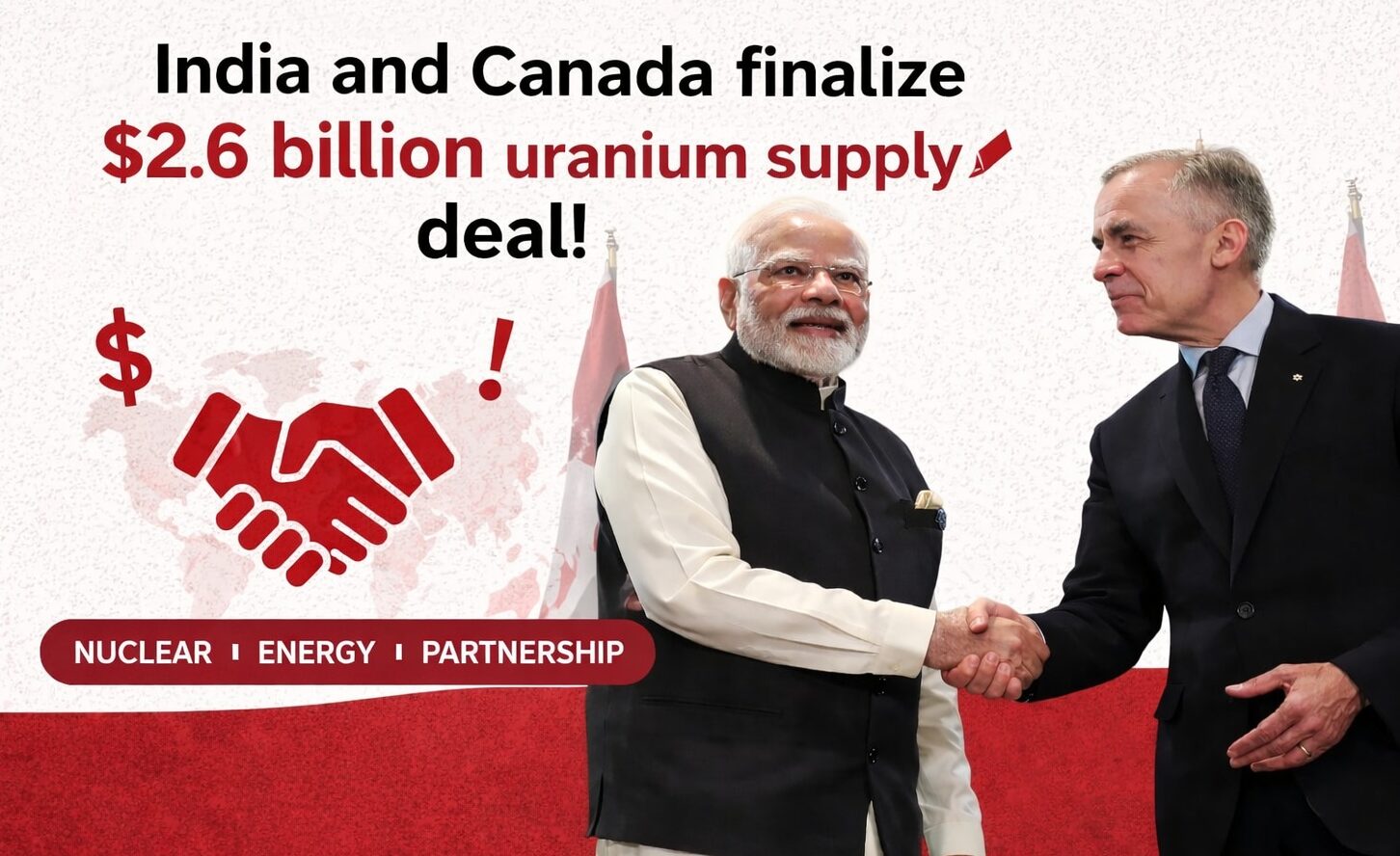
India and Canada have signed a landmark $2.6 billion uranium supply agreement, marking a major step forward in their civil nuclear cooperation. The agreement was concluded during bilateral talks between Prime Minister Narendra Modi and Canadian Prime Minister Mark Carney at Hyderabad House in New Delhi on Monday.
The uranium deal is designed to secure a long-term and reliable fuel supply for India’s civil nuclear energy programme. Addressing the media after the talks, Modi described the pact as a significant milestone and confirmed that both countries will also collaborate on small modular reactors and advanced reactor technologies. The agreement strengthens energy security cooperation at a time when clean and stable energy sources are becoming increasingly important.
Fast-Tracking the Comprehensive Economic Partnership
Alongside the nuclear agreement, the two leaders agreed to accelerate negotiations on the Comprehensive Economic Partnership Agreement, known as CEPA. Carney said both governments are working towards concluding the broader trade pact by the end of 2026.
Modi underlined that unlocking the full potential of economic cooperation remains a shared priority. He said both sides have decided to move swiftly to finalise CEPA, which is expected to create new investment avenues and employment opportunities in both countries. The two leaders also agreed to formal terms of reference for the agreement, laying the groundwork for structured and time-bound negotiations.
Setting a clear economic goal, Modi announced that India and Canada aim to increase bilateral trade to $50 billion by 2030. The proposed trade pact is expected to serve as a key instrument in reaching that target.
Also Read: ₹24 Lakh Salary, Sudden Startup Layoff: A Lesson in Job Stability
Expanding Cooperation in Critical Minerals and Clean Energy
A series of Memorandums of Understanding were signed to broaden cooperation across multiple sectors. External Affairs Minister S. Jaishankar and Canadian Foreign Affairs Minister Anita Anand exchanged documents in the presence of the two Prime Ministers.
Among the key agreements was enhanced cooperation in the critical minerals sector. The two countries agreed to work together to build resilient and reliable supply chains, reflecting the growing strategic importance of minerals essential for advanced manufacturing and clean technologies.
Renewable energy collaboration also featured prominently in the discussions. Modi welcomed Canada’s decision to join the International Solar Alliance and the Global Biofuel Alliance. The two sides further agreed to organise an India-Canada Renewable Energy and Storage Summit later this year, signalling deeper collaboration in clean energy and climate initiatives.
Technology and Innovation Take Centre Stage
Technology partnerships formed another major pillar of the discussions. Modi described India and Canada as natural partners in innovation, highlighting opportunities for cooperation in artificial intelligence, quantum technologies, supercomputing and semiconductors.
These areas are increasingly seen as strategic domains shaping future economic growth. By strengthening collaboration in advanced research and technology development, both countries aim to expand their innovation ecosystems and encourage joint ventures between institutions and industry.
Strengthening Educational and Cultural Bridges
People-to-people ties and academic partnerships were also a key focus. Modi announced new university collaborations in fields such as artificial intelligence, healthcare, agriculture and innovation. Both sides agreed to facilitate Canadian universities opening campuses in India, further deepening educational exchange.
An additional Memorandum of Understanding was signed to enhance cultural cooperation. The agreement includes engagement between Indigenous communities in Canada and tribal communities in India, reflecting a broader commitment to inclusive cultural dialogue and mutual understanding.
Modi credited Carney with bringing renewed momentum to bilateral relations. He noted that both countries share a strong commitment to democratic values and celebrate diversity. The discussions, he said, were aimed at transforming these shared principles into a next-level partnership.
With agreements spanning nuclear energy, trade, technology, critical minerals, renewable energy and cultural exchange, the latest round of talks signals a comprehensive expansion of India-Canada ties. The $2.6 billion uranium pact and the push to conclude CEPA by 2026 underline a clear intent on both sides to build a long-term, strategic and economically robust partnership.
Also Read: Adani Prepares to Roll Out India’s Longest Onshore Wind Turbine Blade