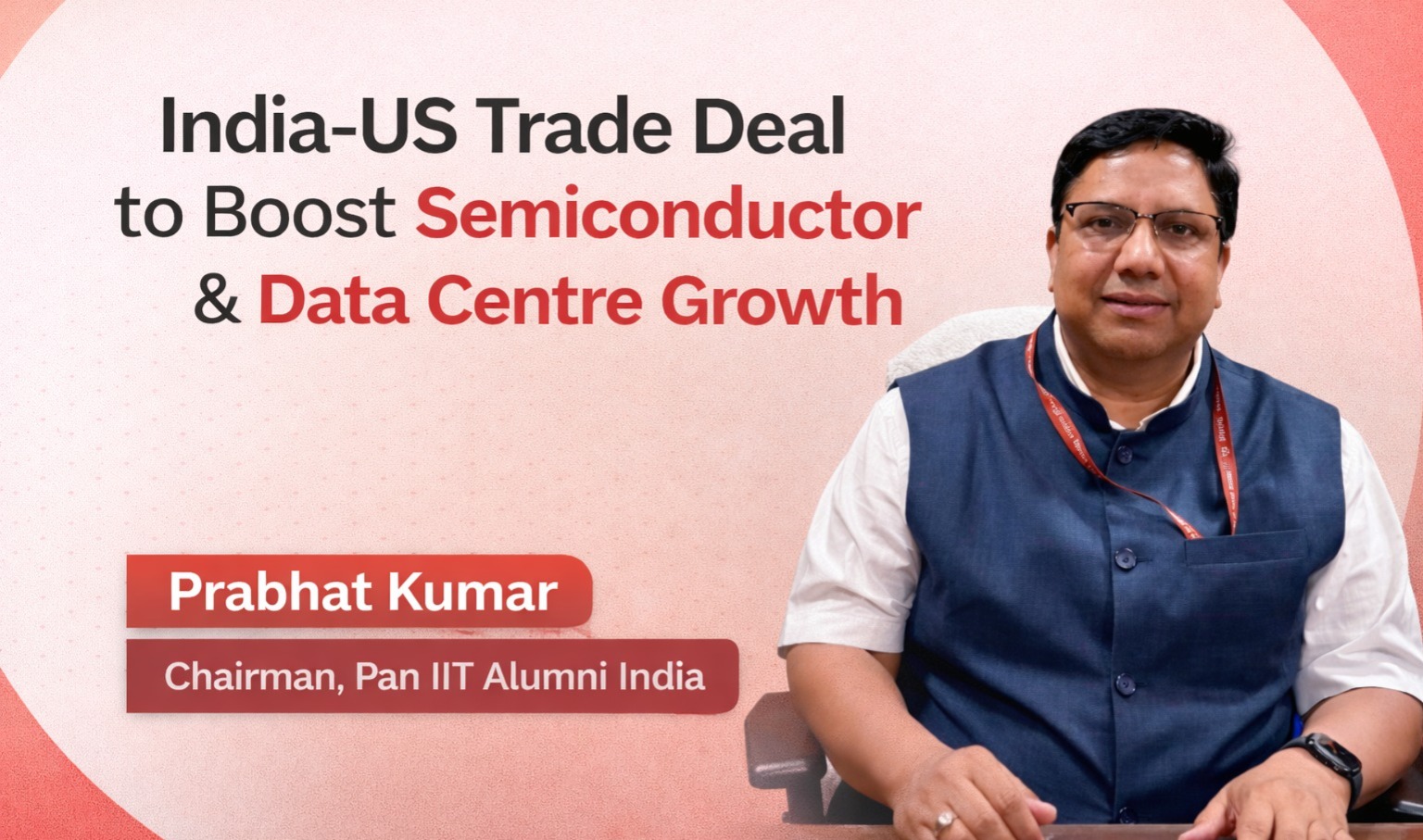
India US Trade Deal: India’s push to scale up semiconductor manufacturing and expand data centre capacity could get a timely lift from the interim trade framework agreement between India and the United States, with Pan IIT Alumni India calling the pact a catalyst for deeper technology collaboration and stronger supply-chain resilience.
At a moment when global companies are reassessing where they source and build critical components, the alumni body said the framework opens a window for India to deepen engagement with the US across the semiconductor value chain.
The Significance Of India US Trade Deal?
Pan IIT Alumni India’s view is that the agreement lands at an opportune time, as shifting global supply chains push firms to rethink risk and concentration. In that context, the group sees the India–US framework as a lever for India to attract larger investments and plug more meaningfully into global tech and manufacturing networks.
Budget measures and the “policy synergy” pitch
The alumni body also pointed to what it described as a strong policy alignment between the trade framework and recent Union Budget measures, especially steps aimed at expanding India’s data centre footprint.
Prabhat Kumar, chairman of Pan IIT Alumni India, argued that the framework improves access to advanced technology and markets, while domestic policy measures help build the foundation at home, together creating momentum for advanced manufacturing and digital infrastructure.
Data centre incentive that stands out
Among the measures highlighted is a proposal for a tax holiday until 2047 for foreign cloud service providers using Indian data centre infrastructure, an incentive positioned as a way to attract long-term global capital into the sector.
The argument, as laid out, is that deeper data centre capacity doesn’t just support cloud and digital services, it also becomes enabling infrastructure for sectors such as telecom, electric vehicles, and defence manufacturing.
Startups and MSMEs: the second-order impact
The alumni group expects the upside to travel beyond large manufacturers. It said startups and MSMEs could benefit from smoother cross-border collaboration, improved access to capital, and entry into global value chains.
It also flagged the IIT alumni network in the US as a practical bridge, helping partnerships form, speeding up market entry, and strengthening India’s position in the evolving “China+1” approach that many firms are pursuing.
In simple terms, as presented by the Pan IIT Alumni India theory, the thesis is that it is a “timing + alignment” file, which means that an India/US trade agreement that could unlock the door for technology access and supply chain relationships, as well as domestic policy intent to build scale in the data center space, are the ingredients that are now perhaps even more clearly on the table to foster the momentum in the relationships.
Also Read: India US Trade Deal: The gains, the fine print, and why the debate has turned sharp