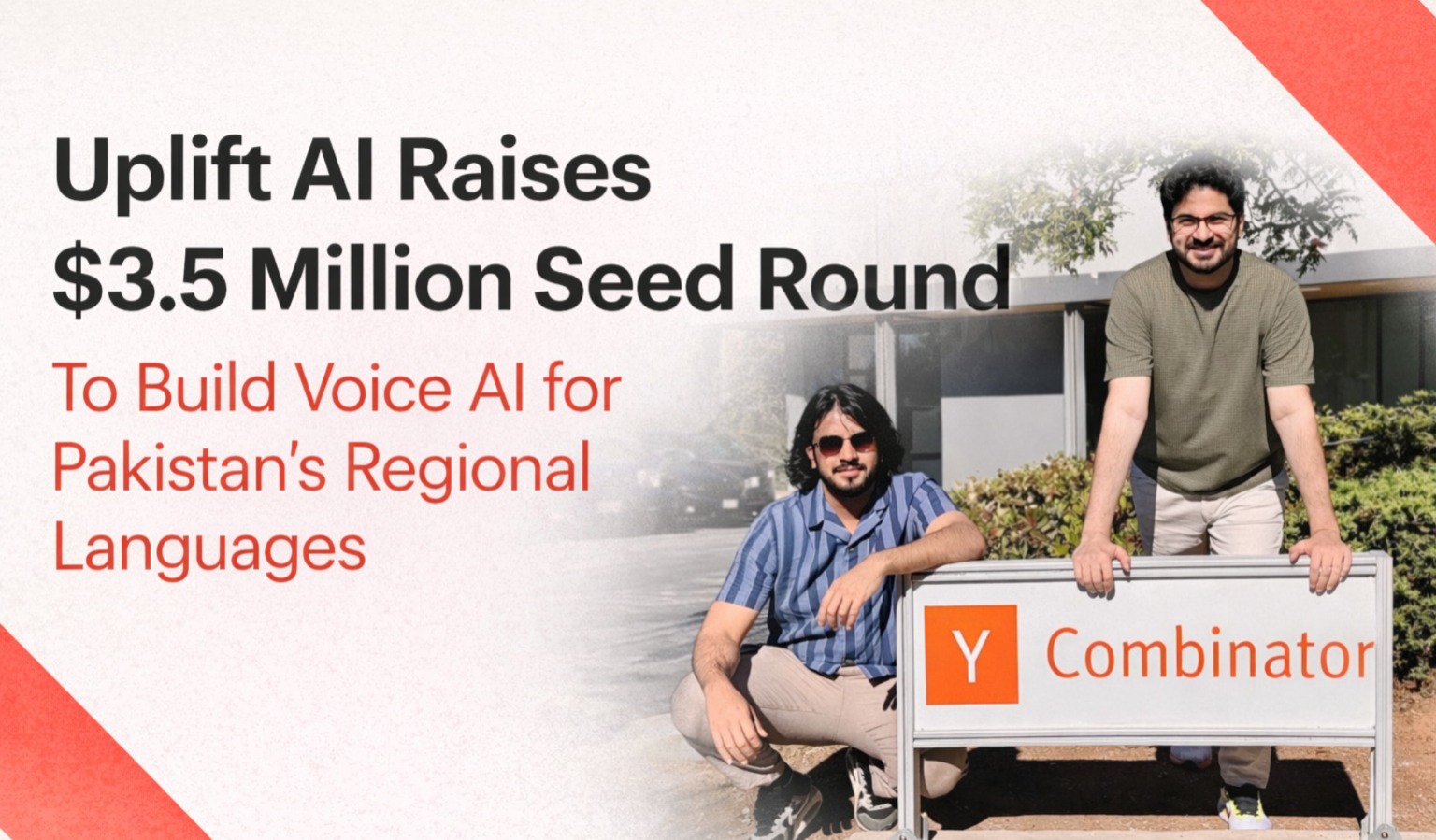
A Pakistani voice AI startup, Uplift AI, has raised $3.5 million in seed funding in a round led by Y Combinator, with participation from Indus Valley Capital and other investors, as the company doubles down on building voice models for Pakistan’s regional languages.
The startup says the fresh capital will go into expanding its voice AI stack, both the “hard” work of building language datasets locally and the R&D required to train speech understanding and generation models.
Who invested, and what’s being built at Uplift AI?
The round was led by Y Combinator, with Indus Valley Capital also backing the raise. The funding included participation from Pioneer Fund, Conjunction, Moment Ventures, and angel investors from Silicon Valley.
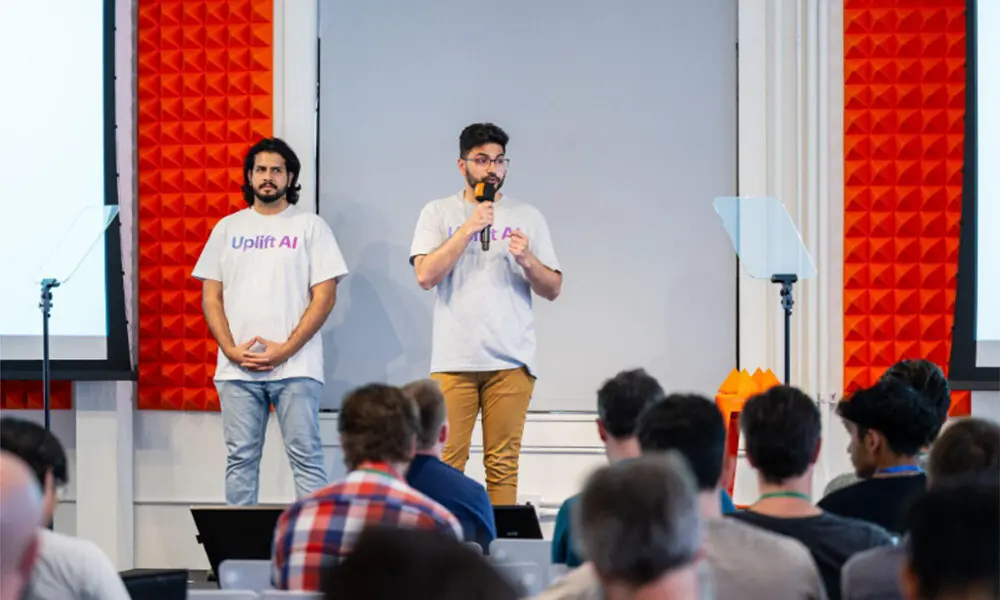
Uplift AI was founded by Zaid Qureshi and Hammad Malik, described as former Apple and Amazon engineers. The company is developing voice AI models for regional languages including Urdu, Punjabi, and Balochi, positioning its tools as a way to use technology “by just speaking” in local languages.
Its flagship model, Orator, “speaks Urdu with human-like realism,” the report noted.
Early traction: 1,000+ developers using APIs
Uplift AI says it’s gaining traction among developers and small businesses, with 1,000+ developers already building using its APIs.
The use-cases being built range widely, from students creating FIR registration bots to entrepreneurs building health intake systems for rural clinics.
The significance of this technology in Pakistan?
Uplift AI is explicitly framing voice-first tech as an inclusion lever in a country where literacy barriers still shape access to services and opportunity. The startup believes voice-first technology is key for Pakistan because 42% of adults cannot read, which it says holds the country back economically.
Hammad Malik, identified as CEO, argued that voice can widen access to knowledge and opportunity: “Voice technology has the potential to uplift our entire GDP by giving everyone access to knowledge and opportunity,” he said, adding that Uplift AI was founded to make that happen sooner rather than later.
Indus Valley Capital partner Aatif Awan backed that thesis, saying voice is the “primary gateway” to the digital economy in emerging markets and positioning Uplift AI as foundational infrastructure for that shift.
“Built in-house” for regional languages no shortcuts
One of Uplift AI’s central claims is that regional language performance breaks when teams rely on generic, off-the-shelf pipelines.
CTO Zaid Qureshi said the company built everything in-house, from data gathering and labelling to training, because packaged solutions “always compromise on regional languages.” He added that customers have told the company its model quality for these languages is better than larger platforms for their use-cases.
What the funding will be used for and the jobs angle
Aatif Awan said that around $1 million is expected to go toward data gathering and labelling, which he said is expected to create thousands of jobs in Pakistan.
He said the remaining funds will be used for R&D to develop “state-of-the-art” speech understanding and generation models for the five major Pakistani languages.
Where Uplift AI is focused next?
Despite describing itself as a global player for “small regional languages,” the company’s short-to-medium-term focus is firmly local. Awan said: “in the short to medium term, Pakistan will remain our only focus.”
The company is also not yet working directly with government departments, according to Awan, though its platform is already available for startups and small businesses. He reiterated that over 1,000 developers already use the API, and that “any startup or small business can sign up and start using” it.
Uplift AI’s pitch is straightforward: if Pakistan’s next wave of digital access won’t come through typing, because millions can’t comfortably read and write, then the interface has to shift to speech.
The startup is betting that building voice infrastructure in Urdu and other regional languages isn’t just a product category, but a new base layer for banking, healthcare, agriculture, and government services aimed at mass users.
And in at least one real-world example, that voice layer is already being tested in agriculture: Syngenta Pakistan’s head of AI transformation Sultan Raja said voice can deliver “accessible intelligence” to farmers in their own language at scale, and described it as enabling market leadership in helping farmers increase yield by adopting AI.
Also Read: What Is Difference Between Republic and Democracy?