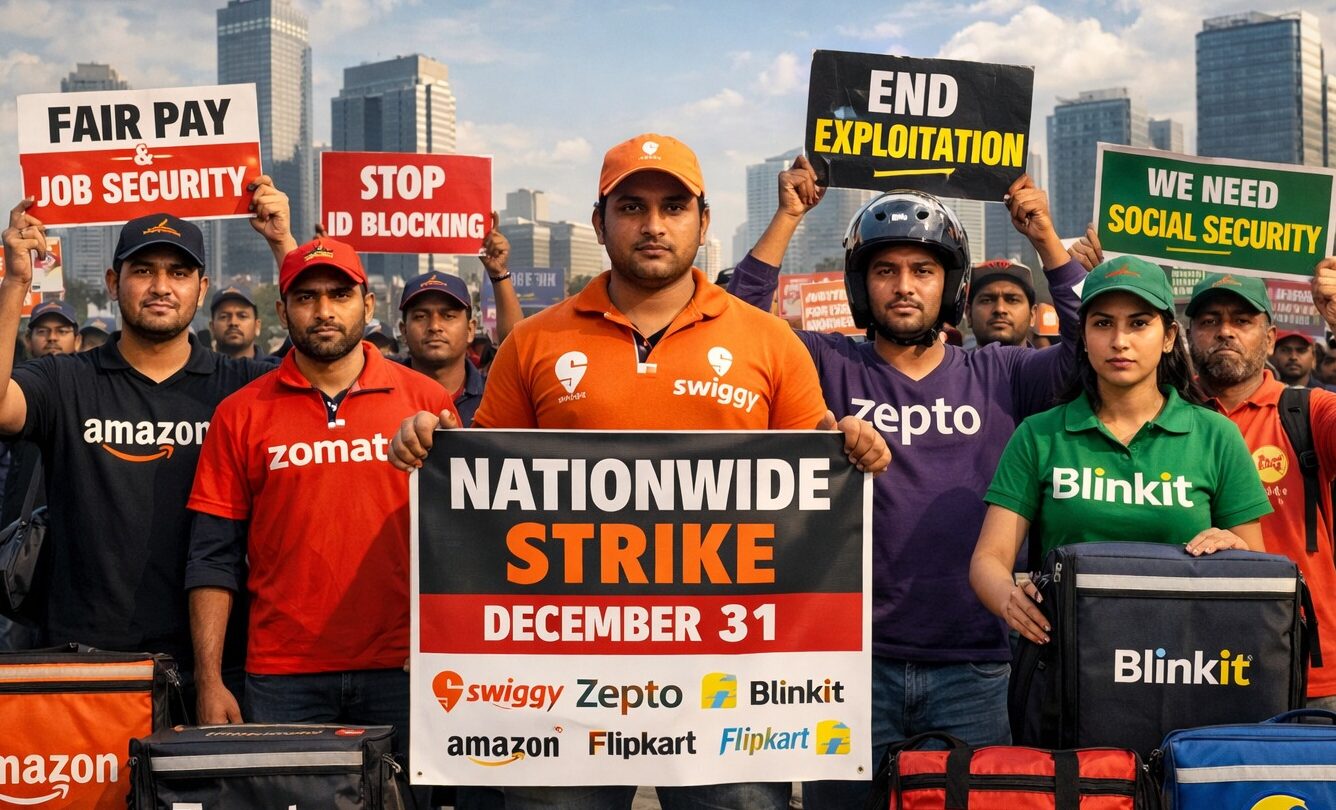
Food delivery and quick commerce services across India may face widespread disruption on December 31, as delivery workers associated with Swiggy, Zomato, Zepto, Blinkit, Amazon and Flipkart have announced a nationwide strike. The planned protest comes just days after a similar walkout on Christmas Day, which affected deliveries in several cities and brought renewed attention to growing concerns within India’s gig economy.
With New Year’s Eve being one of the busiest days for online food orders and last-mile deliveries, the strike could impact customers across metro cities and major tier-2 locations. Delivery partners say the timing reflects both urgency and frustration, as issues around earnings, safety and job security remain unresolved.
Unions Leading the Nationwide Protest
The strike has been called by the Telangana Gig and Platform Workers Union, along with the Indian Federation of App-Based Transport Workers. According to union leaders, delivery workers from large urban centres as well as important tier-2 cities are expected to participate in the action.
They said repeated protests are a response to what workers describe as steadily worsening conditions in the gig economy. Union representatives argue that despite the rapid growth of app-based delivery services, the people who keep these platforms running are facing increasing pressure with fewer protections.
What the Christmas Day Strike Revealed
The December 31 protest follows a nationwide walkout held on December 25. Union leaders claimed that nearly 40,000 delivery workers participated in the Christmas Day strike across the country. According to them, delivery services were disrupted by around 50 to 60 percent in several cities during the protest.
Union leaders also alleged that instead of engaging with worker demands, platform companies attempted to reduce the impact of the strike. They claimed companies relied on third-party delivery arrangements, offered short-term incentives and reactivated inactive delivery IDs to keep services running.
Shaik Salauddin, founder of the Telangana Gig and Platform Workers Union and national general secretary of the Indian Federation of App-Based Transport Workers, said the response to the strike highlighted deeper problems in the gig economy. He stated, “Our nationwide flash strike has exposed the reality of India’s gig economy. When delivery workers raise their voice, platform companies respond with ID blocking, threats, police intimidation, and algorithmic punishment. This is nothing but modern-day exploitation.”
Falling Earnings and Rising Work Pressure
One of the main reasons behind the protest is declining income. Delivery workers say changes in incentive structures have reduced their earnings, even as workloads have increased. Many workers report having to stay logged in for longer hours to earn the same amount they once did.
Safety concerns have also emerged as a major issue. Workers say strict delivery targets and time-based penalties often push them to take risks on the road, especially during peak hours, late nights and bad weather. They argue that the pressure to meet algorithm-driven targets leaves little room for rest or caution.
Also Read: VoxelGrids Unveils India’s First Indigenous MRI at Chandrapur Centre
Concerns Over Job Security and ID Blocking
Another key grievance is the alleged arbitrary blocking of delivery IDs. Workers claim accounts are sometimes suspended or deactivated without prior notice or clear explanations. Since platform access is their only source of income, sudden ID blocking can leave workers without earnings overnight.
The lack of a proper grievance redressal system has further added to frustration. Workers say there is no transparent process to appeal decisions, resolve disputes or seek timely support when issues arise.
Absence of Social Security for Gig Workers
In a joint statement, the unions said delivery workers continue to be denied basic protections, even though they play a crucial role in last-mile deliveries. This becomes especially visible during festivals, sales events and peak demand periods, when platforms depend heavily on gig workers to meet customer expectations.
Despite being essential to daily operations, workers say they remain outside formal social security systems. They argue that while platforms exercise significant control over work allocation and performance through algorithms, workers are still treated as independent contractors without benefits.
Key Demands and Call for Government Intervention
The unions have outlined several demands, including an end to arbitrary ID blocking, improved safety measures, assured work allocation, reasonable working hours and mandatory rest breaks. They are also seeking health insurance, accident coverage, pension benefits and a transparent grievance redressal mechanism.
Delivery workers have urged both the central and state governments to intervene and regulate platform-based companies. They say clear rules are needed to ensure fair wages, safe working conditions and basic social security for the millions of workers powering India’s fast-growing e-commerce and quick commerce ecosystem.
As the year draws to a close, the planned December 31 strike reflects mounting tensions between delivery workers and platform companies, with consumers likely to feel the impact during one of the busiest delivery days of the year.
Also Read: Think Salem 2025 Backs Tier-2 Startups with Grants and Seed Funding