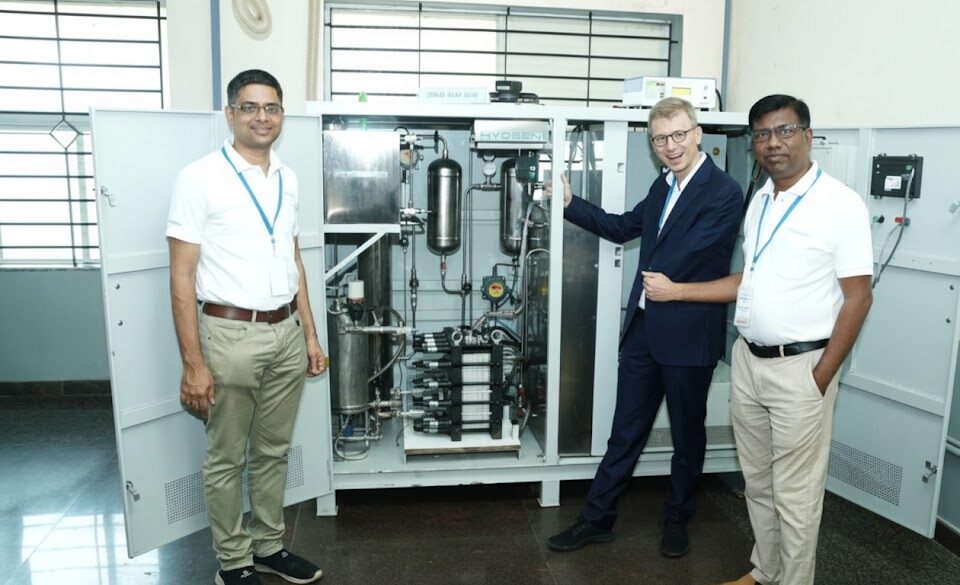
Deeptech startup HYDGEN has raised $5 million (₹44.1 crore) in a mix of equity and debt funding led by Transition VC. The round also saw participation from Cloudberry Pioneer Investments, Moringa Ventures, and strategic family offices from India and Singapore, the company said in a release.
HYDGEN plans to use the capital to make ultra-pure, cost-efficient hydrogen directly available at the point of use through its proprietary Anion Exchange Membrane (AEM) electrolyser technology. The company’s model focuses on decentralised hydrogen generation, allowing industries to produce clean hydrogen on-site instead of relying on large-scale suppliers.
Investors Back Industrial-Scale Electrolyser Capability
“HYDGEN is the first team we’ve seen capable of scaling AEM electrolysers to true industrial levels while maintaining cost leadership. This is no longer a research initiative but a commercially ready platform serving industries already dependent on hydrogen today,” said Mohamed Shoeb Ali, Managing Partner at Transition VC.
The firm believes HYDGEN’s technology can help traditional industries move faster toward low-carbon operations by lowering the cost barrier to adopting green hydrogen.
Also Read: Harsh Goenka Explains the Real Reason China Beat India in Growth
Decentralised Hydrogen Production at Scale
“Decarbonisation needs solutions that are both green and practical. HYDGEN’s decentralised model makes hydrogen generation more efficient and accessible. The company plans to use the funds to upgrade its Mangalore facility to a semi-automated line, scale its single-stack capacity to 250 kW, and expand into Japan, Europe, and the Middle East, markets seeing strong policy support for industrial hydrogen,” added Khoong Hock Yun, Managing Partner at Moringa Ventures.
According to HYDGEN’s statement, the upgraded plant will enable the company to manufacture at higher precision and lower cost while meeting demand from multiple industrial segments.
Building Reliable Hydrogen Access
HYDGEN’s proprietary electrolyser stack designs, ranging from 1 kW to 100 kW and scaling up to 250 kW, are built to deliver ultra-high-purity hydrogen using a low-capex, modular architecture. The approach allows customers to generate hydrogen where it is needed, minimising transportation losses and storage risks.
“Many discuss hydrogen’s focus on its role in a clean energy future, but the urgent opportunity is about enabling industries to have hydrogen where and when they need it, with purity they can trust,” said Manipaddy Krishna Kumar, Co-founder and COO of HYDGEN.
“Our AEM electrolysers allow companies to produce hydrogen on-site at a competitive cost, solving supply chain challenges today while preparing them for the broader transition to green hydrogen in the years ahead,” he added.
Founded by Experts in Deeptech and Energy
HYDGEN was founded by Manipaddy Krishna Kumar, Michael Gryseels, and Goutam Dalapati, bringing together expertise across energy systems, materials science, and deeptech research. The company’s goal is to accelerate industrial adoption of green hydrogen through locally deployable, high-efficiency electrolyser systems.
The startup operates from its Mangalore base, where it develops, tests, and assembles AEM stacks tailored for industrial users that require constant hydrogen supply for refining, metal processing, and chemical manufacturing.
Part of India’s Larger Hydrogen Mission
HYDGEN’s growth comes amid India’s nationwide effort to promote green hydrogen under the National Green Hydrogen Mission, launched in January 2023 by the Ministry of New and Renewable Energy (MNRE) with an outlay of ₹19,744 crore. The mission aims to enable 5 million metric tonnes (MMT) of annual green hydrogen production capacity by 2030.
According to NITI Aayog and RMI India, achieving large-scale hydrogen production could help the country cut nearly 3.6 gigatonnes of CO₂ emissions by 2050. India’s policy environment has encouraged both domestic and global investors to back startups innovating in this space.
Globally, demand for green hydrogen technologies is rising. Reports from the International Energy Agency (IEA) and Allied Market Research indicate that the AEM electrolyser market is expected to grow at more than 25% CAGR through 2030, driven by industrial decarbonisation initiatives in regions such as Europe, Japan, and the Middle East, also target markets for HYDGEN’s expansion.
From Indian Deeptech to Global Impact
With this new funding, HYDGEN is set to strengthen its manufacturing base, enhance capacity, and extend its global footprint. Its decentralised hydrogen generation model fits neatly into the global race for cleaner industrial processes, one that demands not only greener but also economically viable solutions.
As India deepens its commitment to green energy, startups like HYDGEN are likely to play a crucial role in bridging the gap between innovation and large-scale industrial adoption.
Also Read: BlueStone: From IIT Delhi to a ₹11,227 crore Jewellery Brand