In a story that blends stubborn perseverance with rural ingenuity, Dadasaheb Bhagat, a Class 10 pass-out from Maharashtra’s drought-hit Beed district, has gone from earning ₹4,000 in his first city job to ₹9,000 as a housekeeping worker at Infosys and then, against the odds, to founding a design-tech venture now dubbed “India’s Canva.”
His platform, Doorgraphics, grew out of a hard reset during the pandemic and a makeshift office set up on a hill near a cowshed to catch a reliable mobile signal.
Dadasaheb Bhagat: A modest start, a sharp turn
Bhagat’s early years were defined by scarcity and limited access to formal education. After finishing Class 10 and completing an ITI course, he moved to Pune in search of steady work. The first rung on the ladder paid ₹4,000/month; a subsequent role as an office boy at Infosys doubled that to ₹9,000, a figure that felt transformational at the time. Yet the real transformation came from proximity, watching white-collar staff work at computers and wondering how to cross that invisible line.
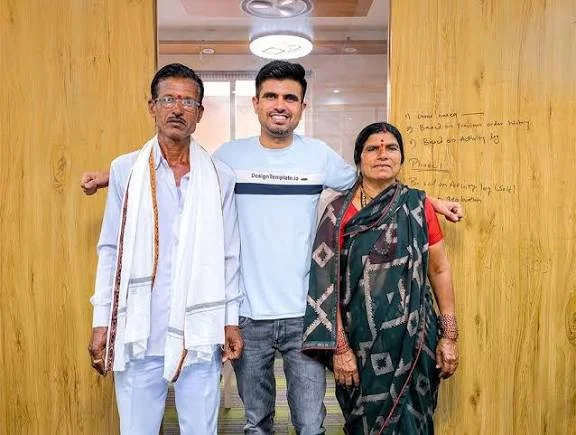
When he asked around, most answers pointed to degrees he didn’t have. One practical suggestion cut through: graphic design and animation, fields where demonstrable skill can trump formal credentials. That tip rekindled a long-dormant love of drawing he had picked up watching a local artist paint temple walls during his school years. He began training at local computer centers, and within a year moved from cleaning around computers to working on them as a designer.
Entrepreneurship by necessity
Freelance gigs soon replaced the housekeeping shift, and Bhagat launched a small design services outfit in Pune. Then COVID-19 hit. Contracts dried up. He shut his office and returned to his village. Where many would see the end of a chapter, Bhagat looked for a workaround: unreliable electricity and weak internet pushed him and a small team to an improvisational workspace on a hilltop near a cowshed, one of the few spots where the mobile network held steady.
It was from this improbable setting that Doorgraphics took shape: a platform offering ready-to-use templates for individuals and small businesses, akin to Canva, but built with an Indian sensibility, supporting the needs of users beyond metro hubs. Alongside the product, Bhagat began training village youth in graphic design, turning a personal pivot into a pipeline for rural digital livelihoods.
Recognition and responsibility
As Bhagat’s story traveled, it drew national attention. He was praised by Prime Minister Narendra Modi as an example of the ‘Make in India’ spirit: a builder of global-quality digital tools from rural India. That recognition doubled as a responsibility, evidence that local ingenuity can scale when the pathways are practical and the product solves a real need.
Today, Doorgraphics is positioned for students, startups, and small businesses that want fast, affordable, and culturally-relevant visual assets. The company’s focus stays close to what sparked it: make creativity accessible and employable, not just in cities, but in the small towns and villages where the next generation of digital workers is coming of age.
What kept him going
Bhagat’s own frame for the journey is disarmingly simple. “Try different things,” he says, advice that mirrors his shifts from housekeeping to design, from city offices to a hilltop desk. “You’ll eventually find what you truly love. Once you give your passion everything you have, success follows naturally.”
Another line he repeats to younger aspirants captures the arc of his story: “When your dream is genuine, even the smallest beginning can lead to the grandest destination.”
Why this story matters now?
- A pathway without pedigree: Bhagat’s entry route, skill-first, credential-later, is instructive for millions outside elite colleges who still want a career in tech-adjacent fields.
- Rural product thinking: Building for India’s languages, contexts, and connectivity constraints is a competitive edge, not a compromise. Design Template’s origin story demonstrates how constraint-led design can become a product thesis.
- Local capacity-building: By training village youth, the venture ties entrepreneurship to employment creation, distributing benefits more widely than a single-founder success narrative.
For Doorgraphics, the next test is execution at scale without losing the rural-to-India empathy that shaped the product. If it can stay nimble, shipping features that reflect how small businesses actually design (festival creatives, hyperlocal promotions, vernacular-first assets), the company can keep carving out space against global incumbents while expanding India’s creative workforce.
Also Read: Can Pepul Rise from India to Take on Facebook, Instagram, and YouTube?