India’s autumn festive season, spanning Navratri (including Navmi), Dussehra, and Diwali has long been a cornerstone of consumer spending. In 2025, this festive period is delivering a major boost to the economy and energising the startup ecosystem. After two years of uneven demand, analysts predict 2025 to be the strongest festive season in three years.
This article examines how the festivals drive surging demand across e-commerce, fintech, logistics, consumer goods, travel, and other startup domains, while also highlighting the innovative responses and challenges in play.
E-commerce Boom Fuels Startup Growth
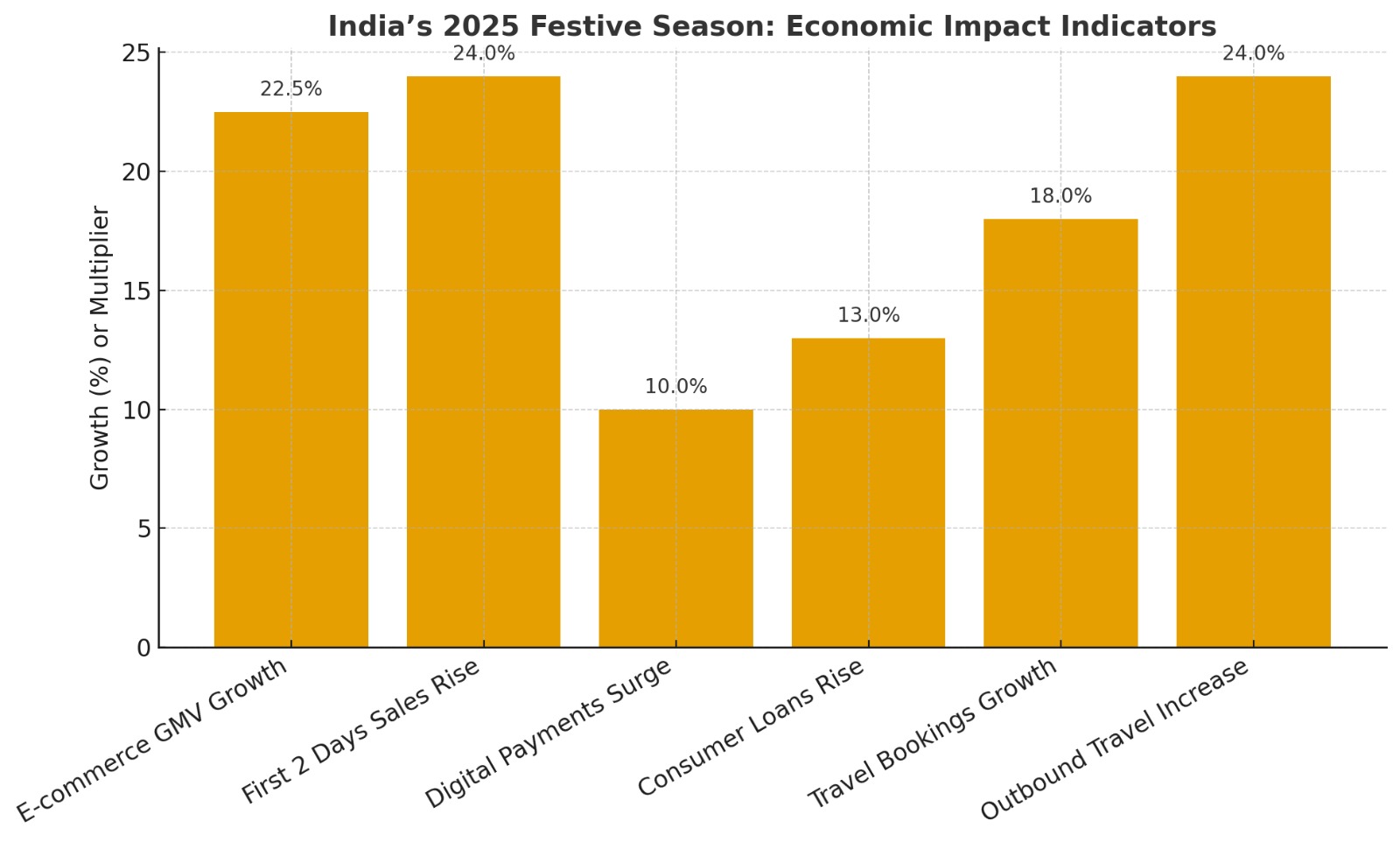
Online retail is breaking records in the 2025 festive season. Market research by RedSeer projects festive e-commerce gross merchandise value (GMV) to reach ₹1.15 lakh crore, up 20-25% year-on-year (YoY), nearly double last year’s pace . If achieved, this would mark the strongest festive sales since 2021.
Early results back up the optimism: in the first two days of Navratri, online retail GMV grew 23-25% YoY, a four- to five-fold jump over the muted start of 2024. E-commerce giants and startups alike are seeing unprecedented traffic. Amazon India reported 380 million customer visits in the first 48 hours of its Great Indian Festival sale, its biggest-ever kickoff with over 70% of traffic coming from outside top metro cities.
Rival Flipkart saw user visits jump 21% versus last year’s start. This surge is broad-based: demand for mobiles, TVs, appliances and fashion has spiked ~26% YoY , and even niche players are benefiting. Snapdeal, for instance, saw its fashion sales double and seasonal ethnic apparel jump nearly 5×.
Crucially, small sellers and direct-to-consumer (D2C) brands are sharing the gains, Amazon noted over 16,000 small businesses from Tier-2/3 cities tripled their daily sales during the sale’s opening.
Multiple factors are powering this e-commerce boom. A unique mix of macroeconomic tailwinds, interest rate cuts, rising disposable incomes, rural wage growth, and pent-up demand has lifted consumer sentiment.
Additionally, a GST 2.0 tax reform effective late September slashed rates on many goods just in time for festival sales. Televisions that were taxed at 28% now incur 18%, fashion under ₹2,500 is down to 5%, etc.
These GST cuts translated into instant price drops (e.g. premium TV prices fell 6-8%), spurring shoppers to make aspirational purchases rather than just bargain-hunting.
Consumer appetite has shifted toward premium products, QLED TVs, high-end smartphones, appliances, not merely chasing the deepest discounts.
As one analyst noted, 2025’s festive season “is not just about deals, it’s about policy shifts and consumer confidence” fueling broader participation.
Even value-focused platforms are growing: “value commerce” channels are expected to expand ~30–35% YoY as millions of new online shoppers from smaller towns seek affordable options.
In short, digital retail startups are seeing a broad uplift from social commerce apps to big marketplaces, as Indian households loosen their purse strings.
Fintech & Digital Payments: Cashless Festivities
The festive spending spree is also a windfall for fintech firms and digital payment platforms. As consumers and businesses ramp up transactions, digital payments have surged to extraordinary levels.
On September 22 (the first day of the new GST rates and Navratri), total digital payment value hit ₹11 trillion in one day, roughly 10× the daily average.
This figure, drawn from RBI settlement data, reflects a massive spike in Real Time Gross Settlement (RTGS) volumes as well as retail payments, UPI transactions alone exceeded ₹82,000 crore that day.
E-commerce purchases contributed heavily: over the first 48 hours of sales, online credit card spending jumped nearly six-fold to ₹10,411 crore, and debit card spending quadrupled.
Fintech startups enabling these payments, from UPI apps to card issuers and “buy now, pay later” (BNPL) services are handling record volumes.
Financial innovators are seizing the moment with festive offers. Banks and digital lenders have rolled out aggressive credit schemes to encourage shopping and smooth out big purchases.
For example, Kotak Mahindra Bank is offering instant discounts up to ₹30,000 on electronics, IDFC First Bank launched a “Khushiyan First” cashback program for appliance purchases, and L&T Finance introduced BNPL plans with features like waived final EMIs for timely payers.
These financing options are turning pent-up demand into actual sales , giving a short-term boost to the economy.
Indeed, consumer durable loans and unsecured personal credit are expected to jump ~13% in the second half of FY26, supported by festive spending and tax cuts.
However, this boom comes with cautionary flags. Regulators are watching for over-leveraging as Indians swipe cards and use BNPL in record numbers.
The RBI has already tightened risk norms on unsecured loans after noting the “runaway” growth in personal lending.
In late September, the central bank even ordered fintech lender Simpl (a BNPL startup) to cease operations, citing licensing breaches .
Such moves underscore that while festive credit fuels consumption and startup growth, it can sow future credit risks.
Logistics & Quick Commerce: Delivering at Scale
Behind the scenes, logistics startups and delivery networks are in overdrive to fulfill the festive rush.
E-commerce and on-demand delivery firms have prepared for volumes that peak at 2–3× the usual levels during Dussehra and Diwali.
Seasonal hiring has surged by 20-25% in retail and logistics, as companies onboard tens of thousands of delivery agents, warehouse staff, and support teams.
Flipkart alone added over 220,000 temporary workers to reinforce its supply chain.
These efforts are paying off in maintaining speed: despite the order deluge, major marketplaces promise quick turnarounds, and are even expanding 10–15 minute delivery services in metro areas.
Amazon India, for instance, now operates 100 urban “dark stores” for its rapid delivery arm , while Flipkart’s “Minutes” service aims for 80-90% pin-code coverage in 19 cities.
Quick commerce startups are capitalizing on last-minute festive needs. Platforms like Swiggy Instamart, Blinkit, and Zepto, known for instant grocery delivery, have broadened their offerings to include gifts, sweets, and small gadgets.
Analysts estimate quick commerce will contribute roughly 12% of all online festive sales in 2025.
Order volumes on festival days (e.g. Diwali) typically spike 2-3× as consumers rely on instant services for forgotten ingredients, last-minute gifts, flowers, and sweets.
To handle this spike, gig workers are being wooed with incentives, Swiggy Instamart offered couriers 20% extra earnings during Navratri, and Zepto gave bonuses (₹10 per order on peak days) to retain riders.
Despite these pressures, the “delivery armies” assembled by startups are largely keeping pace, ensuring customers get their festive orders on time.
The scale-up also brings broader benefits: the seasonal logistics push is generating lakhs of gig jobs and income opportunities across India .
Consumer Goods & Retail: Demand and New Challenges
The festive quarter is make-or-break for many consumer goods startups and brands. Categories like apparel, electronics, home décor, and FMCG see a huge chunk of their annual sales during these festivals, often 30-40% of yearly revenue is booked in the festive months.
In 2025, demand is robust across price points. With middle-class wallets fatter due to tax changes (annual tax-free income limit raised to ₹12 lakh) and lower inflation, consumers are upgrading purchases.
Fashion and beauty startups are seeing 20%+ YoY sales growth, as families invest in festive wardrobes and personal care.
Yet, alongside the uplift come challenges. Sellers who stocked up before GST cuts now face a working capital crunch, since they must absorb tax differences until input credits adjust.
Competition is fierce, with large e-commerce players dominating ad space and discounts. Startups must also ensure platform stability and supply chain agility to avoid crashes and stockouts.
Forward-looking startups that prepared early reap outsized rewards; those that stumble could miss the season’s prime spending window.
Travel and Hospitality: Holiday Surge for Startups
Festivals in India also mean millions on the move, a boon for travel-tech startups and the hospitality sector.
Thrillophilia reports an 18% YoY surge in festive travel bookings, with outbound bookings up 24% YoY to short-haul destinations like Dubai and Thailand.
Domestic tourism is also thriving, with offbeat destinations like Meghalaya and Hampi gaining popularity.
Average spends range ₹25k-45k (domestic) and ₹60k-95k (international) per traveler.
Ebix Travel projects record bookings across rail, bus, and air .
Bus occupancy has touched 95-100%, with fares 1.5-3× higher than normal.
Digital payments are driving this boom, UPI is now the fastest-growing mode for travel bookings.
Innovation, Investment, and the Road Ahead
The festive momentum is encouraging innovation and fundraising. Quick-commerce and fintech startups are piloting new models, while investor confidence is rebounding.
Transport and logistics tech startups saw a 104% funding jump in H1 2025, bucking the overall slowdown.
HUL’s $350M acquisition of Minimalist in mid-2025 reflects rising M&A interest.
Still, experts caution against over-expansion and credit risk build-up amid the euphoria. Sustainable growth will depend on startups balancing scale with stability once festive demand cools.
In Summary
India’s 2025 festive season has provided a timely economic spark, with startups at the forefront. From skyrocketing online sales and digital payments to a travel and hospitality rebound, the ripple effects of Navratri-Diwali spending are extensive.
The startup ecosystem is riding a wave of demand, innovation, and optimism, creating jobs and nudging GDP growth up by ~0.2-0.3% .
But alongside the celebration, founders must navigate thin margins, fierce competition, and post-festive slowdowns.
The season is both a stress-test and opportunity, validating business models while exposing operational gaps. As Diwali lights up homes and markets, India’s startups have reason to celebrate and to prepare for sustaining momentum well beyond the festivities.
Also Read: Trump’s 100% tariff on branded drugs: Why Indian generics may dodge the blow for now?