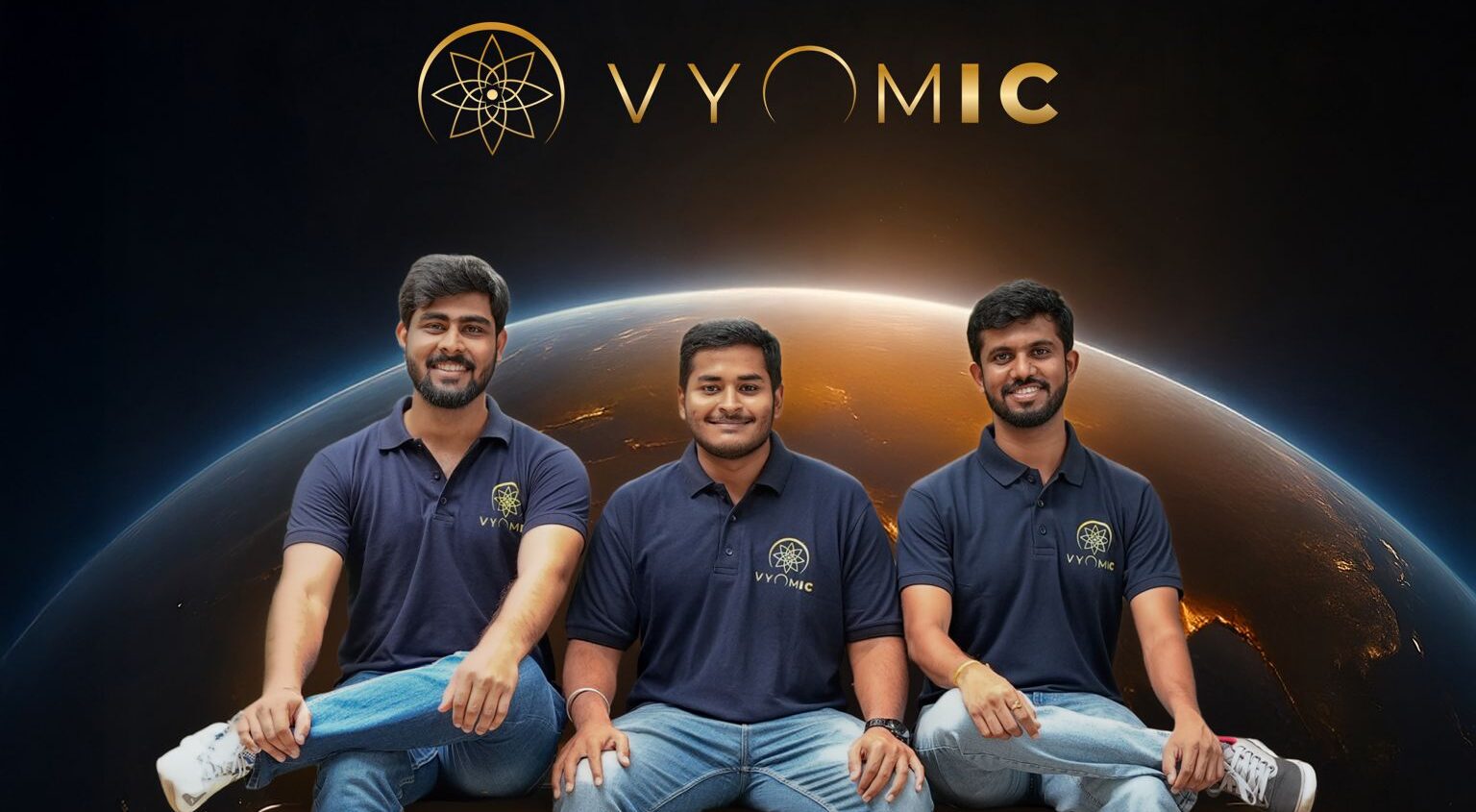
Deep-tech startup VyomIC has raised ₹14 crore (around US$1.6 million) in a pre-seed funding round led by Speciale Invest, with participation from BYT Capital and DeVC. The Chennai-based company, founded by three IIT-Madras alumni, is building a Low Earth Orbit (LEO) satellite constellation to deliver secure and highly accurate Positioning, Navigation, and Timing (PNT) services.
Funding to Accelerate Key Milestones
VyomIC mentioned that the proceeds will be used to further develop its LEO-PNT payload, support an upcoming demonstration mission in-orbit, and ramp up hiring across engineering and business functions, making it one of the largest early-stage investments in emerging navigation and spacetech ecosystems in India. The company views this round as a stepping stone toward building a full-fledged constellation and scaling globally.
Founders with Strong Deep-Tech Background
Lokesh Kabdal, Vibhor Jain, and Anurag Patil co-founded the company after working on other similarly ambitious engineering projects like Avishkar Hyperloop and autonomous drone programs. Their deep-tech experience gave them the know-how to address the venture of developing sovereign navigation systems, which remain a strategically important capability for India.
Moving Beyond Foreign-Dependent Navigation
Currently, India and much of the world rely heavily on foreign-controlled systems like GPS (United States) and GLONASS (Russia). While India operates its own regional system, NavIC, its coverage remains limited. VyomIC aims to change this by developing a global navigation capability from LEO satellites.
Operating satellites closer to Earth allows VyomIC to deliver stronger signals, faster positioning, and better coverage in dense urban areas where traditional systems often fail. The company promises centimeter-level positioning and nanosecond-level timing, essential for next-generation industries such as autonomous mobility, defence, and financial trading.
Also Read: How Pync Is Turning Household Chores Into India’s Next Big Movement
Innovative LEO-PNT Payload Design
VyomIC’s payload incorporates several state-of-the-art features. It has onboard atomic clocks for ultra-precise timing, a multi-layer encrypted signal to reduce the potential for signal compromise, and AI-based orbit determination to enhance the accuracy of its signal resilience. Furthermore, the payload was designed specifically with a small satellite platform in mind to ensure the highest levels of performance capturing innovative technology with missed affordability.
This innovation will ensure the integrity of navigation while in GNSS-denied or contested environments, and is of growing interest to defence, telecom, and aerospace sectors.
Growing Global Focus on LEO Navigation
Globally, there is growing momentum for LEO-based navigation systems. The European Space Agency (ESA) is preparing to launch a demonstrator mission to new PNT services from LEO using ten satellites. Additionally, several commercial enterprises in the United States and Europe are developing or seeking to develop navigation constellations to improve accuracy and resilience.
Market studies indicate robust demand for signals that are resistant to spoofing and jamming, particularly for critical infrastructure and autonomous systems. VyomIC has entered this domain on India’s behalf to reduce these vulnerabilities of traditional GNSS systems, just like other global efforts.
Challenges in Scaling a Constellation
Although LEO-PNT has promise, it poses obstacles. Creating a global constellation requires the launch of dozens of satellites, which is expensive and requires a longer period for financing and planning for operations. Another challenge is the engineering challenge that comes from designing compact payloads that can house atomic-grade clocks, encryption modules, and portions for an AI processor within power and dimensional constraints.
In addition, regulatory clearances and spectrum licensing will be critical as more countries and companies push into LEO navigation. How VyomIC manages these hurdles will determine its ability to move from demonstration to commercial deployment.
Strengthening India’s Strategic Edge
India has already made progress in this area through NavIC, but VyomIC’s LEO constellation could further expand the country’s capabilities through global coverage and enhanced security. This would give India more independence for mission-critical navigation and the status of a leader in a global market for space-based capabilities.
For sectors such as defence, autonomous vehicles, finance, and precision agriculture, VyomIC’s technology could unlock new possibilities by offering reliable, real-time navigation signals in even the most challenging environments.
The Road Ahead
While ₹14 crore may seem insignificant with the large budgets needed for full-scale rollout, the raise indicates India’s intent to focus on homegrown deep-tech innovation. VyomIC’s next big milestone will be announcing its spaceborne demonstration mission to demonstrate the viability of its payload and to facilitate larger investments.
If vyomIC succeeds, it has the power to redefine navigation, reinforcing India’s sovereignty and providing a global alternative in a world of growing geopolitical competition in space.
Also Read: Sailing into the Future: Docker Vision Brings AI to Shipping