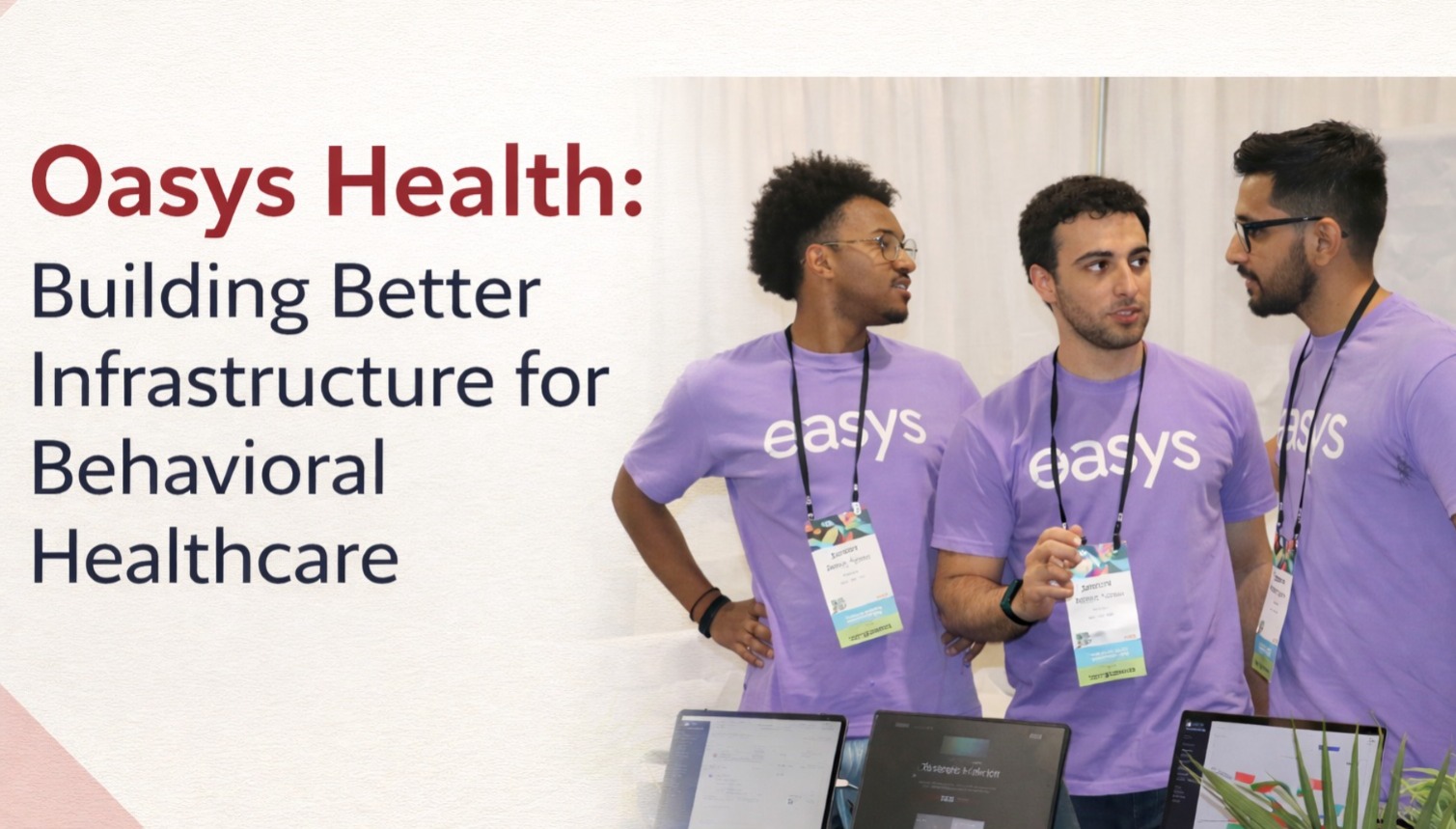
In behavioral healthcare, the real problem often begins long before treatment. Patient records may sit in one system, billing in another, scheduling in a third, and care insights somewhere else entirely. For clinics and providers, that fragmentation creates a daily operational drag: more time on administration, less time on patients. That is the gap Oasys Health has chosen to build around.
Founded in 2024, Oasys Health is a New York-based healthtech startup building what it describes as an AI-native operating system for behavioral health. The company’s pitch is not merely that clinics need another software tool, but that they need a unified infrastructure layer that can connect workflows, data, and decision-making in one place.
The company was founded by Hashem Abdou along with Raffay Rana and Dawit Fasika. In interviews cited in the source material, Abdou argues that behavioral healthcare remains one of the fastest-growing areas in health services, yet much of the sector still runs on disconnected and outdated systems. That mismatch, he suggests, leaves clinicians stuck with heavy administrative burdens while also limiting their ability to understand outcomes in a more meaningful, data-backed way.
Oasys’ answer is a single platform that brings together core functions that practices usually manage across multiple vendors. The platform combines electronic health records, billing, scheduling, documentation, scribing, patient engagement, and insurance reimbursement workflows, while also layering analytics and AI on top of that operating stack. The idea is straightforward: if the workflow and the data live inside the same system, the output can be more useful for both clinical and operational decisions.
That feedback loop sits at the center of Oasys’ strategy. Rather than focusing only on a narrow clinical function or a standalone analytics feature, the startup appears to be building around the belief that the real value in behavioral health software lies in connecting the full ecosystem. In practical terms, that means workflows generate data, and that data can then be used to improve care delivery, revenue operations, and administrative efficiency.
The company says its system also integrates physiological insights from wearables and health applications, including Apple Watch, Oura Ring, Strava, and Flo. That is a notable part of the pitch. It suggests Oasys is not only trying to modernize the back office of behavioral care, but also widen the type of information clinicians and practices can work with. The company says this unified approach is intended to help clinics streamline operations, strengthen revenue, reduce provider burnout, and support more proactive care.
Its current focus, according to Abdou’s comments, is on growing behavioral health practices and multi-provider clinic networks that have outgrown legacy software. That target market makes sense. Smaller clinics may tolerate fragmented tools for a while, but larger organizations tend to feel the friction more sharply as scheduling, records, claims, and staff coordination become harder to manage across separate systems.
Still, healthcare infrastructure is not a category where speed alone wins. The challenge for any company trying to become a system of record is trust. Oasys itself acknowledges that barrier. In the source interview, Abdou says the company is trying to introduce a new standard into an industry that is understandably cautious, especially when clinical records and care delivery are involved. That means the product challenge is only one half of the equation; the other half is convincing providers to place critical parts of their operations inside a newer platform.
For now, the startup remains a relatively lean operation. Abdou describes the team as small and focused, with experience across engineering, product, operations, healthcare, data science, and high-growth startups. But the ambition is larger than team size might suggest. Oasys is positioning itself not simply as another vendor selling software to clinics, but as a foundational layer for how behavioral health organizations run.
That vision has already attracted investor interest. Oasys Health raised $4.6 million in funding, including a $4 million seed round led by Pathlight Ventures, with participation from Twine Ventures and Better Ventures, as well as $600,000 in pre-seed funding from 1984 Ventures.
The company has said the capital will be used to improve its AI platform, deepen integrations with wearables and health apps, expand its engineering and data science teams, and grow partnerships with clinics, management service organizations, and educational institutions.
Money aside, what might be of more importance here is the perspective Oasys brings to the table regarding the issue at hand. Usually, when talking about behavioral healthcare, one tends to approach the issue from the angles of access, outcomes, or a shortage of practitioners. What Oasys brings to the discussion is another angle of approach altogether, namely, that of infrastructure. In other words, Oasys believes that quality healthcare cannot be provided without an adequate amount of frictionless information.
Whether Oasys can become that default infrastructure layer remains an open question. But its startup story is clearly defined. It is building for a part of healthcare that has grown quickly, digitized unevenly, and often relied on software stacks that were never designed to work as one. In that sense, Oasys is not just selling a platform. It is making a broader argument: that behavioral health needs a better operating foundation if it wants better day-to-day care.
Also Read: Seema Ahuja Signs Off from Biocon After Over 15 Years