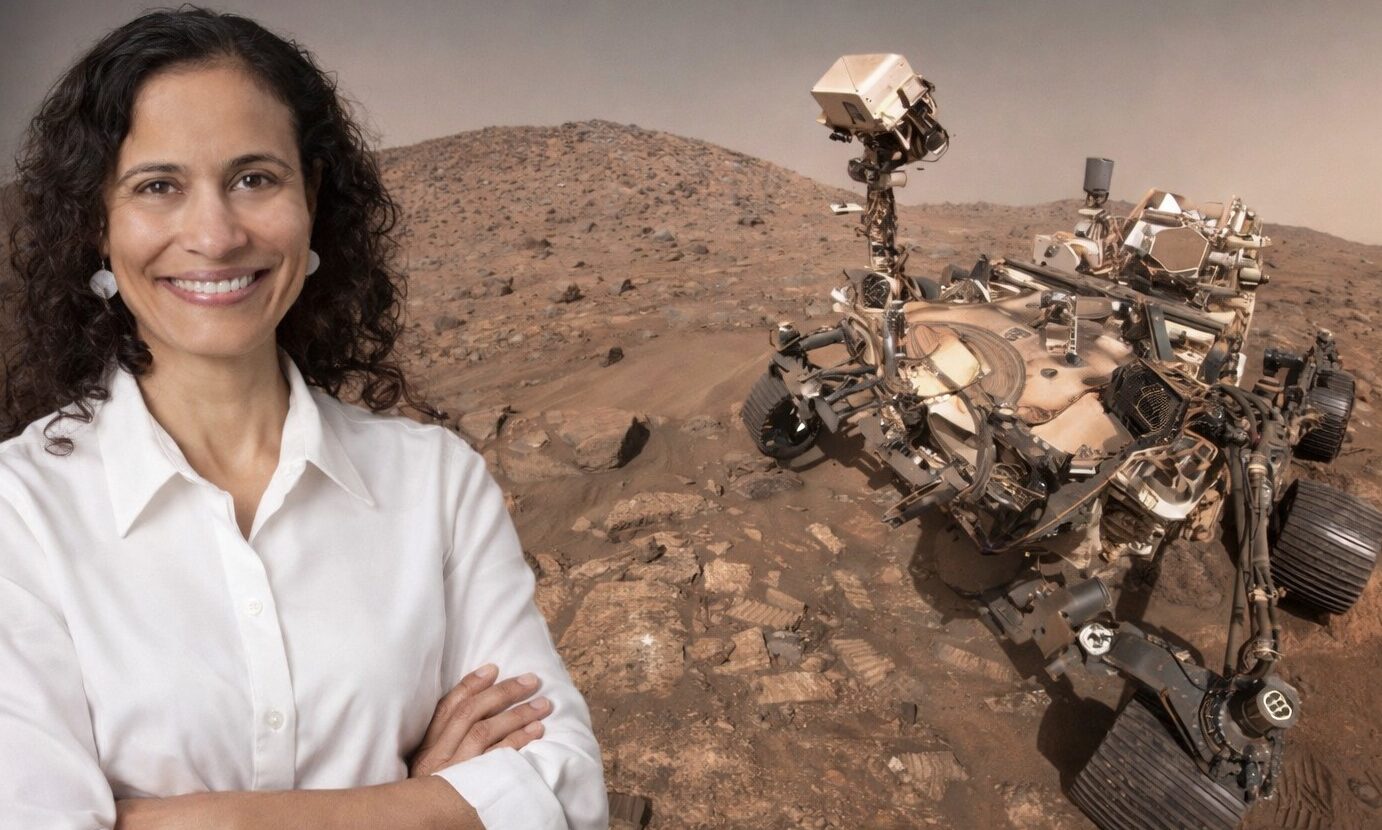
A landmark moment in space exploration unfolded recently when NASA confirmed that its Perseverance rover successfully completed the first-ever planetary drive planned entirely by artificial intelligence. The breakthrough mission, carried out on Mars without any human intervention in route planning, was led by an Indian-origin scientist, Vandi Verma, whose work has been central to advancing autonomous exploration beyond Earth.
A First for Human Space Exploration
NASA announced that Perseverance executed two autonomous drives on December 8 and December 10, 2025, marking the first time a rover navigated another planet using routes planned solely by AI. Unlike earlier missions where humans on Earth carefully selected driving paths, this demonstration allowed artificial intelligence to independently assess terrain and determine a safe route.
The experiment was conducted along the rim of Mars’ Jezero Crater, a scientifically significant region being studied for signs of ancient life. To accomplish the task, Perseverance relied on a generative AI system known as a vision-language model. This technology analyzed visual data from the Martian surface, identified hazards such as rocks and uneven ground, and plotted a sequence of safe waypoints for the rover to follow.
Advancing Autonomous Capabilities on Mars
Announcing the achievement, NASA Administrator Jared Isaacman highlighted the broader implications of the successful demonstration. He noted that autonomous technologies are rapidly expanding what is possible in space exploration, particularly as missions travel farther from Earth where communication delays limit real-time human control. According to NASA, systems like these can improve operational efficiency, help spacecraft respond to complex terrain, and ultimately increase the scientific return of planetary missions.
The demonstration was developed and executed by the Rover Operations Center at NASA’s Jet Propulsion Laboratory in California. Vandi Verma is a key member of this team and has played a leading role in shaping the rover’s autonomous navigation capabilities.
Also Read: From Chapra to Shark Tank: How RCX Lighting Won Rs 50 Lakh Investment
Roots in Punjab and a Path to Robotics
Vandana “Vandi” Verma was born and partly raised in Halwara, Punjab. She grew up in a family connected to aviation, as her father served as a pilot in the Indian Air Force. That early exposure to flight and technology would later shape her career, placing her among a small group of people qualified to operate vehicles on the surface of Mars.
She earned her bachelor’s degree in electrical engineering from Punjab Engineering College in Chandigarh. Her academic journey then took her to the United States, where she pursued a master’s degree in robotics at Carnegie Mellon University in Pittsburgh, an institution known for its leadership in robotics research.
Specializing in Exploration Beyond Earth
Verma continued at Carnegie Mellon for her doctoral studies, completing her PhD in robotics in 2005. Her doctoral thesis, titled Tractable Particle Filters for Robot Fault Diagnosis, focused on developing methods to help robots identify and respond to failures, a skill critical for machines operating far from human support.
During her time at Carnegie Mellon, she developed a strong interest in robotics designed for unknown and extreme environments. She also completed internships at NASA’s Ames Research Center, gaining early exposure to space-related research and mission operations.
Her work extended beyond laboratories when she helped field-test a rover in Chile’s Atacama Desert, one of the most Mars-like environments on Earth. The rover was used to survey the region for signs of life, an experience that foreshadowed her later contributions to planetary exploration.
Leadership at NASA’s Jet Propulsion Laboratory
Verma joined NASA’s Jet Propulsion Laboratory in 2007 and steadily rose through its ranks. By 2019, she was leading JPL’s Autonomous Systems, Mobility, and Robotic Systems group. Over the years, she has worked on multiple Mars missions, including NASA’s Curiosity rover.
Today, she is deeply involved in guiding the AI-driven exploration efforts of the Perseverance rover. Reflecting on the recent milestone, Verma explained that generative AI is proving valuable across all major components of autonomous navigation. These include perception, which allows the rover to interpret surface features; localization, which helps it understand its position; and planning and control, which enable it to choose and execute the safest possible path.
Shaping the Future of Planetary Rovers
Verma has emphasized that the long-term goal is to enable surface rovers to conduct kilometer-scale drives with minimal human oversight. Such systems could also help science teams by automatically identifying interesting surface features from the vast number of images collected on Mars.
Beyond her scientific achievements, Verma is also a certified pilot, reflecting her lifelong connection to aviation and exploration. Her work continues to shape how humanity explores other worlds, with the recent AI-guided drive standing as a major step toward more autonomous and capable planetary missions.
Also Read: How Gurumurthy C is Building Gupio to Fix India’s Corporate Parking Chaos