

iPhone Duo Rumors vs Reality: Apple’s first foldable iPhone spent years as an idea assembled from analyst notes, supply-chain whispers and increasingly detailed leaks. With the iPhone Duo now official, many of those predictions can finally be measured against the product Apple is actually bringing to market.
The result is more interesting than a simple scorecard of right and wrong.
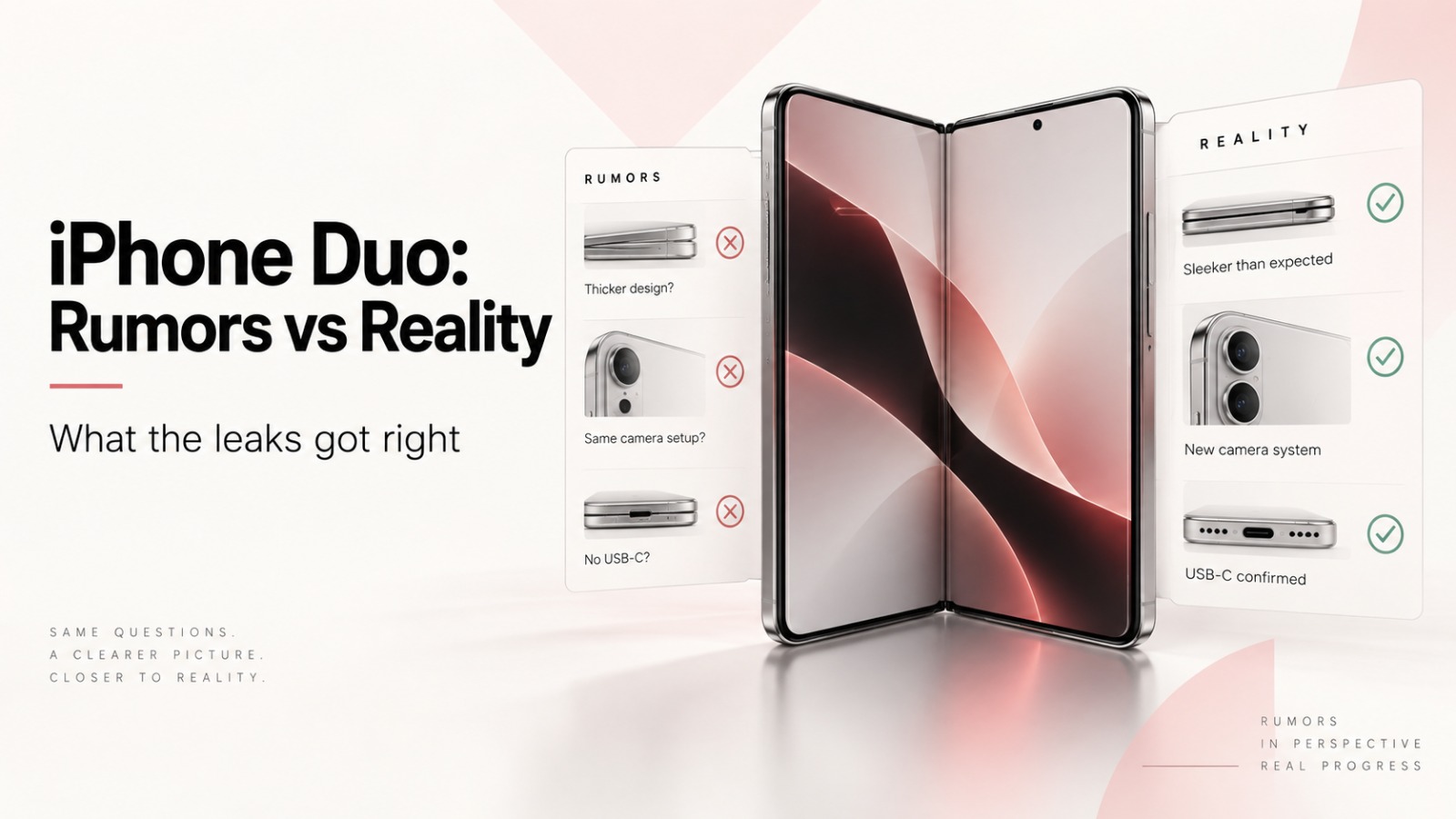
Some of the biggest calls were strikingly close. The book-style design, titanium construction, two-display layout, Touch ID in the side button and a price close to $2,000 all appeared in reports well before the unveiling. Yet some of the details that attracted the most attention during the rumor cycle, particularly claims around a nearly invisible display crease, did not translate quite so neatly into the finished device.
And several features that now help define the iPhone Duo barely featured in the speculation at all.
The screens were close, but not quite what was predicted
Display size was one of the more specific predictions surrounding Apple’s foldable.
In March 2025, analyst Ming-Chi Kuo said Apple was working with an approximately 7.8-inch inner display and a 5.5-inch exterior screen.
Apple ultimately went a little smaller. The finished iPhone Duo has a 7.6-inch inner Super Retina XDR display and a 5.4-inch outer screen.
The difference is modest, but it is a useful reminder of how even detailed supply-chain information can shift before a product reaches production.
The broader form factor, however, was correctly anticipated. Rather than adopting the compact clamshell approach seen on some foldable phones, Apple built a device that opens horizontally into a larger, tablet-like workspace.
Apple says the external display offers 90 percent of the screen area of the iPhone 18 Pro, while the internal display is 50 percent larger than the display on the iPhone 18 Pro Max.
Touch ID made the cut, Face ID did not
Another long-running prediction proved accurate.
Kuo had suggested Apple would remove Face ID from the foldable to conserve internal space, replacing it with Touch ID integrated into the side button.
That is exactly how the iPhone Duo has been configured.
There is no Face ID system on the device. Authentication instead comes through the side-mounted Touch ID sensor, while Apple Watch unlocking is also supported.
For a product built around the challenge of fitting two screens, a hinge and other components into an unusually thin body, the biometric choice turned out to be one of the clearest examples of the rumor cycle matching the finished hardware.
The titanium reports were right, but Apple went much further with the hinge
Titanium was another recurring theme in reports leading up to the launch.
The finished iPhone Duo uses grade 5 titanium, but one of the more specific hardware details goes beyond the early predictions.
Apple’s precision hinge contains more than 100 components and includes a 3D-printed titanium hinge cover.
That engineering detail matters because the hinge is not simply connecting two halves of the phone. It has to support Apple’s effort to make the Duo exceptionally thin while allowing the inner screen to fold repeatedly.
Apple describes the iPhone Duo as its thinnest iPhone when opened.
Earlier predictions had put the unfolded thickness at roughly 4.5mm to 4.8mm, with a folded thickness of around 9mm to 9.5mm. The final reporting confirms that the thin-device direction was correct, even though the comparison now rests on Apple’s description of the finished product rather than those earlier estimates.
The crease is where expectations got ahead of reality
Few parts of Apple’s foldable project attracted as much speculation as the crease running through the center of the flexible display.
Reports had repeatedly suggested Apple was working toward an almost crease-free, or even completely crease-free, screen.
The finished iPhone Duo does not come with such a claim.
Instead, Apple uses a nano-texture finish intended to cut glare and reflections while also reducing how visible the crease appears. Early hands-on images cited in the reporting indicate that the fold can still be seen under certain lighting conditions and viewing angles.
That makes the crease one of the clearest areas where years of speculation created a more ambitious expectation than Apple ultimately promised.
Camera leaks got the basic hardware right
Rumors had also pointed toward a dual-camera rear system instead of the three-camera arrangement used on Apple’s Pro iPhones.
That prediction held up.
What received less attention before launch was how Apple would use the folding design as part of the camera experience. The company has introduced features that make use of both displays, shifting some of the focus away from simply counting rear lenses.
The device also includes a hidden inner FaceTime camera, one of several details that became clearer only once the finished product was revealed.
The $2,000 price predictions came within a dollar
Pricing was another area where the leak cycle landed remarkably close.
Earlier reports frequently placed Apple’s first foldable above $2,000, with some estimates ranging from $2,000 to $2,500.
Apple has priced the iPhone Duo just below that psychological threshold.
The phone starts at $1,999 in the United States and £1,999 in the United Kingdom with 256GB of storage.
Buyers can also choose 512GB, 1TB and 2TB versions. The 2TB option pushes local storage considerably beyond what many of the earlier foldable reports had focused on.
Some of the most important features barely figured in the rumors
The biggest gap between the leak cycle and the finished iPhone Duo may not be something the rumors got wrong. It may be what they largely failed to anticipate.
Apple Pencil support is scheduled to arrive later this year, with Apple Pencil with USB-C working across either display.
Apple has also adapted iOS 27 around the dual-screen format. The software includes Split View for running two applications side by side, saved app pairs and the option to open two windows from the same app.
Those additions make the iPhone Duo more than a conventional iPhone whose screen happens to fold. Apple has built parts of the software experience specifically around the larger internal canvas.
The comparison with smaller iPads becomes harder to ignore once those multitasking tools and Pencil support are included.
Battery life became another surprise
A very thin foldable naturally raises questions about battery capacity, yet Apple’s figures suggest the company has approached the problem with a dual-battery architecture.
The iPhone Duo is rated for up to 31 hours of video playback using the inner screen and up to 44 hours when the outer display is used.
Apple also says fast charging can bring the battery to around 50 percent in roughly 20 minutes.
Those figures were not among the headline features that dominated years of pre-launch speculation, but they have become an important part of the final product story.
The leaks got the outline right, not the whole experience
Looking back, the rumor ecosystem did a credible job of sketching the broad shape of Apple’s first foldable.
The book-style design was there. So were two displays, Touch ID, titanium, dual rear cameras, an extremely thin body and a premium price approaching $2,000.
But the finished iPhone Duo also exposes the limits of following a product through isolated leaks.
The predicted screen dimensions moved slightly. The much-discussed crease was not eliminated outright. Meanwhile, features such as Apple Pencil support, dedicated multitasking tools, a hidden inner FaceTime camera and Apple’s broader two-screen software approach became meaningful parts of the product without dominating the earlier conversation.
That may ultimately be the most useful way to read the iPhone Duo rumor story. The leaks were good at identifying the hardware Apple was building. They were less complete when it came to explaining what Apple intended to do with it.
The iPhone Duo is scheduled to open for pre-orders at 5 a.m. PT on Friday, October 16, with general availability beginning Friday, October 23.
Also Read: Anthropic AI ‘Kill Switch’ Debate Deepens as Microsoft Flags Claude’s Humanlike Traits