
Soumyarendra Barik, an Indian Express journalist, went beyond the newsroom to document Delhi’s gig economy from the saddle of a delivery scooter.
In a ground report based on his own three-day stint as a delivery worker for Zomato, Blinkit and Swiggy, Barik lays out a stark set of numbers that cut through the marketing of “10-minute” convenience: 23 deliveries, 15.5 hours on the road, 105 km travelled, and total earnings of ₹782, about ₹34 an hour. After fuel costs, he reports that the take-home shrank to ₹532.
23 deliveries across three platforms, one Delhi reality
Barik’s narrative is organized around how gig work actually takes place: there is constant movement, there is lots of downtime between orders, and there is pressure from time windows that do not allow for rest. This work takes three days and has to deal with Delhi roads and delivery locations every time.
What jumps out is not just the distance and time but the wage math: ₹782 for 15.5 hours comes to roughly ₹34/hour on gross earnings. Once fuel is deducted, the outcome gets more sobering: ₹532 left from this whole exercise. The report presents this gap as the central tension of platform delivery work: instant convenience for the customer, fragile and variable earnings for the worker, and costs beyond their control.
The invisible expense: costs that don’t show up on the app
Barik’s fuel-adjusted figure is the most significant because it shows a reality often asserted to be true for many gig workers: app earnings and actual earnings differ. Simultaneously, fuel costs have the ability to significantly impact a day’s earning performance. His narrative portrays the gig economy model, where the actual operating costs of the business have been shifted to the worker for the day.
The result is a simple but powerful ledger: long hours and significant travel do not automatically translate into sustainable pay when basic running costs are subtracted.
Time pressure as the job, not just the backdrop
While consumers experience delivery in minutes, Barik’s on-ground numbers show that the job is defined by hours and by the cumulative strain of staying available for orders. The Delhi context of this report is important to the actual “rate” a worker earns: traffic, distance between pickups and drop-offs, and unpredictable waiting time shape this.
Barik’s hourly calculation-₹ 34/hour gross-continues to be much more than a statistic. It is a good way to estimate the practical value of gig labour against the acuteness of the schedule needed to be kept to earn it.
What this ground report adds to the gig economy debate?
The strength of Barik’s account is its discipline: it does not rely on sweeping claims or second-hand anecdotes. It relies on logged work, time, distance, and earnings, the kind of evidence that’s hard to dismiss because it’s auditable and specific.
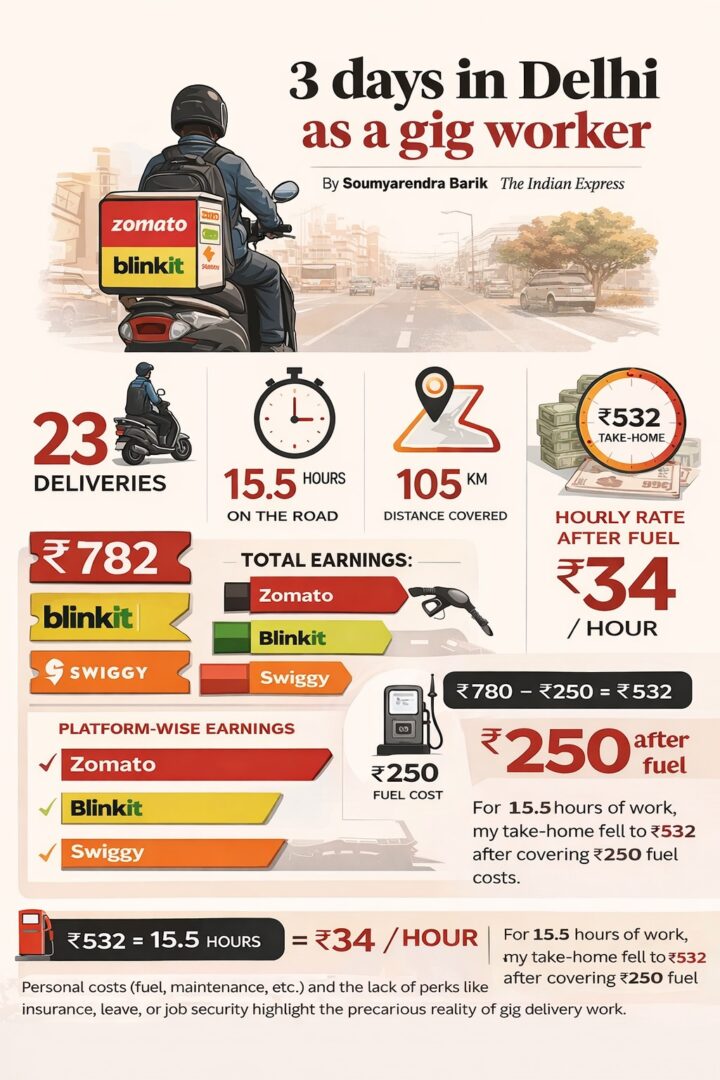
His three-day experience doesn’t claim to represent every worker’s every day. But it does demonstrate a verified snapshot: even with steady movement across major platforms, the combination of working hours, travel, and fuel costs can compress earnings sharply.
The Significance
The gig economy in India has been described, at times, within the framework of growth, speed, and convenience. The figures given to me bring the focus of the conversation back to the bottom line of the worker. According to Barik, “The hallmark of gig services, it is said, is their flexibility. But what happens to that flexibility once real expenses are factored in?”
And in that space between what appears in the application and what the employee has, Barik’s ground report finds itself with the most difficult question: if 15.5 hours and 105 km are able to turnover an income of ₹532 inclusive of fuel costs, how does “fair wage” look, and how are we to pay, and in whom, for convenience?
Also Read: ClickHouse Raises $400 Million at $15 Billion Valuation in AI Data Boom