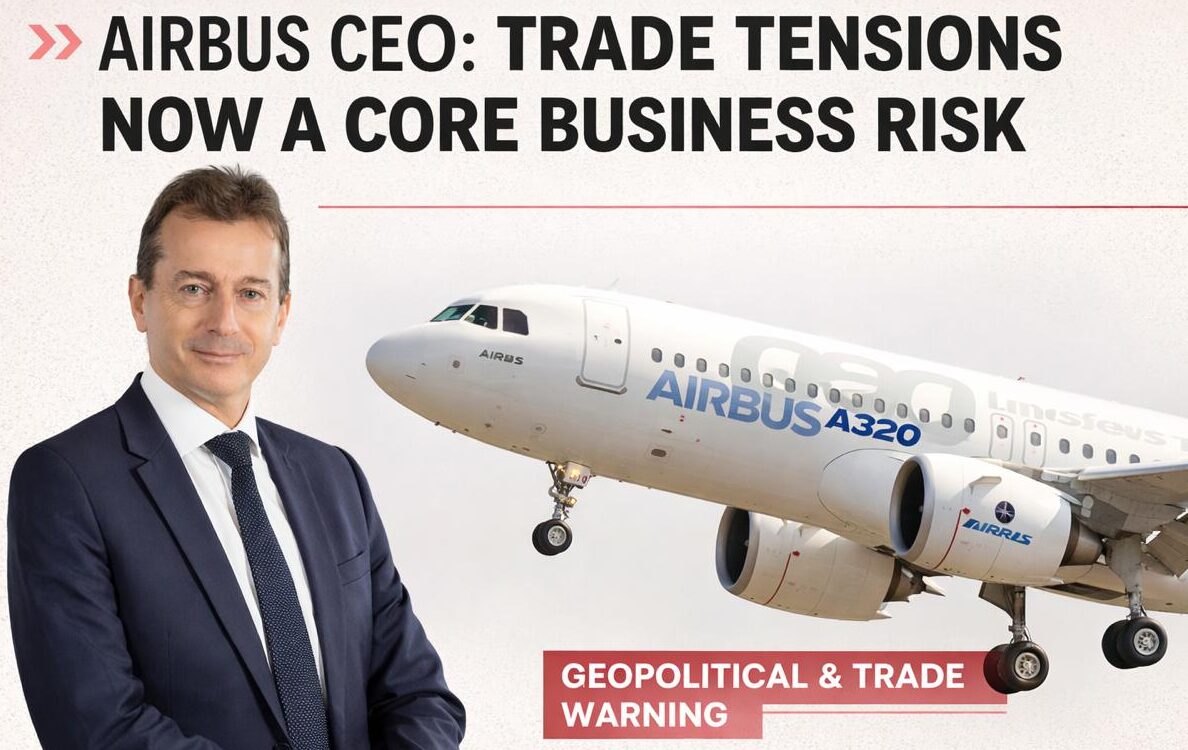
Airbus CEO Guillaume Faury has warned about growing geopolitical and trade risks, saying the company has already faced major logistical and financial setbacks and now faces more uncertainty in 2026. He shared this warning in an internal message to employees, as Airbus deals with rising trade tensions, fragile supply chains, and pressure to meet production goals while competing with Boeing.
The comments underline how global politics is increasingly shaping the future of aerospace manufacturing, even as demand for new aircraft remains historically strong.
A Message From the Top as the Ground Shifts
Guillaume Faury, who has led Airbus since April 2019, told employees that early 2026 brings an unusual number of geopolitical crises and trade disputes. He said the business environment is getting more complex and warned that outside shocks are now a regular part of doing business.
Faury’s message came after a year when Airbus performed well operationally but faced repeated disruptions from changes in global trade policies, especially those involving the United States and China.
When Politics Starts Rewriting Production Plans
Airbus was directly affected by rising trade tensions in 2025. In April, the United States, under President Donald Trump, announced broad tariffs on many imports. China responded with export restrictions on some key materials.
These measures disrupted the flow of components across borders. At several points during the year, U.S. authorities temporarily frozeThese actions disrupted the movement of parts across borders. Several times during the year, U.S. officials temporarily stopped exports of important aerospace parts meant for planes built in China. Since Airbus depends on a global supply chain, the effects were felt right away.ilability forced adjustments to production schedules and increased costs tied to inventory management and alternative sourcing.
Engines, Delays, and the Weakest Link in the Chain
One of Airbus’ ongoing challenges is getting enough engines. Programs like the A320neo rely on engines from Pratt and Whitney and from CFM International, a partnership between GE Aerospace and Safran.
In 2024 and 2025, inspections for powder metal problems at Pratt and Whitney grounded hundreds of planes worldwide and slowed new deliveries. While things have improved somewhat, Airbus still struggles with limited engine supply, which makes it hard to speed up production.
By the end of 2025, Airbus had delivered about 735 commercial planes, a bit less than its earlier goals. This shortfall was mostly because of supply chain problems, not a lack of demand.
Also Read: IndiGo Vacates 717 Airport Slots After DGCA Enforces Winter Schedule Cut
Internal Fault Lines Add to External Stress
Besides trade disputes, Airbus has also faced internal problems. In 2025, it had its biggest software recall ever, which affected onboard systems and required extra checks and updates. Quality issues with fuselage sections also caused temporary delivery delays.Faury said Airbus needs better discipline in systems engineering and product management. He stressed that simply being large is not enough if the company’s processes do not keep up.
Strong Balance Sheet, Thinner Margins for Mistakes
Despite these challenges, Airbus remains financially resilient. Despite these problems, Airbus is still financially strong. The company has about 160,000 employees worldwide and made over €65 billion in revenue in its latest full-year report. Its backlog of more than 8,500 planes is one of the largest in the industry, giving it steady long-term income. Earlier in the decade, it showed improvement following restructuring, while Airbus Helicopters delivered stable earnings through government and civil contracts. However, Faury warned that having many orders does not protect Airbus from geopolitical shocks, especially since its supply chains stretch across many countries.
Competing With Boeing While the World Watches
Airbus’ warning comes as its main rival Boeing works to recover from safety crises and regulatory scrutiny. While Boeing’s difficulties have allowed Airbus to capture market share in recent years, Faury made it clear that Airbus cannot rely on competitor weakness alone.Any prolonged disruption to Airbus’s own production system could quickly erode its advantage, particularly as airlines worldwide push for faster aircraft deliveries to meet rising travel demand.
What the Next Phase Demands From Airbus
Airbus is scheduled to release its full 2025 financial results on February 19, 2026. Investors and analysts will closely examine guidance on production rates, cash flow, and capital expenditure, especially in light of the CEO’s cautionary tone.
Looking ahead, Airbus is expected to continue investing in supply chain resilience, diversifying sourcing where possible, and strengthening internal quality controls. At the same time, it must prepare for future aircraft programs, including potential successors to the A320 family, in an environment shaped as much by geopolitics as by engineering. Faury’s message is clear: even for a global leader like Airbus, the main challenge is not demand, but learning to operate in a world where trade, politics, and manufacturing are closely linked.