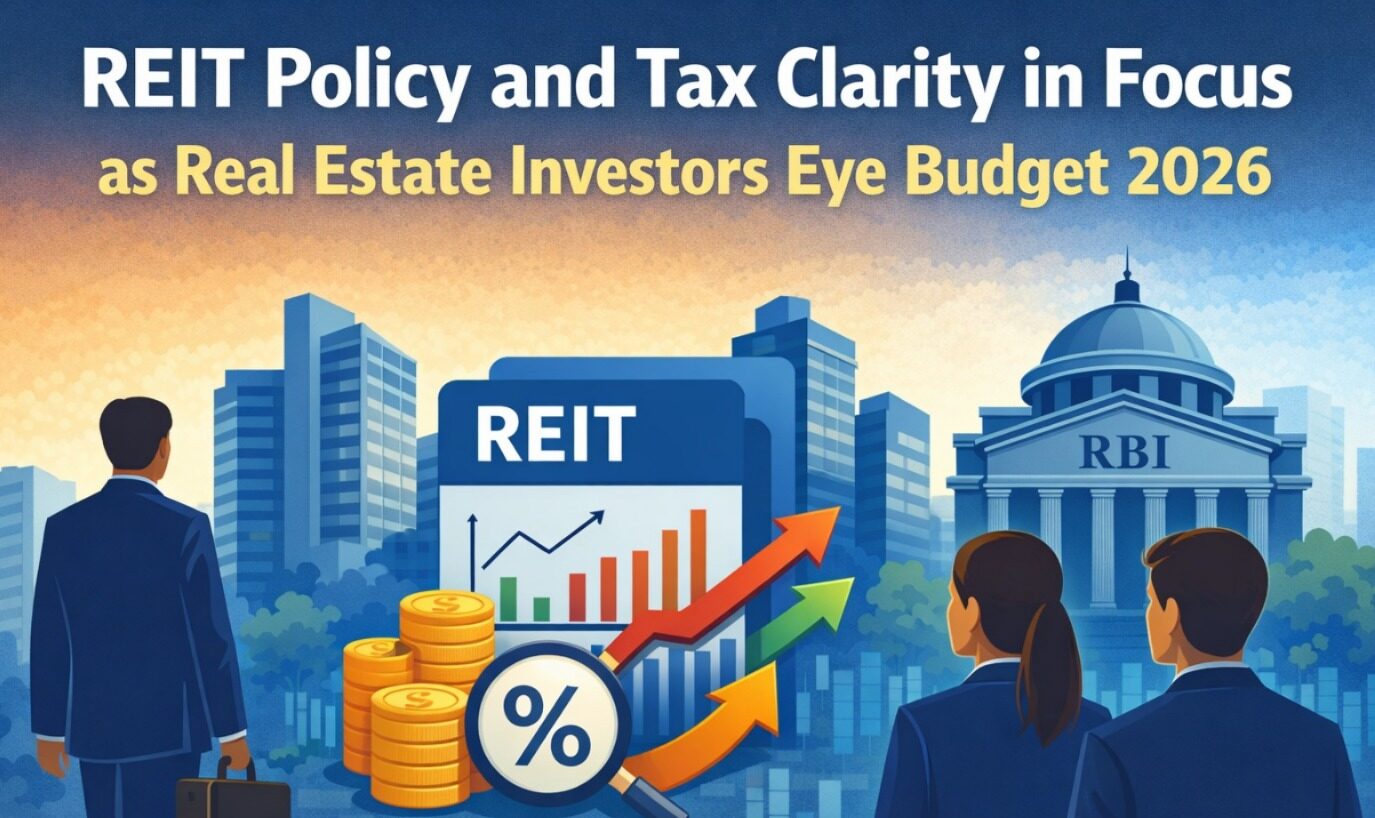
The policy signals about Real Estate Investment Trusts (REITs), which will be announced in Budget 2026, are being inspected with great care by the real estate investors of India, as the expectations about predictability of taxes and regulatory stability are taking an increasingly firm hold in their investment calculus. The current market opinion holds that the government attitude towards the taxation of REIT will play a leading role in determining the pace as well as the flow of capital into the commercial real estate sector within the next fiscal year.
REITs have become a relevant mode of investment in India, which allows exposure to income-generating office, retail, and logistics real estate and allows developers to monetize completed properties. That notwithstanding, with the Union Budget approaching, the mood of investors has changed to one of caution and an overemphasis on the need to have clarity and consistency throughout tax and regulatory systems.
Investor wariness increases before Budget 2026.
The lack of clarity regarding capital gains taxation as well as levies on the dividend and the pass-through nature of REITs has burdened investor confidence over the past few months, according to industry experts. Despite the fact that the commercial real estate market still has high levels of resilience, there is a certain degree of inherent uncertainty in the way tax is treated, and this led to many investors holding back new commitments pending the release of the next budget, which will give a clearer picture.
The foreign investors, especially, are extremely sensitive to any changes in laws, and they often compare the REIT infrastructure in India with those in the international market. The overseas funds have been very picky in a macro environment of high interest rates in the world and geopolitical instability, such as jurisdictions that provide long-term regulatory stability and predictable post-tax returns.
The Importance of Predictability in Taxes in REITs.
The main thesis of REIT investment is tax predictability because the returns are mainly influenced by fixed dividends and long-term capital appreciation. Even the allegedly non-core changes in the calculation of dividend or interest income taxation can significantly change the calculus of yield expectations, hence decision-making on portfolio allocation.
Market analysts argue that clear and stable tax policy would increase investor confidence and position India as a viable destination of global real estate capital. Clear guidelines would also allow investors to better control and evaluate the risk-adjusted returns at a point when the world capital is being reallocated to the emerging markets.
Effect on Capital Flows and Commercial Real Estate.
With that, a favorable ripple effect within the commercial real estate industry could be created with the help of a supportive policy posture in Budget 2026. The contribution of REITs to the liquidity strengthening is critical, as it allows the developer to reinvest capital in new projects to support the expansion of office parks, shopping centers, and logistic buildings.
The heightened transparency of the taxes would tend to spur new institutional involvement and asset price support and take pressure off the developers to raise money. On the other hand, the uncertainty or bad changes in the taxation that may arise will delay decision-making on investment as well as slow down the level of transactions and reduce the market momentum.
Outlook Policy-Remains Driven.
Though the situation is cautious in the short run, domestic investors still offer a calming effect to the REIT market, as supported by the rising level of awareness of the REIT as a source of income. The involvement of mutual funds and long-term institutional investors has helped to alleviate some of the volatility created by the varying amounts of foreign inflows.
The investor sentiment is expected to be strongly tethered to policy indicators as Budget 2026 approaches. Analysts assume that a transparent and foreseeable REIT structure may open up new sources of capital and bolster confidence levels in the Indian commercial real estate sector. Until this clarity is reached, it is the foremost variable that will influence the expectation of the future course of the sector in both the short term and the long term.
Also read – UPI Hits Record 21.63 Billion Transactions Worth Rs 27.97 Lakh Crore in December