


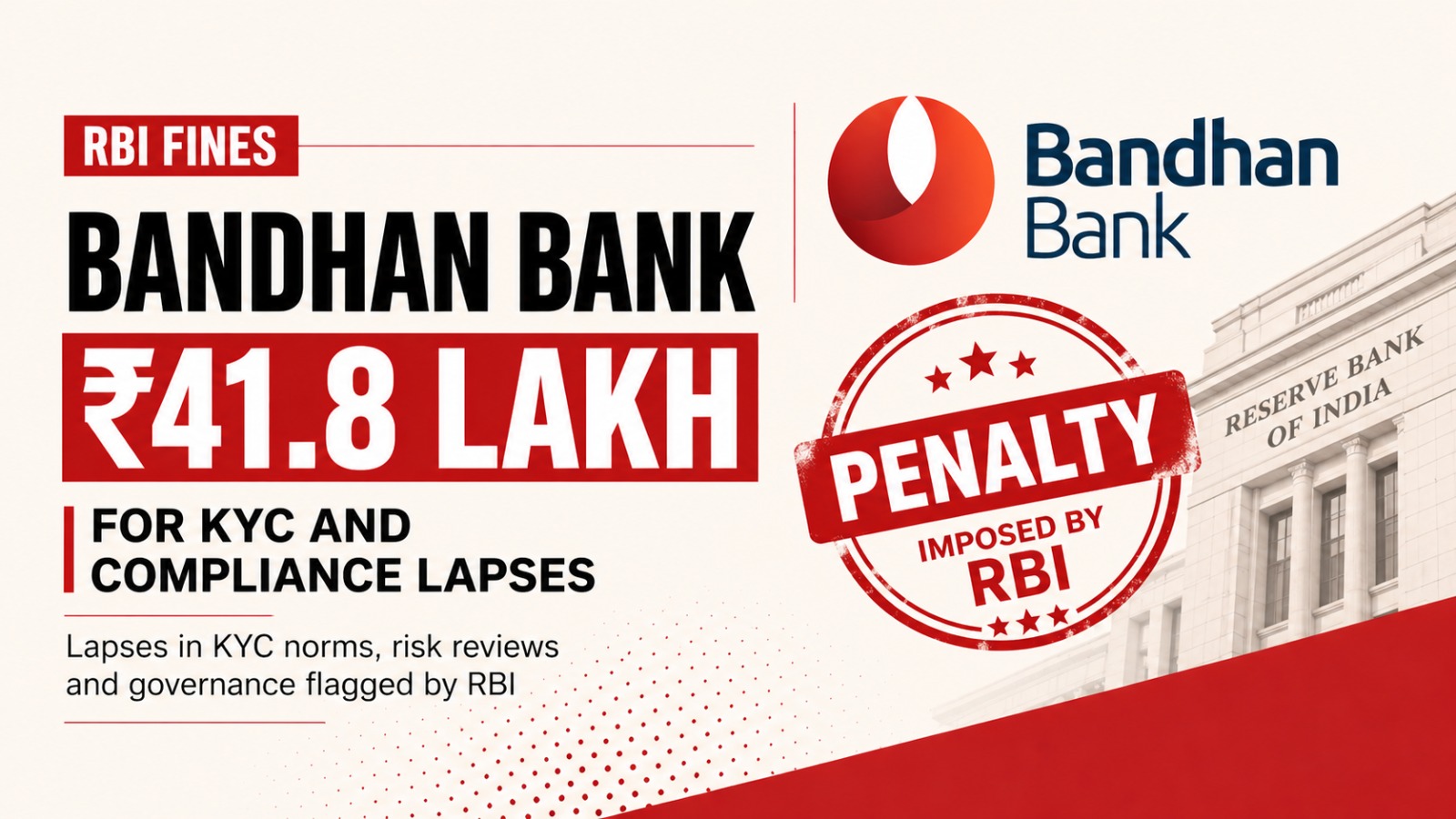
The Reserve Bank of India has imposed monetary penalties on Bandhan Bank and Muthoot Housing Finance Company, signalling once again that regulatory compliance remains a non-negotiable area for banks and financial institutions.
Bandhan Bank has been fined ₹41.8 lakh after supervisory inspections found lapses linked to compliance requirements, including issues around Know Your Customer norms. The central bank also flagged that the bank had not carried out periodic reviews of risk categorisation for certain accounts. Another concern noted was the sanctioning of loans involving directors, raising questions around governance and internal checks.
In a separate action, Muthoot Housing Finance Company has been fined ₹80,000 for non-compliance with the Fair Practice Code, which lays down standards for transparency and fair dealings with customers in the housing finance sector.
While the penalty on Muthoot Housing is comparatively small, the action is significant because it shows that the RBI is not limiting enforcement only to large violations. Even smaller deviations from prescribed norms are being taken seriously, especially when they relate to customer-facing practices.
A higher fine indicates that there may be some shortcomings in the internal surveillance and governance systems of Bandhan Bank. Customer due diligence and risk classification are fundamental aspects in determining whether the bank’s clients qualify for such services and whether the channels will be abused.
The RBI has clarified that the penalties relate to deficiencies in regulatory compliance. They do not affect the validity of any customer transactions or agreements with the two institutions.
The development comes at a time when the regulator has been keeping a close watch on banks, housing finance companies and non-banking financial companies. The message is clear: financial institutions cannot treat compliance as a back-office formality. It has become a core part of governance, customer protection and institutional trust.
For customers, the immediate impact may be limited since existing transactions and agreements remain valid. For the wider banking and financial services sector, however, the penalties serve as another reminder that internal controls, periodic reviews, fair practices and board-level governance cannot be allowed to slip.
Regulatory penalties may look like routine enforcement actions, but they often reveal where institutions need to strengthen their systems. In this case, the focus is on three sensitive areas: KYC discipline, risk monitoring and fair customer treatment.
India’s financial sector has expanded rapidly in recent years, with banks and housing finance firms serving a wider customer base. That growth also increases the responsibility on institutions to ensure that compliance systems keep pace with business expansion.
The move by the RBI against Bandhan Bank and Muthoot Housing reflects a broader change in the way regulations think about compliance issues. Non-compliance is not seen as a mere mistake anymore. It is now considered a governance issue.
Also Read: Who Owns Your Team Now? IPL’s Latest Ownership Breakdown