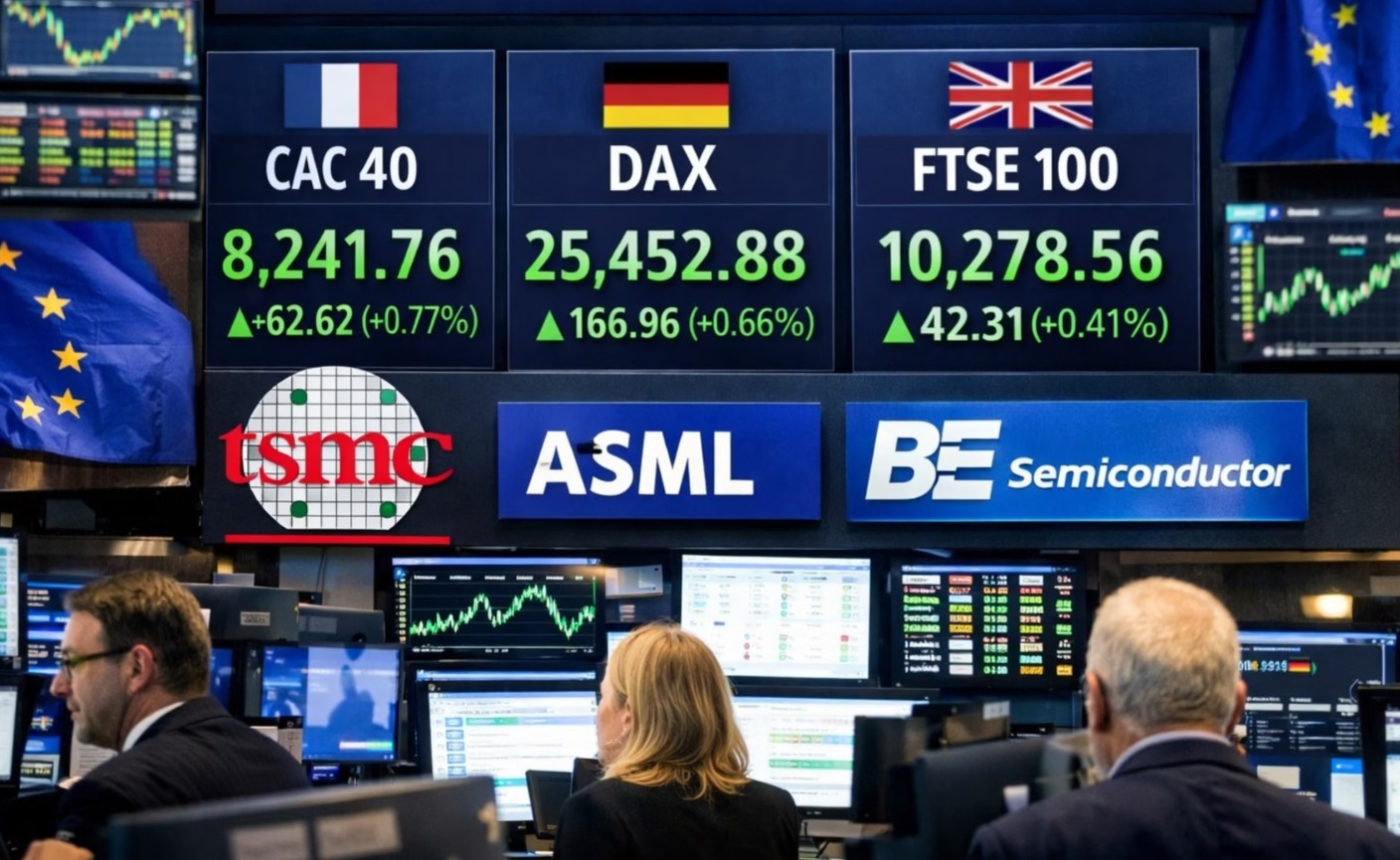
European equity markets rose as renewed strength in semiconductor stocks outweighed persistent concerns related to geopolitics, uneven economic growth, and banking-sector uncertainty across the region. Investor sentiment improved notably after stronger-than-expected earnings from Taiwan Semiconductor Manufacturing Company (TSMC) reinforced confidence in sustained global demand for artificial intelligence–related chips and advanced semiconductor technologies.
The pan-European STOXX Europe 600 ended Thursday’s session higher, supported primarily by gains in technology and industrial sectors. While the broader market advance was modest, the session highlighted the increasingly central role of the semiconductor industry in shaping European equity performance, particularly as AI-driven investment cycles continue to expand globally.
Semiconductor Rally Drives European Market Gains
The positive momentum in European equity markets followed TSMC’s announcement of a 35 percent increase in fourth-quarter profit, exceeding market expectations and reaching a record level. The company attributed its performance to strong and persistent demand for advanced chips used in artificial intelligence, high-performance computing, and data center infrastructure. Market participants interpreted the results as confirmation that AI-related capital expenditure remains resilient despite broader macroeconomic uncertainty.
As European equity markets rise, the semiconductor sector has emerged as a key beneficiary of these global technology trends. Investors increasingly view chipmakers and equipment suppliers as structural growth plays rather than cyclical assets, given their critical role in next-generation computing, automation, and digitalization.
TSMC Earnings Boost Confidence in AI Chip Demand
The earnings report from TSMC provided a positive signal not only for Asian markets but also for the broader global semiconductor supply chain. In Europe, the impact was immediate and pronounced. Shares of Dutch semiconductor equipment manufacturer ASML surged and closed near record highs, reflecting its exposure to advanced chip fabrication technologies.
Other European semiconductor-related firms, including ASM International and BE Semiconductor, also posted strong gains. The breadth of the rally underscored widespread investor optimism regarding the sustainability of the semiconductor cycle and reinforced expectations of continued capital investment in chip manufacturing capacity.
Mixed Performance Across European Benchmarks and Banks
Despite the strength in technology stocks, performance across major European benchmarks remained mixed. France’s CAC 40, Germany’s DAX, and the United Kingdom’s FTSE 100 all finished modestly lower, reflecting profit-taking and continued pressure on non-technology sectors. This divergence highlights the selective nature of the current market rally, as investors favor globally competitive firms with strong earnings visibility.
In the banking sector, shares of UniCredit moved higher after the lender dismissed reports suggesting it planned to acquire a stake in Banca Monte dei Paschi di Siena, describing such claims as unfounded. Nevertheless, analysts continue to expect increased merger and acquisition activity within the European banking sector in 2026, particularly in Italy, where consolidation pressures remain significant amid regulatory and profitability challenges.
Geopolitical and Macroeconomic Factors Remain in focus.
While European equity markets rise on semiconductor optimism, geopolitical developments continue to influence investor sentiment. Markets monitored high-level discussions involving the United States, Denmark, and Greenland following renewed remarks by Donald Trump regarding the strategic importance of the Arctic region. Although these developments did not trigger immediate market volatility, they contributed to a cautious tone in risk-sensitive assets.
Macroeconomic data from the United Kingdom provided limited support. Figures from the Office for National Statistics showed that U.K. GDP expanded by 0.3 percent in November, outperforming expectations. However, economists cautioned that the medium-term outlook remains challenging. ING economist James Smith noted that U.K. growth could slow to approximately 0.9 percent in 2026, citing weak investment confidence and reduced fiscal support.
Selective Optimism Shapes European Markets
In conclusion, European equity markets rise primarily due to renewed optimism in the semiconductor sector, driven by robust earnings and strong AI-related demand. However, the uneven performance across sectors underscores the fragile balance between structural growth opportunities and persistent geopolitical and macroeconomic risks. As a result, future market gains are likely to remain selective, with investors continuing to favor companies positioned to benefit from long-term technological transformation rather than broad-based economic acceleration.
Also Read: Secret Alchemist Raises $3 Million in Fresh Funding Led by Unilever Ventures