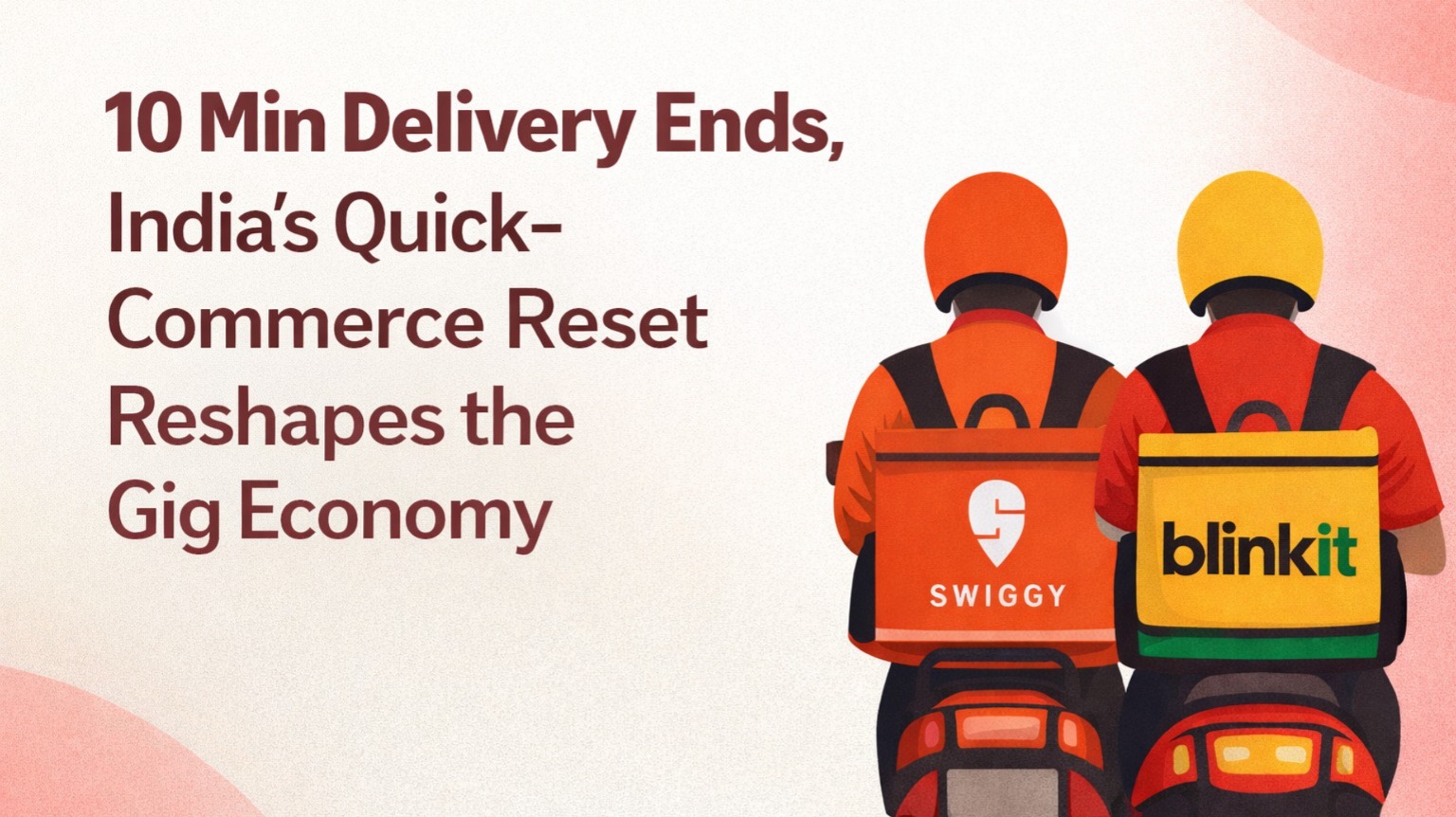
10 Min Delivery Ends: India’s quick-commerce sector is undergoing a quiet but consequential shift. After intervention by the Union Labour Ministry, leading instant-delivery platforms have agreed to remove rigid “10-minute delivery” timelines from their branding and public messaging.
What appears, on the surface, to be a marketing adjustment is in fact a deeper reckoning with the realities of gig work, delivery-partner safety, and the limits of speed-driven growth.
Ultra-fast delivery was supposed to be the defining promise of the industry for a long time: groceries, essentials, and items of everyday use are supposed to be just minutes away, building an addictive consumer habit and fuelling furious competition among platforms. But the same promise set an invisible clock for delivery partners-one that critics say translated into pressure on the road, stress, and safety risks.
The Labour Ministry’s intervention has now forced the sector to pause and recalibrate. Companies have assured the government that strict delivery deadlines will be dropped from advertisements and promotional claims, acknowledging that such timelines can encourage unsafe working conditions. Several platforms have already altered their taglines, replacing time-bound claims with broader messaging around assortment, availability, and convenience.
10 Min Delivery Ends: When branding Becomes a Labour Issue
Unlike traditional retail or logistics, quick commerce placed speed at the centre of its identity. The “10-minute” claim was not just a service feature; it was a public benchmark that shaped customer expectations, algorithmic incentives, and delivery-partner behaviour.

In this context of the gig economy, where workers are mainly controlled by applications as opposed to human supervisors, these performance measures may have an amplified effect. Whether or not these workers receive direct encouragement to hasten their pace, they may still be driven by perceived demands that help them avoid any form of punishment or depreciation in future assignments.
“The moment speed becomes the headline promise, it stops being a neutral metric and starts influencing behaviour across the system,” said Hemendra Dhar, digital enthusiast, reflecting on the shift. “Quick commerce showed what technology can achieve, but it also exposed the human cost when growth narratives run ahead of worker protections. This course correction was inevitable.”
Worker unrest and policy scrutiny?
The government’s move did not emerge in isolation. Over recent months, gig workers across delivery and mobility platforms have repeatedly flagged concerns around low earnings, lack of social security, and unsafe working conditions. Strikes and protests by delivery partners have added urgency to the debate, pushing labour issues in the app-based economy into the national spotlight.
By stepping in on delivery timelines, policymakers have signalled that worker safety is no longer a secondary consideration to innovation or consumer convenience. The message is clear: growth models that depend on extreme performance promises will face closer scrutiny.
This aligns with a general policy direction, too. States have begun to look at formal frameworks for gig workers: welfare boards, grievance-redress mechanisms, and social security funds being among them. As implementation remains patchy, the direction of travel is unmistakable.
What this means for platforms and consumers?
For quick-commerce firms, abandoning the hard promises of the clock minimizes risks of reputation and regulation. There is also a kind of comfort in terms of logistics flow because delivery times will consider traffic and weather conditions as opposed to the ticking clock.
At the same time, platforms face a delicate balancing act. Speed has been a key differentiator in a crowded market, and any perceived dilution could test consumer loyalty. The challenge now is to reframe value, shifting the narrative from “fastest” to “reliable, safe, and consistent.”
Consumers, too, are part of this transition. The popularity of instant delivery was built on convenience, but there is growing awareness that hyper-speed often comes at a human cost. Whether customers are willing to trade a few extra minutes for safer working conditions will shape the sector’s next phase.
A defining moment for India’s gig economy
“This is a symbolic moment in the gig economy,” says Sukesh Ranjan, an editor and media professional in the industry. “The removal of the ‘promise of delivery within 10 minutes’ reflects a recognition in the Indian marketplace that it’s now ready to pose tougher questions to the way in which online companies think about scalability.”
While the ending of the “10-minute delivery” age does not mean the death of quick-commerce, the fact remains that the experience has pointed towards an important aspect of the digital economy, which is that the story of growth cannot ignore the realities of the labor market for an indefinite period of time.
With the maturing of the gig economy in India, the attention is slowly being diverted from the race of speedy delivery at the cost of everything else towards the creation of platforms which address both the aspects of speed along with the notion of delivering in a dignified manner. Removing the strict delivery deadlines may appear like a small step at this point; however, this might be the start of a new era of Responsible Gig Employment in India.
Also Read: India’s Computer Gap: Smartphone Boom Masks a Growing AI Skills Crisis