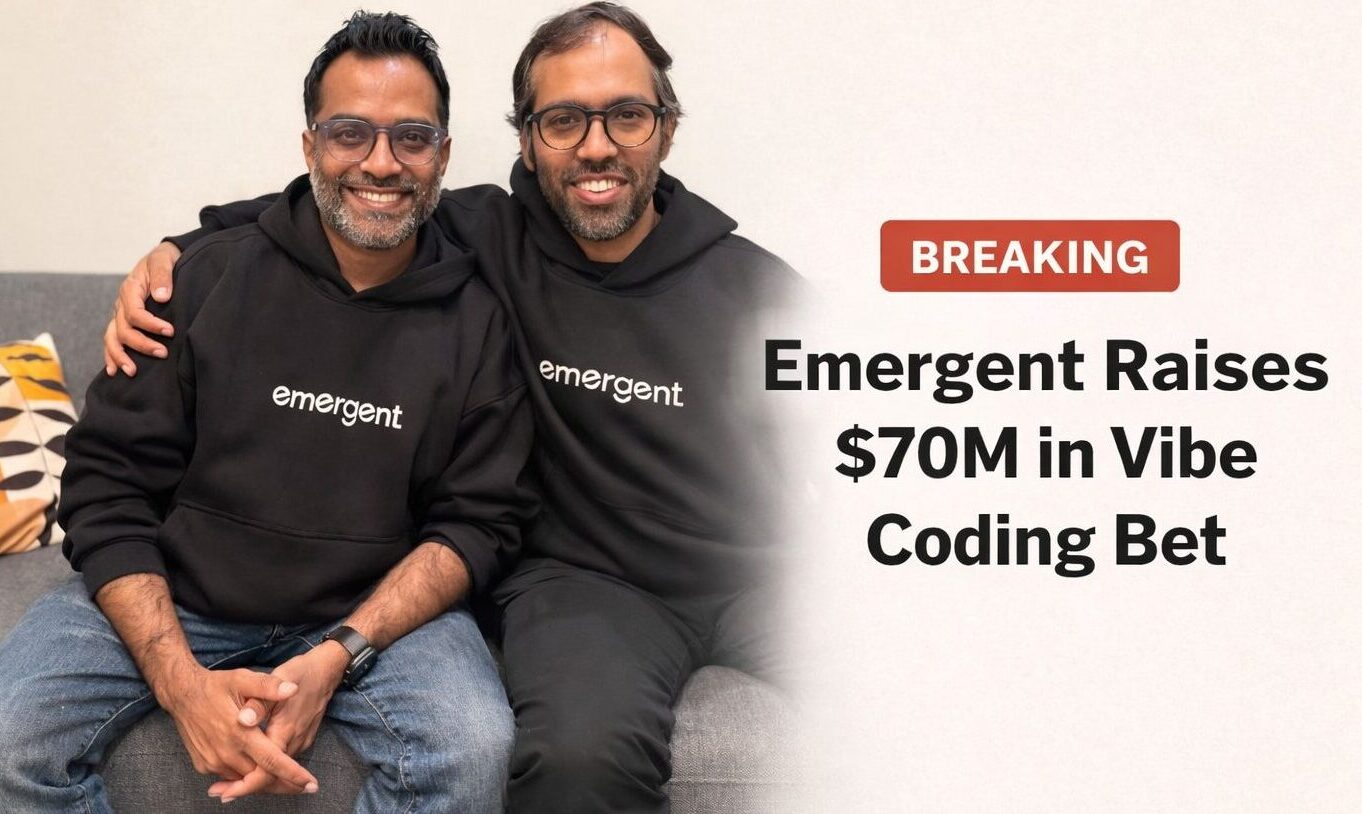
Emergent is a quickly growing AI startup focused on automating software creation. In January 2026, the company raised $70 million in Series B funding from Khosla Ventures and SoftBank Vision Fund 2, marking a key milestone in its growth.
January 2026 Funding Marks a Defining Moment
In January 2026, Emergent announced a $70 million Series B round led by Khosla Ventures and SoftBank Vision Fund 2. Prosus, Lightspeed Venture Partners, Together Fund, and Y Combinator also joined the round. This funding valued Emergent at about $300 million, almost triple its previous valuation from just a few months earlier.
This investment makes Emergent one of the best-funded early-stage companies in the fast-growing AI software development space. It also shows that investors are confident in platforms that help more people build applications.
Founding Roots and the Idea Behind Emergent
Emergent was founded by twin brothers Mukund Jha and Madhav Jha. Mukund Jha serves as CEO and previously co-founded the now-defunct delivery company Dunzo. His brother Madhav Jha is CTO and has a background in artificial intelligence and machine learning.
The goal was to build a system where intent is more important than code, so anyone with an idea can launch a real product without programming.Emergent was incorporated in 2025 and operated in stealth for several months before opening access to early users later that year.
Leadership Team and Key People
Mukund Jha is the Founder and CEO, guiding the product vision and long-term plans. The technical team includes senior engineers with experience in large distributed systems and AI research, many of whom worked at global tech companies and AI startups.
Emergent’s core leadership includes a Head of Engineering overseeing model integration and infrastructure reliability, a Head of Product focused on user experience and workflow design, and a Growth and Partnerships lead driving adoption across startups and enterprises. While the company has kept some leadership details private, investors have highlighted the depth of its technical bench as a key reason for backing the company early.
What Emergent Builds and How Vibe Coding Works
Emergent uses vibe coding, a new way to build software where users simply describe what they want in plain language. The platform’s AI agents turn these ideas into working applications, handling everything from the interface and backend to databases, cloud setup, authentication, payments, and deployment.
Unlike most no-code platforms that depend on templates, Emergent focuses on letting its system work on its own. It keeps improving applications, fixing bugs, and updating features as needs change. This means users get a finished, ready-to-use app instead of just a prototype.The platform is designed for non-technical founders, small businesses, creators, and internal teams at larger organizations that need speed and flexibility.
Also Read: Nootie: A Family Business Reimagined for India’s Pet Nutrition Boom
Business Model and Pricing Strategy
Emergent follows a tiered subscription-based business model combined with usage-based pricing. Individual users can start with a free or low-cost entry tier that allows limited application builds and experimentation. Paid plans scale based on compute usage, application complexity, and deployment needs.
Startups and larger companies can choose higher-priced plans with advanced security, private deployments, custom integrations, and priority support. Enterprise customers can also get dedicated infrastructure and options focused on compliance.
This mix of pricing lets Emergent earn revenue from individual creators and also capture more value from fast-growing startups and big organizations, helping the company grow quickly.
Early Traction and Global Adoption in 2025
After launching publicly in mid-2025, Emergent quickly gained users around the world. By the end of the year, millions from over 190 countries had joined. Most users had little or no programming experience, which supported the company’s main idea.
In just a few months, Emergent reached tens of millions of dollars in yearly recurring revenue, thanks to paid subscriptions and enterprise customers. This fast growth was impressive, even among other AI startups.
Series A and Early Investor Support
Emergent raised $23 million in its Series A round in mid-2025 from early supporters like Khosla Ventures, Together Fund, and Y Combinator. Several angel investors with tech and AI backgrounds also joined.
That capital was used to strengthen model performance, improve infrastructure stability, and expand the engineering team. The Series A marked Emergent’s transition from an experimental product to a commercially scalable platform.
Why Khosla Ventures and SoftBank Are Doubling Down
Khosla Ventures often invests in AI-first companies that change how work gets done, while SoftBank Vision Fund 2 looks for platforms that could transform whole industries. Their lead roles in the January 2026 Series B show they believe AI-driven software development could become the standard in the next decade.
Investors view Emergent as a platform focused on results, not just making developers more productive. Rather than helping engineers code faster, Emergent wants to remove the need for coding in many situations.
Use of Funds and the Road Ahead
Emergent will use the $70 million raised in January 2026 to grow its engineering and research teams, make its AI agents more reliable and independent, and add enterprise features for security and compliance. The company also plans to expand further in North America, Europe, and Asia.
Emergent is putting a lot of resources into trust, safety, and reliability so that AI-built applications can work well in real business settings.
A Second Entrepreneurial Chapter
For Mukund, Emergent is his second startup, drawing on what he learned from Dunzo. This time, the company is more efficient with its capital, global from the start, and focused on cutting-edge AI technology.By early 2026, Emergent is at a key moment. With strong support from investors, fast user growth, and a clear way to make money, the company now aims to show that vibe coding is a real change in how software is built, not just a short-term trend.
Also Read: Snack Brand Troovy Raises $5 Million in Series A Led by Fireside and Sharrp Ventures