

India’s startup ecosystem has expanded rapidly over the past decade, producing thousands of new ventures and attracting billions of dollars in venture capital. Yet, behind this growth lies a striking imbalance. Women entrepreneurs continue to receive only a tiny share of startup funding, highlighting a structural gap that persists despite rising participation of women in science, technology, engineering and mathematics (STEM) education.
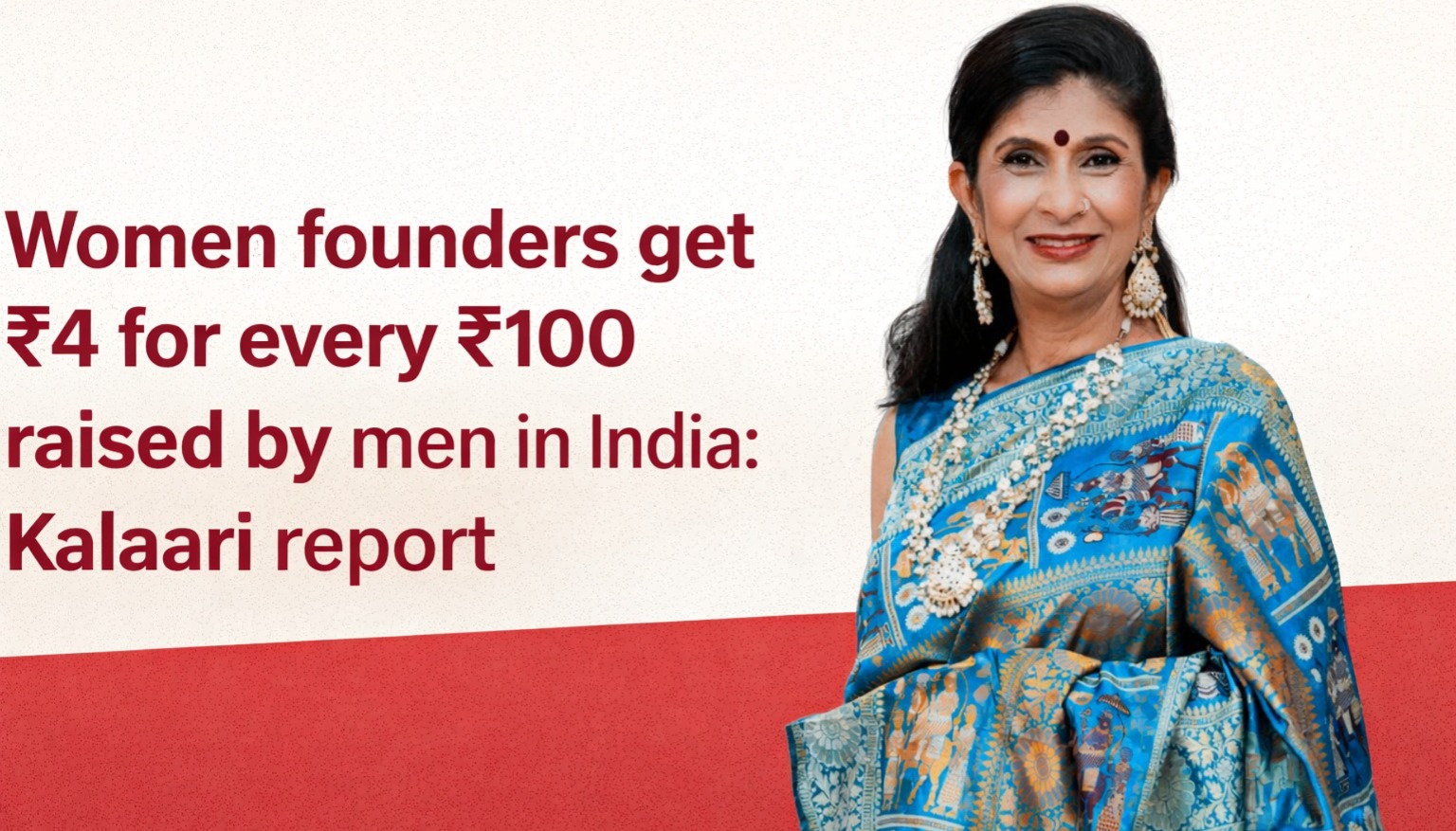
A recent study by venture capital firm Kalaari Capital reveals that women founders in India receive just ₹4 for every ₹100 raised by male founders. The finding points to a deep gender disparity in how capital flows through the country’s innovation economy, raising questions about access, networks and decision-making power within the venture capital ecosystem.
Women Founder and the Funding Gap That Persists Despite Growing Talent
The report argues that the issue is not a shortage of capable women entrepreneurs. In fact, the pipeline of women entering technical education and competitive exams has grown significantly over the past decade.
Data referenced in the article indicates that the number of girls in high school STEM courses increased 1.7 times between 2013 and 2024. Women’s participation in engineering entrance exams has also seen a sharp rise; their enrollments for the JEE exam have doubled between 2015 and 2025. Women make up a substantial percentage of STEM graduates in India.
Despite this expanding talent pool, the translation of technical education into startup leadership remains limited. According to the report, women are only about 0.6 times as likely as men to emerge as startup founders, indicating that the barrier appears not at the education stage but later in the entrepreneurial journey.
Where Capital Decisions Are Made?
Another factor contributing to the imbalance lies within venture capital firms themselves. While women have made some inroads into the investment industry, representation drops sharply at senior decision-making levels.
The report notes that women make up around 38% of venture capital analysts, the entry-level roles where research and deal sourcing typically begin. However, at the partner level, where final funding decisions are taken, the representation falls to just 16%.
This imbalance in leadership may influence which founders receive funding and which ideas gain traction. Venture capital networks often operate through established relationships, educational backgrounds and professional circles, which can inadvertently favour founders who resemble those already within the system.
Opportunity Hidden in Market Inefficiency
Vani Kola, founder and managing director of Kalaari Capital, argues that the funding gap reflects a broader market inefficiency rather than a lack of ability among women entrepreneurs.
She emphasised that capital often flows toward familiar networks, founders from the same institutions, companies or professional communities. When investment decisions rely heavily on these patterns, talented founders outside those networks can be overlooked.
According to Kola, this creates a missed opportunity for investors themselves. If a significant segment of founders is consistently underestimated or overlooked, the market may fail to recognise valuable businesses at an early stage.
The Larger Implication for India’s Startup Economy
India is currently one of the world’s largest startup ecosystems, with thousands of early-stage ventures emerging across sectors such as fintech, healthtech, climate technology and consumer internet. Expanding access to capital is widely seen as critical for sustaining this momentum.
The findings of the Kalaari Capital study suggest that improving gender balance in funding is not just a social goal but also an economic one. A broader and more inclusive founder base could unlock new ideas, markets and business models that remain underrepresented today.
As more women enter STEM education and professional careers, the next issue is how to ensure that the channels to entrepreneurship and venture funding continue to be available and accessible. The bridge between educational participation and entrepreneurial leadership may ultimately be the key to how inclusive the Indian innovation economy is in the future.
Also Read: Have You Bought Noice Without Knowing It’s Swiggy’s?