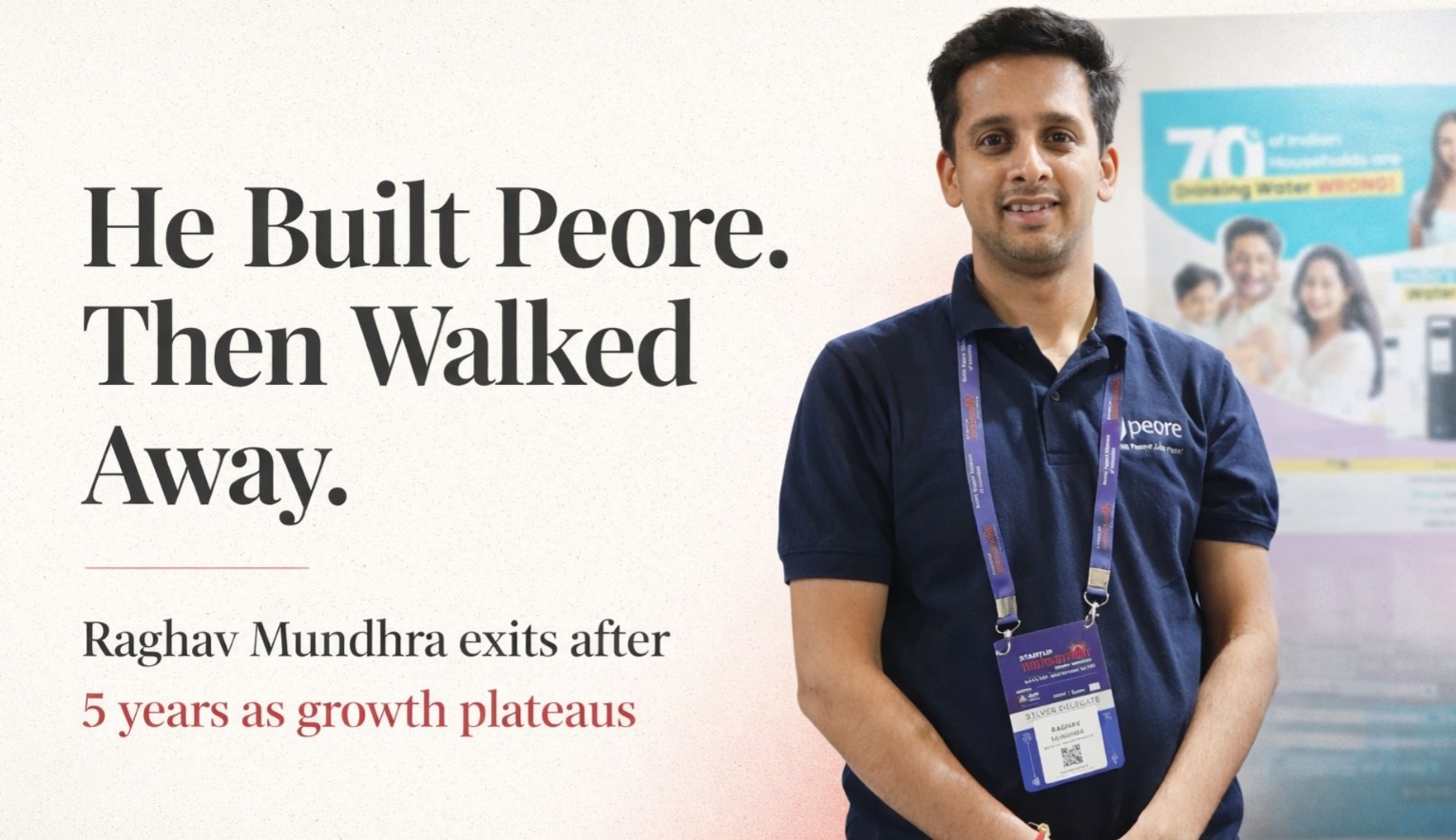
Raghav Mundhra, founder of NF+UV water purifier startup Peore, has officially exited the company after spending nearly five years building the brand in India’s water purification market.
In a detailed personal note reflecting on the decision, Mundhra described the exit as difficult but necessary, saying the company had reached a stage where growth had begun to flatten and the path ahead required a very different scale of capital and distribution.
Peore was started with a sharply defined mission: to build what Mundhra described as a healthier and more sustainable alternative to traditional RO purifiers, while also challenging what he called the widespread mis-selling that exists in the category. By his own account, the company succeeded in delivering on much of that original promise.
Over the course of its journey, Peore built a profitable business from day one, served more than 15,000 families, and saw around 30 per cent of its sales come through referrals. In a market like water purifiers, where customer acquisition is often driven by aggressive selling rather than organic advocacy, that referral figure stands out as a sign of strong user trust and satisfaction.
But the business also ran into a familiar problem faced by niche consumer hardware brands: market education.
According to Mundhra, nanofiltration, or NF, remains a niche technology despite being, in his view, a better fit in many situations than conventional alternatives. The challenge was not only product quality, but consumer understanding. He noted that taking such a technology to the mass market would require significant capital and a much larger distribution engine, advantages that larger players are better placed to deploy. At Peore’s scale, he suggested, the company had largely exhausted the early-adopter segment while the broader market had not expanded quickly enough.
That business reality appears to have coincided with a personal one.
In his statement, Mundhra spoke candidly about the emotional weight of stagnation, describing it as something less visible than failure but just as draining over time. Rather than continuing without conviction, he and the team chose to pursue an exit.
He said the outcome has been positive, adding that Peore has moved into the hands of a more experienced team that can take the brand forward from here. He also emphasized that the company continues to operate, and that customers should not expect any major change in their experience, apart from possible short-term transition-related hiccups.
That message is likely to matter to existing users of the brand, especially in a category where trust, servicing, and after-sales continuity are central to consumer confidence. Mundhra’s reassurance was clear: the brand is still running, the product remains the same, and the transition will be managed as smoothly as possible.
The founder’s farewell note also offered a glimpse into the realities of building in a complex category from scratch. He said he entered the space with no prior knowledge, and described the last five years as the most intense learning experience of his life. Manufacturing, supply chain management, service, hiring, mistakes, and the work of correcting those mistakes all shaped the journey, he wrote.
There was also gratitude, and not just the usual founder sign-off variety. Mundhra acknowledged the people behind the company, including team members, customers, vendors, and service partners. He also made a point to thank critics, noting that some of them became valuable teachers who helped keep the company honest along the way.
That self-awareness gives the exit a tone that is less about celebration and more about closure. This is not a story of a founder claiming to have conquered the market. It is the story of someone recognizing both the value of what was built and the limits of what could be done under the circumstances.
For India’s startup ecosystem, Peore’s journey offers a quieter but important reminder: not every meaningful startup story ends in explosive scale. Some businesses solve a real problem, build a loyal customer base, create a viable model, and then reach a point where the next phase requires a different kind of ownership. In such cases, an exit is not necessarily an ending born of failure. It can also be a handover shaped by timing, market maturity, and founder clarity.
Mundhra, for his part, is not stepping away from entrepreneurship for long. While he said he is taking some time off to spend with family and reset, he also revealed that he is already working on a new venture in the agritech space. He has not disclosed further details yet, but said he has not felt this excited about something in a while.
That leaves Peore at an interesting moment: a founder-led chapter has closed, but the company itself continues. And for Mundhra, the exit appears less like a retreat and more like a transition from one hard-earned chapter to the next.
For now, the message he leaves behind is simple: gratitude for the journey, respect for the people who helped shape it, and optimism that both the brand and the founder still have more ahead.
Also Read: Greenvize Launches Hydrogen Cooktop That Runs on Water