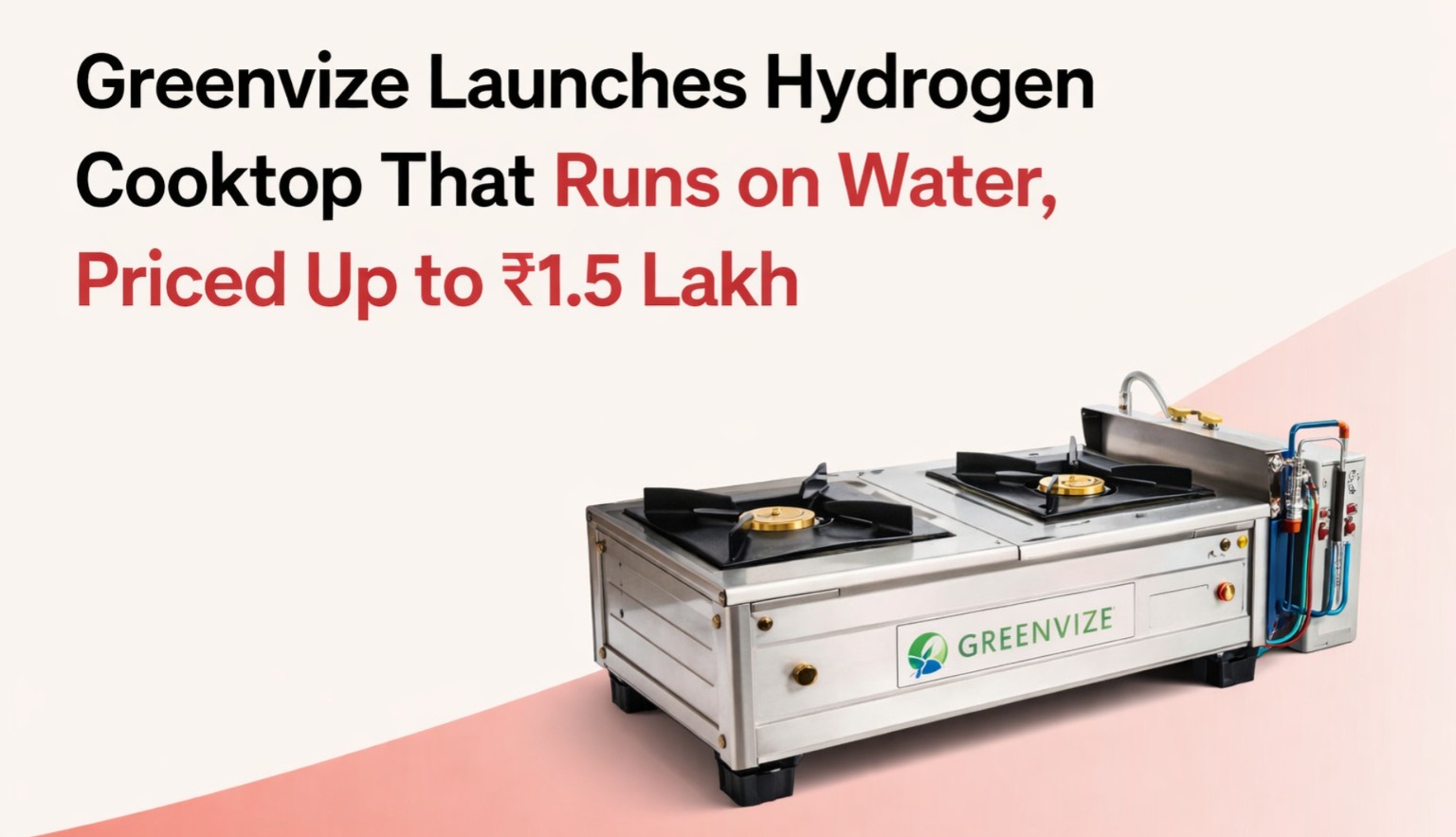
In a country where cooking fuel has long been tied to cylinders, pipelines, and delivery cycles, a new entrant is attempting to rewrite the rules, using nothing more than water and electricity.
Indian startup Greenvize has introduced a hydrogen-powered cooktop that generates its own fuel on-site. At first glance, it looks like a standard kitchen appliance. Underneath, however, it represents a shift in how energy can be produced and consumed inside homes and commercial kitchens.
The premise is simple, but ambitious. Instead of relying on LPG or PNG, the cooktop uses water to produce hydrogen, which is then used as the cooking fuel. The system is built with an integrated proton exchange membrane (PEM) electrolyser, allowing hydrogen to be generated instantly within the unit itself. There is no external fuel storage, no refilling cycle, and no dependence on distribution networks.
Turn the knob, and the process begins. Water molecules are split into hydrogen and oxygen through electrolysis. The hydrogen feeds the flame, while water vapour is released as a by-product and oxygen is emitted into the surrounding environment. The entire cycle happens within the appliance, making it a self-contained system.
That design choice is where the product’s biggest departure lies. Traditional cooking setups in India depend on a supply chain. cylinders that need booking and delivery, or pipelines tied to urban infrastructure. Greenvize’s approach attempts to eliminate that layer entirely, bringing fuel generation directly into the kitchen.
From a technical standpoint, the company claims the appliance requires about 100 ml of water and roughly 1 kilowatt of electricity to deliver up to six hours of continuous cooking. If those numbers hold in everyday conditions, the efficiency argument could become one of its strongest selling points, especially when compared to conventional electric cooking methods that typically consume significantly more power over similar durations.
There is also a sustainability angle built into the product’s design. The system can be paired with rooftop solar installations, opening up the possibility of running the cooktop on renewable energy. In such a setup, cooking could theoretically happen without dependence on grid electricity or fossil fuels, a proposition that aligns with the broader push toward decentralised and clean energy solutions.
For now, however, the product is positioned far from the mass market. Greenvize has launched both single-burner and double-burner variants, priced at approximately ₹1,05,000 and ₹1,50,000 respectively, excluding GST. At that level, the cooktop is likely to find early adopters among commercial kitchens, institutions, or consumers willing to experiment with emerging technologies, rather than everyday households.
Yet, price alone does not define its significance. What this launch represents is a shift in how hydrogen is being introduced into public imagination. For years, hydrogen has largely remained within policy discussions, industrial use cases, and future energy roadmaps. By placing it inside a kitchen appliance, Greenvize is attempting to bring that conversation into daily life.
Whether this remains a niche innovation or evolves into a viable alternative to LPG and PNG will depend on factors that go beyond technology, cost reductions, safety validation, user adoption, and long-term performance in real-world conditions.
For now, the cooktop does not replace existing systems. But it does something equally important: it challenges them.
And in India’s evolving energy landscape, that may be where the real story begins.
Also Read: Seema Ahuja Signs Off from Biocon After Over 15 Years