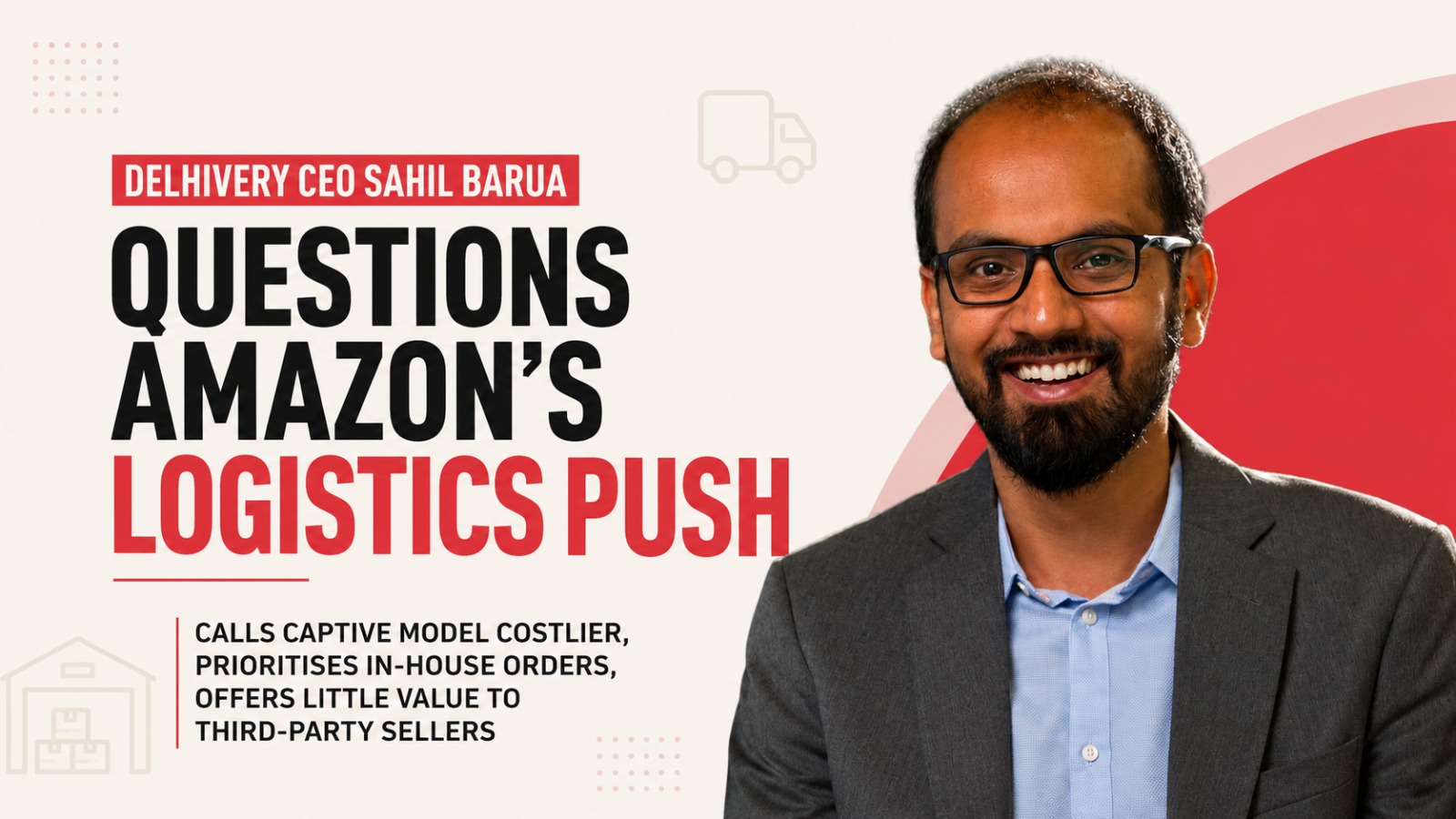
CEO of Delhivery Sahil Barua of is not pleased with Amazon’s efforts to make its logistics chain available to external merchants. He raised doubts about the efficiency of an exclusive delivery chain that mainly caters to its own order fulfillment in providing similar treatment to external vendors.
Amazon recently said businesses would be able to use its warehousing, transportation and delivery network even for orders placed outside its ecommerce marketplace. The move signals Amazon’s intent to widen its logistics and supply-chain play in India, beyond its own platform.
Barua, however, was unconvinced. Speaking during Delhivery’s fourth-quarter earnings call, he described the offering as “an old product in a new wrapper” and argued that first-party logistics is structurally more expensive than third-party logistics. His central concern was simple: when a network is designed around a company’s own shipments, outside sellers may not get the same operational attention.
“When it finally comes down to the process of deciding at the last mile which order has to be delivered, when a rider has to make a choice and is running out of time, the first-party order is of course going to get prioritised over any third party,” Barua said.
That comment goes to the heart of India’s logistics debate. For marketplaces and quick-commerce players, delivery speed is not only a service feature. It is a competitive weapon. But for smaller merchants, reliability, equal treatment and cost efficiency matter just as much. Barua’s argument is that a captive network cannot easily behave like a neutral logistics provider.
He also raised a question of scale. Amazon’s in-house shipment volumes are far larger than what most external businesses would bring to its network. In Barua’s view, that imbalance could make customer service difficult for third-party clients.
“The relative scale of Amazon’s in-house operations compared to any client who onboards themselves into Amazon logistics is going to be absolutely miniscule,” he said. “So how do you get customer service at all?”
The sharpest line came when Barua questioned the strategic value of the move altogether. “This has been tried before and I’m not really certain what strategic value this serves for anyone,” he said, adding, “If only businesses could be built off press releases.”
Amazon’s logistics expansion comes at a time when competition in ecommerce and quick commerce is intensifying. In April, the company announced a Rs 2,800-crore investment to expand its India operations network, including fulfilment centres, sortation hubs, delivery stations and quick-commerce infrastructure. Amazon is also scaling Amazon Now, with plans to expand the quick-commerce service to 100 cities and build more than 1,000 micro-fulfilment centres, as it competes with Blinkit, Zepto and Instamart.
For Delhivery, the timing is important. The company reported a net profit of Rs 73.4 crore in the fourth quarter, compared with Rs 72.6 crore a year earlier. Revenue from operations rose 30 percent sequentially to Rs 2,850 crore. For the full year, Delhivery’s revenue grew nearly 18 percent to Rs 10,508.3 crore, while profit stood at Rs 152.5 crore, down 6 percent from the previous fiscal.
Barua’s comments also reflect a larger tension in India’s delivery economy. Large platforms want to monetise their logistics backbone. Independent logistics companies argue that neutrality remains their biggest advantage. For sellers, the question is not whether a network is large. It is whether it will treat their shipment as important when it competes with the platform’s own order on the same delivery route.
Amazon is betting that its existing infrastructure can become a broader service layer for Indian businesses. Delhivery’s CEO is betting that merchants will still prefer a logistics partner whose core business is serving them, not competing priorities inside a marketplace.
The real test will not be the announcement. It will be the last mile.
Also Read: Who Owns Your Team Now? IPL’s Latest Ownership Breakdown