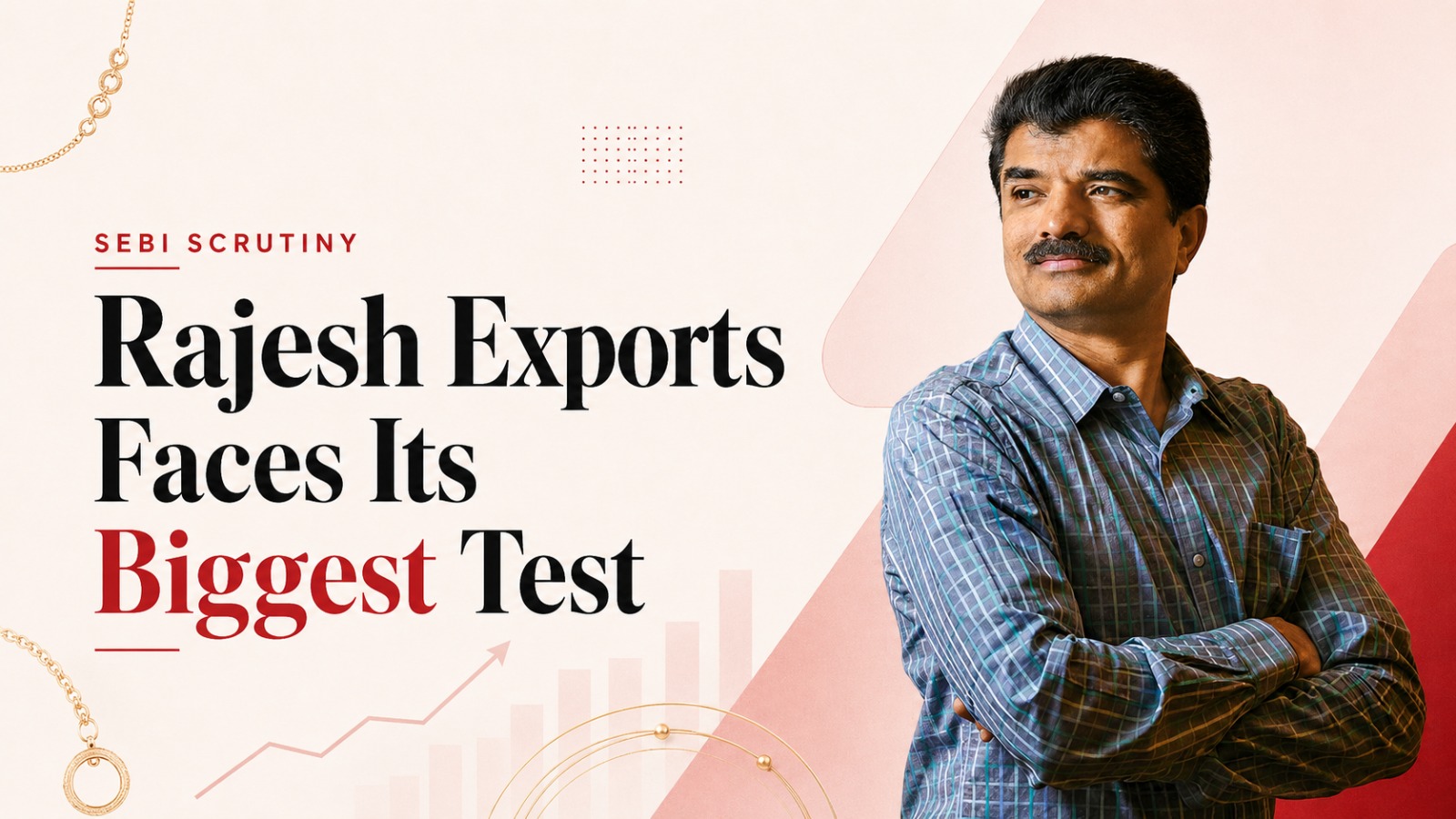
For decades, Rajesh Exports carried the aura of a rare Indian business story: a Bengaluru company that moved from jewellery trading to global precious metals, built a public-market presence, and expanded deep into the gold value chain. Its chairman, Rajesh Mehta, became closely associated with that rise.
The Securities and Exchange Board of India (SEBI) has passed an interim ex-parte order against Rajesh Exports Ltd and its chairman and managing director Rajesh Mehta, alleging large-scale financial misstatement, fund diversion through promoter-linked entities, and serious lapses in corporate governance. At the heart of the matter is a staggering figure: around ₹15.15 lakh crore in consolidated revenues that SEBI has alleged were misrepresented between FY21 and FY25.
The company has rejected the allegations. Mehta has said there is “nothing true” in the interim order and that the company is preparing its response. Rajesh Exports has also told stock exchanges that its declared revenues are correct and described the issue as a “communication gap and confusion” with the regulator.
That leaves investors, regulators and the wider market staring at a high-stakes question: was this one of India’s most remarkable gold-sector growth stories, or did the numbers hide a deeper governance problem?
The order that shook the market
SEBI’s interim order, issued on June 3, does not mark a final finding of guilt. It is an interim action based on prima facie findings. But the scale of what the regulator has alleged is what makes the case so significant.
SEBI has alleged that Rajesh Exports misrepresented consolidated revenues of about ₹15.15 lakh crore between FY21 and FY25. The regulator has also said this represented nearly 99.8 percent of the company’s total reported consolidated revenue during the period.
The concern, therefore, is not about a marginal accounting entry or a disputed line item. It goes to the core of the company’s reported business scale.
The regulator’s case, as reported, points to a multi-year pattern of non-genuine transactions, questionable accounting practices, inadequate disclosures, and routing of company funds through entities linked to the promoter group. SEBI has also alleged instances of routing and layering of funds through personal accounts and related entities without adequate disclosures or supporting documents.
The immediate market reaction was sharp. Shares of Rajesh Exports fell 5 percent on Thursday and hit the lower circuit at ₹103.92 after SEBI barred Mehta from dealing in the company’s securities.
Company denies wrongdoing
Rajesh Exports has taken a firm position that SEBI’s interim order does not contain any adverse conclusion and that the revenues declared by the company are correct. Its clarification to stock exchanges argued that there appears to be confusion between the regulator and the company.
Mehta’s response was even more direct. Speaking after the order, he said it was an interim order and that “nothing in it is true.” He also said the company was studying the order and would prepare a response.
That distinction matters. SEBI has not issued a final adjudication. The company will have the opportunity to respond. But until then, the market is left weighing two competing claims: a regulator alleging massive misrepresentation and a company insisting its numbers are correct.
Why the allegations are unusually serious
Corporate disputes over accounting are not uncommon. What makes this case stand out is the alleged proportion of disputed revenue. SEBI has reportedly observed that about 97 to 99 percent of Rajesh Exports’ revenue was inflated, calling the aberrations egregious and unusual.
The regulator also said the company had been issued repeated summons and given several opportunities to provide true and fair financial statements, complete records explaining end use of funds, business rationale, and ultimate beneficiaries of fund flows. SEBI said it did not receive a satisfactory response.
There is another layer: auditors. SEBI reportedly flagged non-cooperation by the company’s statutory auditors, saying they had promised during deposition to provide audit working papers but later failed to do so. The regulator treated this as part of its concern around suppression of material information and obstruction of regulatory inquiry.
In simple terms, SEBI’s questions appear to be not only about whether revenue was booked correctly, but whether the underlying trail of documents, money movement, business purpose, and beneficiaries can be properly established.
The man at the centre
Rajesh Mehta’s business journey has long been part of Rajesh Exports’ public identity.
Born on June 20, 1964, in Bengaluru, Mehta went to St Joseph’s School. Instead of furthering his studies, he joined his dad’s jewellery biz while still young. In the ’80s, Mehta and his bro Prashant started their own silver jewellery enterprise, borrowing ₹1,200 from their older brother. It flourished in South India first, then expanded to places like Gujarat and Mumbai.
Rajesh Exports entered the capital markets in 1995 through an IPO that raised ₹10 crore. Over the years, the company expanded across refining, manufacturing and retailing. In 2015, it made global headlines by acquiring Swiss precious metals refinery Valcambi for $400 million in an all-cash deal, giving the company a larger international footprint.
That is why the current case has wider resonance. It is not merely about one regulatory order. It challenges the market’s reading of a company that had built its reputation on scale, speed and global ambition.
Why investors are watching closely
The case has also drawn attention because Rajesh Exports is not an obscure listed company. It has been a visible name in the jewellery and precious metals space. The Economic Times reported that Life Insurance Corporation of India held a 10.80 percent stake in the company,
That makes the issue relevant beyond traders tracking one stock. If SEBI’s concerns are eventually upheld, it would raise difficult questions about financial reporting, auditor responsibility, investor diligence and the ability of the market to detect large-scale accounting gaps in companies with complex operating structures.
At the same time, the company’s denial cannot be ignored. Rajesh Exports has said its revenues are correct. Mehta has rejected the order’s claims. The next stage will depend on the company’s formal response, the evidence it produces, and how SEBI evaluates that material.
The larger governance question
The Rajesh Exports case cuts to a basic but often overlooked question in corporate India: how much of a company’s reported scale can be independently traced?
In the gold biz, big volumes and thin margins are the norm. Deals cross lots of places too. So, verifying docs is super important. Just knowing profits isn’t enough. Investors need to ensure sales are real, with actual deals, goods moving, money flowing right, and honest info given.
That is why SEBI’s allegations, even at an interim stage, are serious. They suggest a possible gap between reported revenue and revenue that could be verified. Rajesh Exports says that gap does not exist and that the regulator has misunderstood the facts. The matter now turns on documentation.
For now, SEBI’s order restrains Rajesh Mehta from buying, selling or dealing in the securities of Rajesh Exports, directly or indirectly, until further orders. The company is expected to respond to the regulator’s findings.
The next phase will likely determine whether this remains a fierce regulatory dispute or becomes a landmark corporate governance case. If Rajesh Exports can substantiate its revenue numbers and fund flows, it may contain the damage. If it cannot, the consequences could stretch well beyond one promoter and one company.
Either way, the shine has dimmed for now. A business once celebrated for its reach in gold is now being asked to do something far more basic: show the trail behind the numbers.
Also Read: Who Owns Your Team Now? IPL’s Latest Ownership Breakdown