In a move that could reshape how young founders in India access global startup opportunities, Y Combinator has partnered with Polaris School of Technology and Emergent to launch what is being positioned as a new student-focused entry route into the accelerator’s ecosystem in India.
This program, known as the Vibecon Student Track, takes a build-first approach, unlike other programs which rely heavily on applications to select their candidates. It is simple and yet effective: find those student teams who can develop fast, reason fast, and work under pressure.
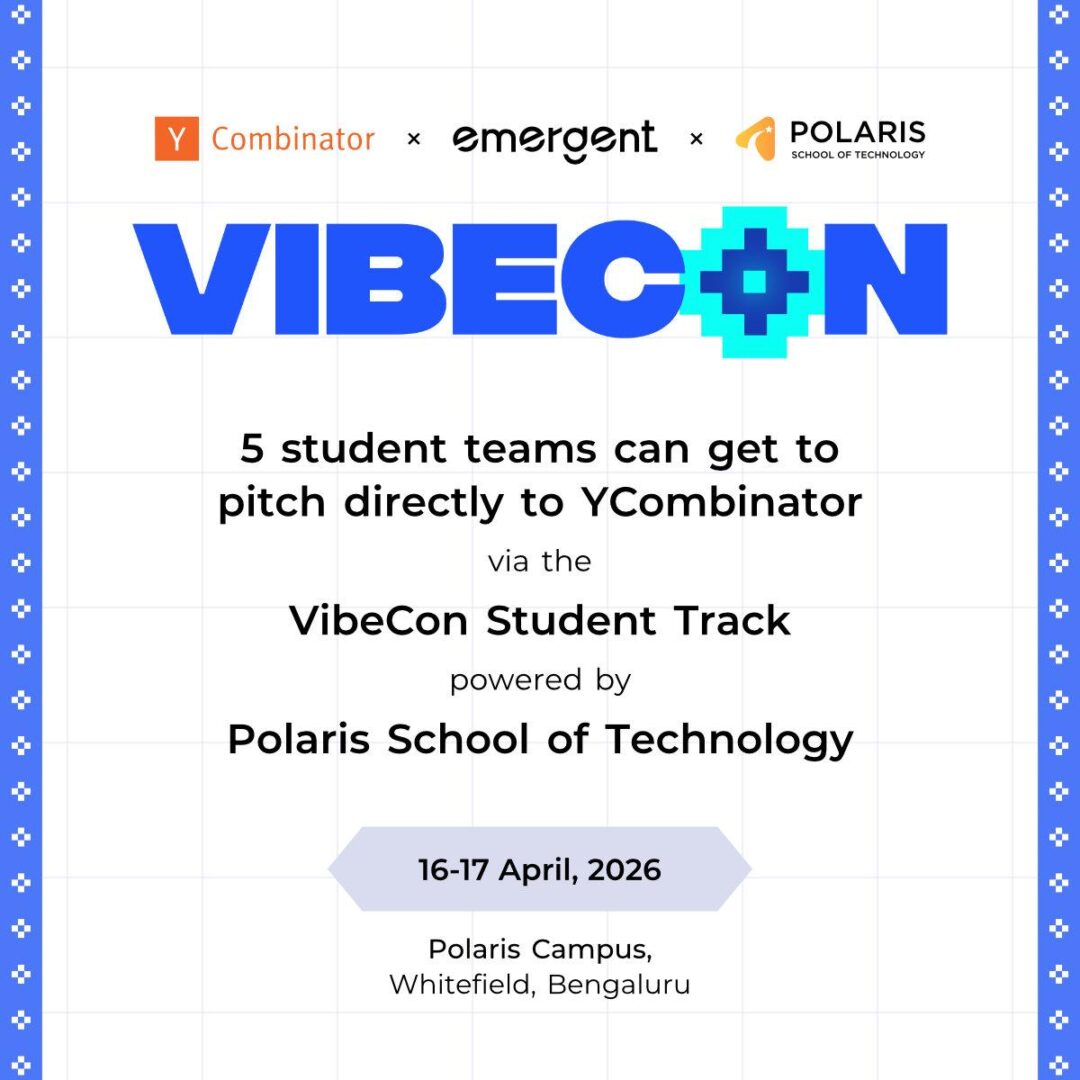
According to the announcement, students from across India are applying in teams of two to three by posting short pitches on social platforms, explaining the problem they want to solve and how they plan to build on the Emergent platform.
What makes this development stand out is not just the Y Combinator name, but the signal it sends about where India’s startup pipeline may be headed next. For years, access to elite startup networks often seemed tied to established credentials, geography, or prior visibility. This collaboration appears to be betting on a different filter: raw building ability.
From the reported applicant pool, only five teams will be shortlisted for the final round, which is scheduled to take place at the Polaris campus in Bengaluru on April 16 and 17, 2026. There, finalists will go through a live, high-intensity building sprint before presenting to a judging panel that includes representatives from YC and well-known operators from the startup ecosystem.
The announced panel includes Mukund Jha, CEO of Emergent; Mukul Rustagi, co-founder of Polaris School of Technology and Classplus; Shashank Kumar, co-founder of Razorpay; and Hemant Mohapatra, Partner at Lightspeed, among others.
The biggest draw, naturally, is the prize at the end. The winning team will receive an opportunity to directly interview with YC partners for an upcoming cohort, effectively skipping the traditional global application route. The top three teams will also share $10,000 in cash prizes, along with more than $10,000 in tools and cloud credits from partners including AWS, Anthropic, and Razorpay.
This is significant for sure. However, the real essence of the story is quite different. It is about the confidence being gained by India’s student builder community as a whole, particularly those institutions and forums who wish to support implementation over lineage. From this perspective, Polaris is more than a mere partner organization.
The institution has been described as a skills-first computer science programme built around the idea of “building skills over theory.” The release says Polaris offers a four-year programme in Bengaluru, a 200,000 sq ft residential campus, and specialised tracks including Applied AI, Product Management & Engineering, and Cloud & Big Data Engineering. It also says the curriculum includes live projects, dedicated mentors, 5,000 hours of coding, and internships beginning in the first year.
The announcement further states that Polaris students have seen early visibility in international programmes such as Google Summer of Code and Summer of Bitcoin, and that more than 40% of its interning students last year worked with global organisations. That claim, if viewed in the context of the institution’s positioning, helps explain why Polaris has been chosen as the on-ground base for this student track.
Mukul Rustagi, co-founder of Polaris School of Technology, framed the moment in symbolic terms. “By bringing YC directly to our campus, we are proving that the distance between a dorm room in India and the world’s most prestigious accelerator is no longer thousands of miles, it’s a single afternoon of building,” he said.
That line captures the pitch of the collaboration neatly. It is not selling a classroom programme or a conventional startup contest. It is selling proximity, the idea that globally relevant startup access can now be compressed into a direct, live test of talent on Indian soil.
The timing is also notable. India’s startup ecosystem has matured enough to produce repeat founders, unicorns, and global tech talent at scale. But pathways for undergraduate builders, especially those outside the usual elite circuits, have remained uneven. A format like this attempts to shorten that distance by creating a real-time proving ground rather than another slow-moving funnel.
Polaris, YC, and Emergent appear to be making a joint statement here: that the next breakout founder may not emerge through academic rank, résumé signaling, or polished pitch decks alone, but through the ability to build something useful, quickly, and under scrutiny.
Whether this becomes a one-off experiment or the beginning of a larger student-founder pipeline remains to be seen. But as an idea, it is already significant. It suggests that in India’s fast-changing startup landscape, credibility may increasingly come from demonstrated output rather than inherited filters.
And that may be the most important takeaway from this announcement. For a generation of young builders, especially those still in college, the message is becoming clearer: the gap between ambition and opportunity is narrowing, and the test is no longer only what you know, but what you can build when the clock starts.
Also Read: Greenvize Launches Hydrogen Cooktop That Runs on Water