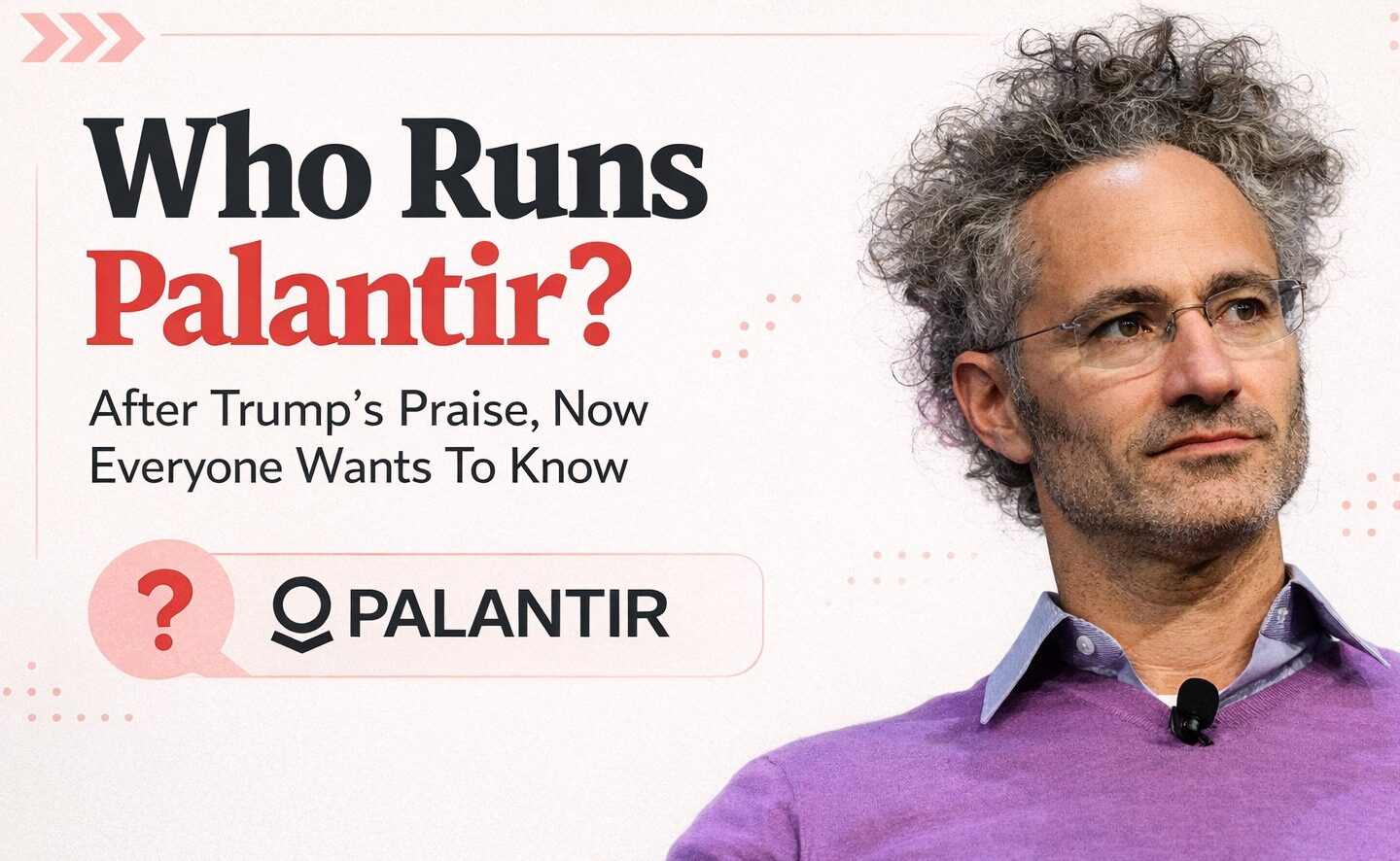
When Donald Trump praised Palantir Technologies on Truth Social this week, many people outside the worlds of defense, investing, and Silicon Valley were left asking the same question: who runs this company now at the center of political attention?
The answer is Alex Karp, one of the most unusual chief executives in modern tech.
Trump’s Post Brings Fresh Attention to Palantir
Trump’s message arrived during a difficult week for Palantir’s stock, which reportedly suffered its sharpest weekly decline in about a year. Even so, the former president praised the company’s military capabilities and highlighted its role in national security.
The post quickly sparked debate. Critics questioned whether public praise for a listed company, especially one with strong government ties, could influence investors or create ethical concerns.
That reaction also reflected Palantir’s growing prominence in Washington. The company has become one of the best-known software contractors serving U.S. defense and security agencies, making it far more visible than it was in its early years.
Also Read: Vaibhav Suryavanshi’s Rise Is Bigger Than a Net-Worth Number
A CEO Who Never Fit the Silicon Valley Mold
Alex Karp does not resemble the typical image of a technology executive.
Known for his unconventional style, Karp has often presented himself as an intellectual outsider rather than a corporate operator. He studied philosophy before attending law school, then went on to complete a doctorate in social theory at Goethe University in Frankfurt, Germany.
That academic path set him apart from many tech founders who followed more traditional business or engineering routes.
Karp has also spoken publicly about personal challenges, including dyslexia, and has said those experiences shaped how he thinks about problem-solving and leadership. Over the years, he has built a reputation for blunt commentary, unusual interviews, and a willingness to reject Silicon Valley conventions.
How Palantir Was Built
Palantir was founded in 2003 by Alex Karp, Peter Thiel, Joe Lonsdale, Stephen Cohen, and Nathan Gettings. The company’s original goal was to create software that could help organizations understand massive and complex datasets.
Its early development received backing from In-Q-Tel, the investment arm associated with the CIA. That connection helped establish Palantir’s first major customer base among intelligence and defense agencies.
For years, the company operated with relatively little public attention while supplying data analysis tools for sensitive government work. Over time, however, Palantir expanded beyond intelligence operations and entered commercial industries such as healthcare, manufacturing, energy, and aviation.
Today, its customers include government agencies and major private companies across multiple sectors.
Strong Growth Driven by AI Expansion
Palantir’s profile has risen sharply alongside the global race to adopt artificial intelligence.
The company reported 2024 revenue of about $2.87 billion, with continued growth in both government and commercial business lines. Executives have credited demand for Palantir’s AI products as a major growth driver.
Investors have increasingly viewed the company as a key player in enterprise AI, particularly because Palantir focuses on helping institutions apply AI tools to real-world operations rather than building consumer apps.
That positioning has helped move the company from a niche contractor to a widely watched public business.
Politics, Power, and Controversy
Karp’s leadership has also generated criticism.
Palantir has faced scrutiny over contracts involving surveillance, immigration enforcement, and military operations. Supporters argue the company provides tools that help democratic governments respond to serious threats. Critics counter that such technologies can be misused or expand state power too far.
Karp himself has often defended the company’s mission in ideological terms, saying advanced technology should be controlled by democratic nations rather than authoritarian rivals.
His own political positioning has sometimes appeared complex. Though he has previously been linked with Democratic causes, he has also aligned with priorities that overlap with the current conservative national security agenda.
Why Alex Karp Matters Now
Karp spent years leading a company that remained largely behind the scenes. That has changed.
As artificial intelligence becomes more important to governments, militaries, and corporations, Palantir now sits at the intersection of technology, politics, and global security. Trump’s public endorsement only intensified that spotlight.
Whether people view Alex Karp as a visionary builder or a controversial power broker, one thing is clear: he is no longer a little-known executive in a quiet corner of tech. He is now one of the most closely watched figures in the AI era.
Also Read: Greenvize Launches Hydrogen Cooktop That Runs on Water