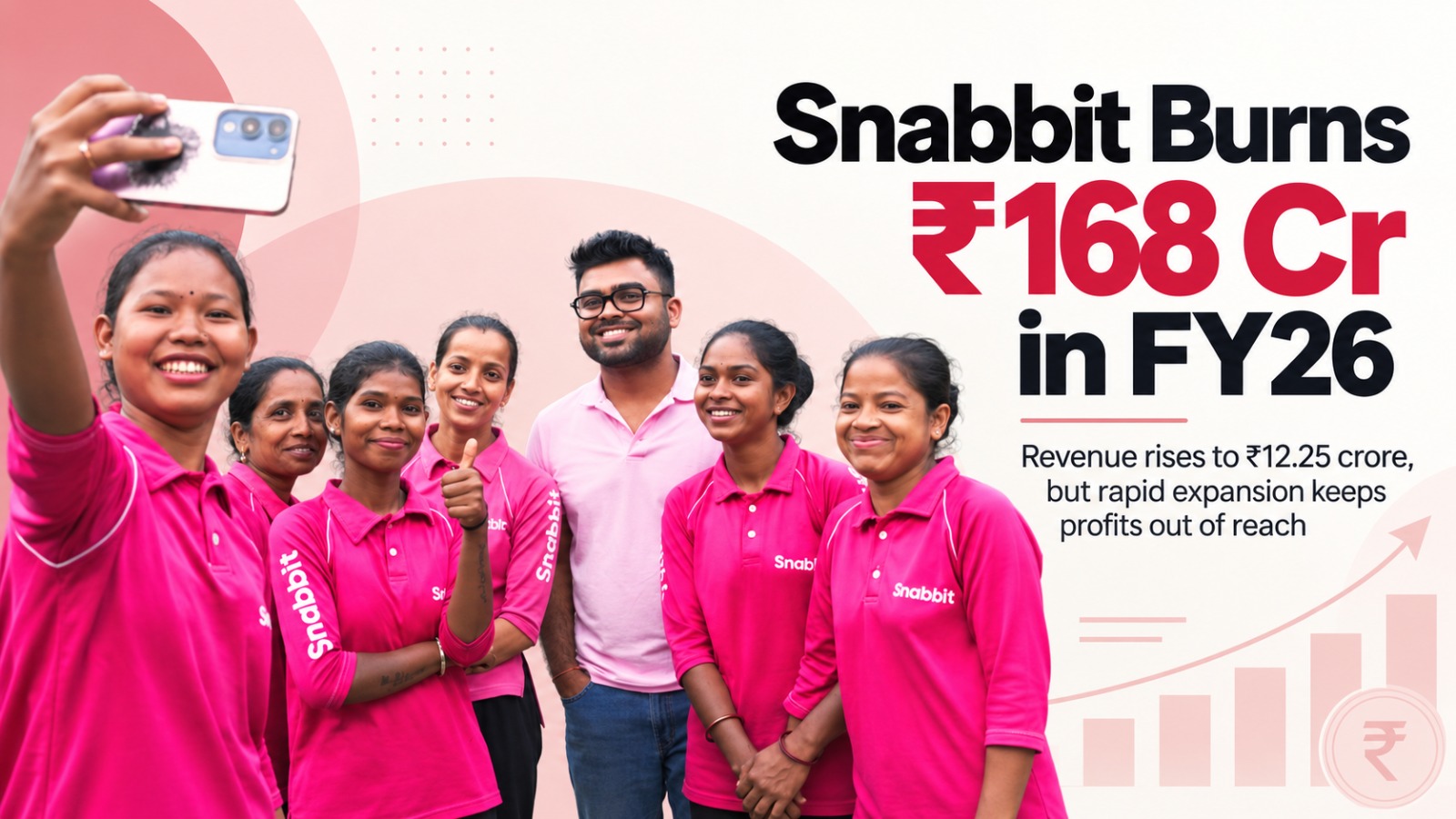
Snabbit‘s revenue surged to Rs 12.25 crore in FY26, but its expenses climbed to Rs 195 crore. With heavy spending on workers, marketing and service delivery, the bigger question is whether rapid growth can translate into a sustainable business.
Quick home services startup Snabbit is growing fast, but the cost of that growth is proving expensive. The company reported a net loss of nearly Rs 168 crore in FY26 against operating revenue of just Rs 12.25 crore, raising questions about the economics of delivering household services within minutes.
The Aayush Agarwal-led startup had reported revenue of Rs 26 lakh and a loss of Rs 5.7 crore in FY25. In FY26, its expenses jumped to Rs 195 crore from Rs 6.8 crore, reflecting an aggressive push to acquire customers, recruit service professionals and expand into new neighbourhoods.
Attracting customers through convenience and aggressive pricing is one thing, but making those transactions profitable is another.
Snabbit Spends Nearly Rs 16 to Earn Rs 1
The gap between Snabbit’s revenue and expenditure is difficult to ignore.
For every rupee of operating revenue generated in FY26, the company spent approximately Rs 15.92. Its operating revenue of Rs 12.25 crore was also lower than the Rs 14.76 crore it earned through other income, largely interest on bank deposits.
Of its operating revenue, Rs 10.82 crore came from services, while the remainder was generated through uniform sales.
A closer look at the expenditure reveals where the money went. Snabbit spent Rs 63 crore on expert services, Rs 49 crore on marketing, Rs 46 crore on employee benefits and another Rs 23.8 crore on service fulfilment.
These four expense categories alone amounted to Rs 181.8 crore, nearly 15 times the company’s operating revenue.
The numbers point to a business still spending heavily to build both sides of its platform. Snabbit needs enough customers to keep service professionals occupied, while also maintaining sufficient worker availability to fulfil bookings quickly.
That balancing act becomes more difficult when customers expect domestic help at short notice and at affordable prices.
The Hidden Cost of Cheap, On-Demand Househelp
Quick home services platforms are attempting to bring the convenience of instant delivery to domestic chores such as cleaning, dishwashing and laundry.
But unlike delivering groceries from a nearby warehouse, completing a household task requires a person to travel to the customer’s home, perform the work and become available for the next assignment.
That creates a different cost structure.
A service professional can handle only a limited number of assignments in a day. Travel time, gaps between bookings and uneven demand across neighbourhoods can all affect productivity. Platforms promising service within minutes must also maintain adequate worker availability, even when demand is unpredictable.
Aggressive discounts and unusually low introductory prices can make these services attractive to first-time users, but they can also increase the amount a platform effectively spends to acquire and serve each customer.
Importantly, Snabbit’s reported financial figures do not disclose how much of its FY26 losses came specifically from discounts, free services or promotional pricing. It would therefore be inaccurate to attribute the entire loss to cheap bookings.
Nevertheless, its substantial marketing and fulfilment expenses underline the cost of expanding a convenience-led business before it reaches sufficient operating efficiency.
The key question is whether customers acquired through low-cost offers will continue booking once promotional incentives are reduced and prices move closer to the actual cost of delivering the service.
Daily Jobs Jump 70-Fold, but Growth Has Come at a Price
Snabbit’s operating performance tells a considerably stronger story than its financial results.
According to founder Aayush Agarwal, the startup began FY26 with around 500 daily jobs across eight micro-markets. By the end of the financial year, that figure had increased to approximately 35,000 daily jobs across more than 100 micro-markets.
The company also reported acquiring nearly one million customers during the year.
Momentum reportedly continued into FY27, with Snabbit crossing 115,000 fulfilled jobs in a single day and completing more than four million househelp jobs during the first quarter.
Snabbit has also claimed that its burn per job fell by more than Rs 100 during Q1 FY27 to below Rs 250.
That reduction suggests improving operating efficiency, although the company has not provided enough details in the reported figures to determine how close individual bookings are to profitability.
Agarwal claimed that FY26 marked the company’s first full year of operation, and that the Rs 167.8 crore loss occurred due to investments made to expand, acquire customers and service professionals, and build capabilities. It is also worth noting that the numbers presented did not capture the improvements in the company’s efficiency thereafter.
A rapidly expanding startup can report heavy annual losses while improving its economics over time. However, those improvements must eventually become visible in its financial performance.
Urban Company, Pronto and Snabbit Face the Same Test
The spending race is not limited to Snabbit.
Urban Company’s InstaHelp and Pronto are also competing for customers in the emerging quick home services segment, where speed, availability and pricing have become important differentiators.
In July 2026, InstaHelp completed approximately 1.9 million orders, marginally ahead of Snabbit’s 1.85 million. Pronto crossed 1.25 million bookings during the month.
A platform can increase its booking numbers through advertising, promotional offers and geographic expansion. Whether those customers return frequently enough, and pay enough, to cover the cost of servicing them is a separate issue.
The competitive pressure could also make it difficult for platforms to reduce promotional spending or increase prices without risking customers switching to alternatives.
For a labour-intensive service, there is another constraint. Unlike software platforms, which can often serve additional customers at relatively low incremental costs, home services businesses must continue paying for the human work involved in each assignment.
Technology can improve matching, scheduling and utilisation, but it cannot eliminate the underlying cost of labour.
Can Snabbit Reduce Its Dependence on Investor Capital?
Snabbit has raised more than $112 million, including a $56 million Series D round backed by Susquehanna VC, Elevation Venture Investments and Bertelsmann India Investments.
That funding has supported a period of rapid expansion, but the reported financial results show how capital-intensive the business has become.
The challenge is not necessarily the size of the FY26 loss in isolation.
Startups usually find themselves spending more than what they earn as they venture into different markets. The issue here lies with the large discrepancy between earnings and expenses, and how soon that discrepancy will be resolved.
The company’s ability to improve worker utilisation, increase repeat bookings, control marketing expenses and establish pricing that customers are willing to pay without recurring incentives will be central to its next phase.
For now, Snabbit has demonstrated that there is demand for household assistance delivered through an app. What its FY26 numbers have not yet demonstrated is that the demand can be served profitably at scale.
In a market where companies are racing to make domestic help faster and cheaper, the eventual winner may not be the platform processing the most bookings, but the one that can fulfil them without consistently losing money.
Also Read: Elon Musk’s 2019 Tesla Roadster Prediction Comes to Life in 2026