Elon Musk’s long-awaited Tesla Roadster has finally made its flying debut, using SpaceX-developed thrusters to leap into the air and perform a midair flip. But can it really fly like an aircraft, and when will customers be able to buy one? Here’s everything you need to know.
Tesla has finally shown the world what Elon Musk meant when he repeatedly hinted at a car that could fly. At a spectacular unveiling on October 15, 2026, the electric vehicle maker demonstrated a new-generation Roadster prototype that climbed a towering curved ramp, turned upside down, launched itself into the air and landed using a system of compressed-air thrusters.
The event took place at SpaceX’s testing facility in McGregor, Texas, nearly nine years after Tesla first introduced the second-generation Roadster concept in 2017.
But flying was only part of the spectacle. Tesla also demonstrated an extraordinary acceleration run, claiming the Roadster could reach 60 miles per hour (approximately 97 km/h) from a standstill in just 0.81 seconds.
The unveiling has revived excitement around one of Tesla’s most delayed projects. It has also raised an important question: Has Tesla actually built a flying car, or has it demonstrated an exceptionally powerful electric sports car capable of brief, controlled jumps?
Tesla is now targeting 2028 for production.
What happened at the Tesla Roadster unveiling?
The highlight of the event was a demonstration that looked more like a movie stunt than a conventional car launch.
A Roadster prototype drove up a steep, curved structure using a fan-powered suction system that kept it attached to the surface even as the vehicle turned upside down. Once it reached the upper section, its thrusters propelled it away from the ramp.
The car then performed a barrel roll before descending and landing in a cloud of white vapour.
In another demonstration, the Roadster jumped over a lineup of Tesla vehicles and a semi-truck. Tesla also showed the prototype accelerating with assistance from rear-mounted thrusters.
There was no human driver inside the vehicle during the flying demonstration.
Musk acknowledged the risks involved in the stunt, telling the audience that success was not guaranteed. The demonstration was conducted without an occupant for safety reasons.
The event was livestreamed on X and attended by a select audience of fans, investors and media representatives.
“Turns out the future does have flying cars,” Musk declared during the unveiling.
However, the demonstrations took place under controlled conditions. It did not establish that the Roadster can undertake extended flights or operate as a conventional aircraft.
How does the Tesla Roadster flying car actually work?
Unlike flying vehicles that rely on propellers or wings to generate lift, Tesla’s new Roadster uses compressed-air propulsion alongside an unusual aerodynamic system.
The technology combines two main features: a suction system beneath the vehicle and thrusters developed through Tesla’s collaboration with SpaceX.
The suction system
Tesla says the Roadster uses powerful fans beneath its body to create suction, helping the car remain attached to the driving surface.
The company claims the system can generate suction equivalent to 2g, enabling the prototype to travel along the sharply curved demonstration ramp, including its inverted section.
The system also has separate operating modes designed to improve traction at lower speeds and manage airflow beneath the vehicle during high-speed driving.
The SpaceX thrusters
The second major technology is a collection of cold-gas thrusters powered by ultra-high-pressure air tanks.
These thrusters release pressurised gas to generate force, helping the vehicle accelerate, lift off and control its movement while airborne.
Tesla says the system can recharge its compressed-air supply onboard.
The Roadster reportedly uses 10 nozzles, while the flying demonstration involved a thrust system said to generate more than 80 kilonewtons of force.
The important distinction is that the car does not need conventional jet fuel to power these thrusters.
Tesla is effectively combining an electric sports car with propulsion technology designed to produce bursts of force beyond what the tyres alone can deliver.
How fast is the new Tesla Roadster?
The Roadster’s acceleration figures were nearly as dramatic as its flight demonstration.
During the launch event, Tesla conducted multiple acceleration tests using the vehicle’s rear-mounted thrusters.
The first run was reported at approximately one second for the sprint from zero to 60 mph.
A subsequent run produced a claimed time of just 0.81 seconds.
Musk suggested the company could eventually improve on that figure.
Tesla also claims the new Roadster will be capable of exceeding 230 mph, or approximately 370 km/h. Musk went further, discussing an ambition to approach 383 mph, roughly half the speed of sound.
However, the 383 mph figure is a development ambition rather than a demonstrated performance result.
The 0.81-second acceleration figure was presented during Tesla’s own event and has not been established here through independent testing.
Tesla Roadster 2026: Key specifications and launch details
| Feature | Details |
|---|---|
| Vehicle | Second-generation Tesla Roadster |
| Unveiling date | October 15, 2026 |
| Location | SpaceX facility, McGregor, Texas |
| Seating | Two seats in the displayed Roadster |
| Acceleration | Claimed 0 to 60 mph in 0.81 seconds |
| Top speed | More than 230 mph, according to Musk |
| Propulsion technology | Electric drivetrain with compressed-air thrusters |
| Flight demonstration | Short airborne manoeuvres and controlled landings |
| Production target | 2028 |
| Final selling price | Not announced |
These figures describe Tesla’s prototype demonstrations and announced plans.
Is the Tesla Roadster really a flying car?
This is where the excitement surrounding the launch needs some perspective.
Tesla has demonstrated that its Roadster prototype can leave the ground, move through the air, perform a manoeuvre and land.
What it has not demonstrated is sustained flight over meaningful distances.
That difference separates a vehicle capable of making a powered jump from one that can function as an aircraft.
Aircraft must maintain lift, remain stable and control their movement throughout flight. For a vehicle designed primarily to operate on roads, achieving all three presents substantial engineering challenges.
Roger Conner, curator for vertical flight at the Smithsonian’s National Air and Space Museum, raised concerns about the compromises involved in combining an aircraft and a road vehicle.
Cars require structures such as bumpers and crumple zones, while aircraft are particularly sensitive to additional weight.
Conner also questioned whether the Roadster’s abilities amounted to sustained flight, describing the concept as closer to hopping.
There are other companies developing vehicles capable of vertical takeoff and landing, including California-based Alef Aeronautics. But their designs and methods of generating lift differ from Tesla’s approach.
For now, the Roadster’s demonstration is best understood as a successful showcase of short-duration airborne capability, rather than proof that Tesla has developed a road car capable of travelling through the sky like an aircraft.
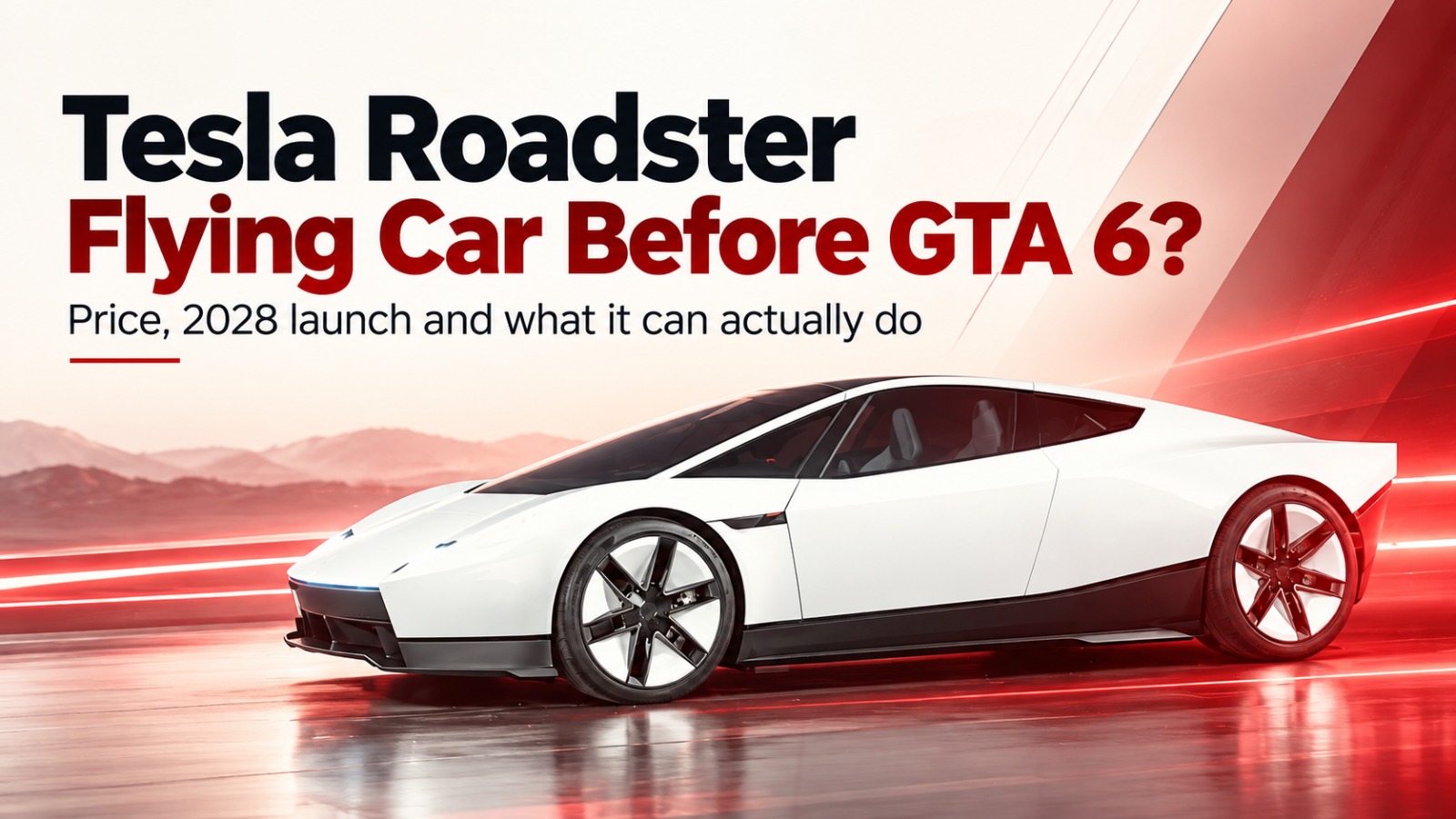
What does the new Tesla Roadster look like?
The redesigned Roadster marks a significant departure from the rounded styling of Tesla’s earlier sports-car concept.
The new vehicle has a low, wedge-shaped profile, sharp body lines and a futuristic appearance inspired, according to Tesla, by aircraft such as the SR-71 Blackbird.
A large active rear wing is among its most noticeable features.
Tesla says the wing can automatically adjust its angle and operate in high-drag and high-downforce modes, depending on the vehicle’s requirements.
Inside, the Roadster features a two-seat cabin, butterfly-style doors, a yoke-shaped steering wheel and a large horizontally mounted display.
The cabin follows Tesla’s preference for a relatively minimalist interior, although the company has not provided a complete breakdown of its production equipment.
One interesting detail from the unveiling is that the Roadster used for the aerial stunts was visibly different from the vehicle displayed on stage.
The stunt prototype had wheel covers resembling those seen on other futuristic Tesla vehicles, while the display car featured more elaborately styled wheels.
That leaves open the question of how closely the demonstration vehicle resembles the Roadster customers will eventually receive.
What will the Tesla Roadster cost?
Tesla did not announce a final selling price during the October 15 unveiling.
When the second-generation Roadster was originally presented in 2017, the company quoted a starting price of $200,000.
The reservation information reported after the latest event indicates that Tesla is offering different configurations with substantially different reservation payments.
- Roadster Performance: $50,000 reservation payment.
- Roadster Thrust: $250,000 reservation payment, with acceleration thrusters.
- Roadster Rocket: An invite-only, single-seat version described as having a full flight system.
These amounts are reservation payments, not confirmed final purchase prices.
The Rocket version is particularly notable because it suggests Tesla may distinguish between a road-focused performance car and a more specialised variant designed for flight-related capabilities.
When will the Tesla Roadster go on sale?
Tesla is now targeting 2028 for the start of Roadster production.
It is an important announcement, but one that comes with considerable history.
The second-generation Roadster was originally unveiled in 2017, when Tesla indicated that deliveries would begin in 2020.
That deadline passed without the promised production launch.
The latest unveiling has at least brought a new demonstration prototype into public view, but Tesla has not established when customer deliveries will actually begin.
Musk said the Roadster would be a vehicle that customers could own and drive on public roads. He also acknowledged uncertainty about whether its capabilities would be legal in every jurisdiction.
Can you legally drive or fly the Tesla Roadster?
Tesla has not demonstrated that the Roadster’s airborne capabilities are approved for public use.
The ability to perform a controlled stunt at a private testing facility does not automatically establish permission to use the same technology on public roads or in shared airspace.
Musk himself acknowledged that the vehicle might not be legal in every jurisdiction.
It is also unclear whether the eventual production Roadster will allow owners to activate its full thrust capabilities in ordinary driving conditions.
Questions concerning vehicle safety, permitted operating environments and aviation-related approvals will need to be resolved before Tesla’s flying-car ambitions can become a practical consumer product.
Why is the new Roadster important for Tesla?
The Roadster occupies a different position in Tesla’s lineup from its mainstream electric vehicles.
It is designed to showcase performance rather than serve as an everyday family car.
That explains why Tesla has concentrated on acceleration, unusual aerodynamics and dramatic demonstrations rather than conventional measures such as passenger space or practicality.
The SpaceX connection also distinguishes the project from ordinary electric performance cars.
By incorporating compressed-air thrusters, Tesla is attempting to extend vehicle performance beyond the limits imposed by tyre traction alone.
During the event, Musk suggested that the Roadster could eventually become Tesla’s only manually driven vehicle, reflecting his broader ambitions for autonomous driving across the rest of its lineup.
That remains a statement about the company’s intended direction, not confirmation of a future product strategy already achieved.
What happens next?
The Roadster has now moved beyond its original 2017 concept presentation, but several important questions remain.
Tesla still needs to establish whether the performance demonstrated by its prototype can be reliably reproduced in a customer vehicle.
Independent acceleration testing, further flight demonstrations, final pricing, production specifications and regulatory clarity will all be important in determining what the Roadster ultimately becomes.
Musk has promised additional live demonstrations, which could provide a clearer picture of the car’s capabilities.
Has Tesla finally delivered the flying car?
Tesla’s October 15 unveiling delivered something unusual: a Roadster prototype that could drive upside down, launch into the air, perform a midair manoeuvre and land using compressed-air thrusters.
It also introduced an astonishing claimed acceleration figure of 0.81 seconds from zero to 60 mph.
But calling it a fully functional flying car would be premature.
The Roadster has shown it can get airborne. It has not yet proved it can sustain practical flight, nor has Tesla established that the technology will be available for unrestricted use by customers.
With production targeted for 2028, the real challenge begins now.
Tesla has demonstrated that its Roadster can leave the road. The next question is whether it can turn that achievement into a car people can actually buy, drive and safely use.
Also Read: Tesla Driver-Assist Was Active Before Fatal New Jersey Crash, Filing Reveals