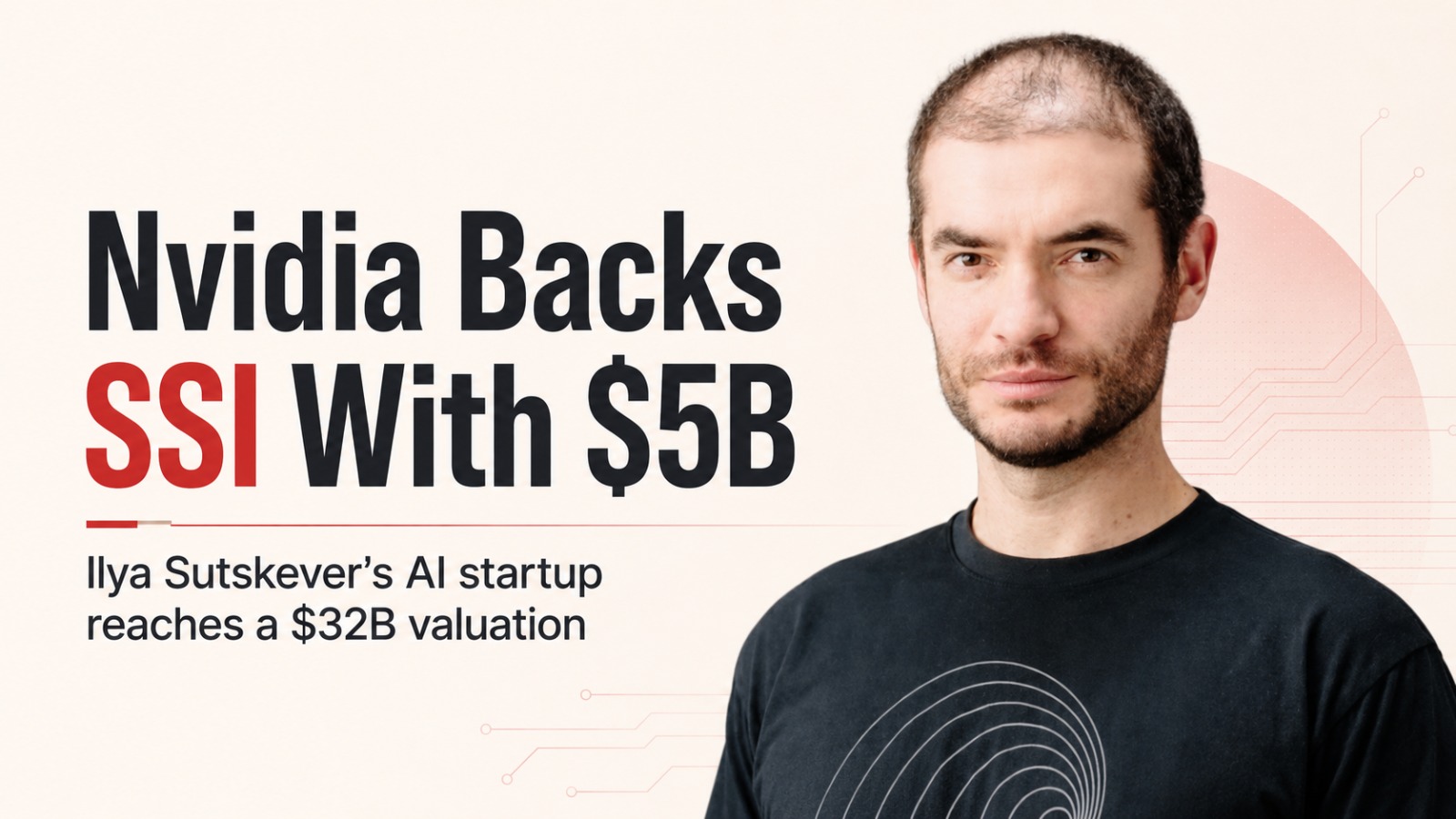
Nvidia has committed $5 billion to Safe Superintelligence Inc. (SSI), the artificial intelligence startup founded by former OpenAI chief scientist and co-founder Ilya Sutskever, in a deal that values the company at $32 billion.
The size of the investment is striking for one simple reason. SSI has not released a commercial product, published research papers or disclosed revenue since it was launched in 2024. Instead, the company has kept its attention firmly on the long-term pursuit of what it calls safe superintelligence.
For Nvidia, the deal is more than a conventional startup investment. It places the chipmaker alongside a highly secretive AI research company while also giving SSI access to substantially more computing capacity.
SSI takes a research-first route
Safe Superintelligence was established in 2024 by Ilya Sutskever, who previously served as OpenAI’s chief scientist.
Unlike AI companies racing to release chatbots, applications and commercial platforms, SSI has chosen a very different path. It has said little publicly about its technology roadmap and has not introduced a chatbot, AI platform or commercial service.
That makes its valuation unusual by traditional startup standards.
Young companies are commonly judged on factors such as customers, revenue growth, market demand and product performance. SSI currently offers investors little of that publicly. Its valuation instead rests heavily on the strength of its research team, Sutskever’s standing in artificial intelligence and expectations about what the company might eventually build.
Following the Nvidia deal, SSI’s total funding stands at approximately $7 billion, with the company carrying a $32 billion post-money valuation.
Nvidia is also putting computing power behind the bet
The relationship between Nvidia and SSI is not limited to capital.
SSI is set to gain access to Nvidia’s next-generation Vera Rubin computing systems, while the two companies have said SSI’s available computing capacity will increase tenfold over the next year.
That computing access is particularly important for a company trying to build advanced AI systems.
Training increasingly powerful models requires specialised AI chips, large data centres, significant electricity and supporting software infrastructure. For a research-focused company such as SSI, access to computing resources can therefore be just as consequential as the funding itself.
The investment also creates a clear connection between Nvidia’s financial interests and its core computing business. AI developers require enormous amounts of infrastructure, and Nvidia supplies many of the processors used to build those systems. Backing companies that need more computing power can consequently leave Nvidia participating in their growth both as an investor and as a technology supplier.
Why Ilya Sutskever matters to SSI’s valuation?
Much of the confidence surrounding SSI is tied to Sutskever himself.
His career includes influential work in deep learning, helping advance modern neural-network approaches, co-founding OpenAI and serving as its chief scientist during the development of GPT models.
That history gives SSI something difficult to measure on a balance sheet: credibility around frontier AI research.
In effect, investors are betting that a team led by Sutskever can produce technological breakthroughs valuable enough to justify the company’s current valuation, even before a public product exists.
It is a high-conviction approach to startup investing. The company’s present value depends less on what customers can buy today and more on what its researchers may be capable of creating in the future.
A $32 billion valuation built around future potential
That distinction also explains why the deal is likely to attract scrutiny.
A valuation of $32 billion requires substantial assumptions about SSI’s future. Investors must believe that increasingly advanced AI systems will carry significant economic value, that SSI can make meaningful technical breakthroughs and that it can compete with better-established AI companies.
Those outcomes are not guaranteed.
SSI’s unusual position makes the investment an example of how differently frontier AI companies can be valued from ordinary technology startups. Where a traditional business may need users, revenue and measurable product adoption to command a higher valuation, companies working at the edge of AI research can attract enormous sums based on talent, computing capacity and expected scientific progress.
The deal arrives amid wider questions about AI spending
Nvidia’s investment also lands at a moment when investors are examining the enormous sums being directed towards AI infrastructure.
The SSI investment was announced shortly before a semiconductor market decline that erased more than $1.3 trillion in market value across some of the world’s largest chip companies. Nvidia itself reportedly lost around $238 billion in market capitalisation during that selloff.
The concern was not described as an immediate collapse in AI demand. Instead, attention turned to whether the scale of spending on AI infrastructure would eventually generate sufficient financial returns.
Against that backdrop, a $5 billion commitment to a company without a public commercial product brings the debate into sharper focus.
The potential upside is substantial if SSI succeeds in developing genuinely advanced AI systems. The risk is equally clear. Breakthrough research can take time, and there is no certainty that scientific progress will translate into a commercially successful business.
Nvidia and SSI are betting on what comes after today’s AI products
The significance of the deal extends beyond SSI’s valuation.
The AI race is increasingly becoming a competition for scarce research talent, computing capacity, data-centre infrastructure and long-term technological advantage, rather than simply a contest over which company can release the next popular application.
SSI sits at the extreme end of that shift.
It has no public product to place alongside its valuation. What it has instead is a prominent founder, billions of dollars in funding, access to powerful computing infrastructure and a stated ambition to work on safe superintelligence.
Whether that combination ultimately produces a breakthrough remains uncertain.
For now, Nvidia’s $5 billion commitment makes one point clear: in the most ambitious corner of the AI industry, research talent and access to computing power can command multibillion-dollar valuations long before a finished product reaches the market.
Also Read: Is Zendaya Pregnant? Viral Baby Bump Photo With Tom Holland Appears on Social Media