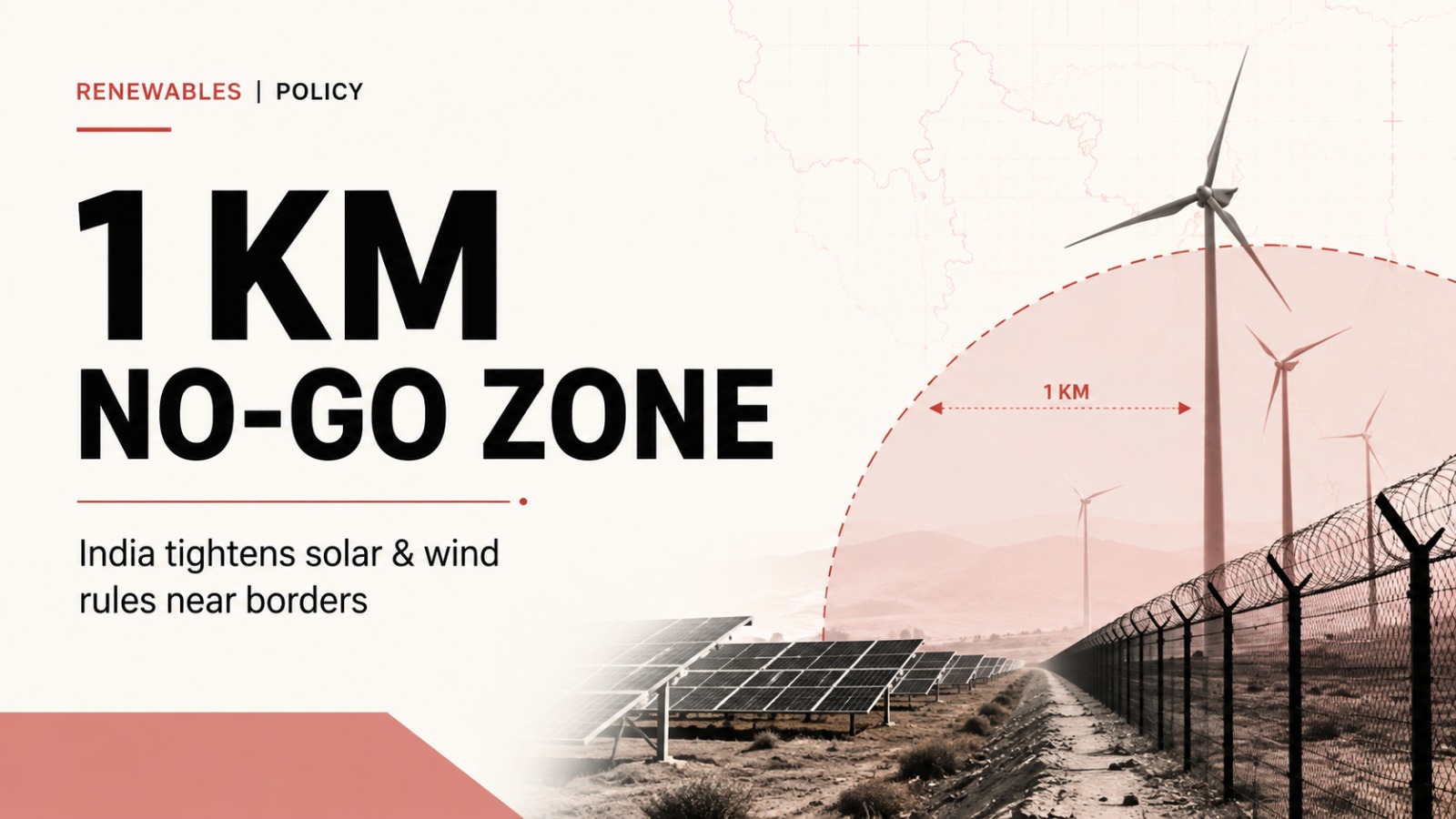
India has tightened the security framework for renewable energy development along its borders, prohibiting new solar, wind and hybrid projects within one kilometre of the Line of Control, Line of Actual Control and International Border.
The Ministry of Home Affairs has also classified locations extending up to 50 km from these border lines as “sensitive areas”, bringing renewable energy projects in the wider belt under a security-clearance regime.
Under the guidelines, solar, wind and hybrid projects proposed between 1 km and 50 km will require security clearance from the MHA. Projects falling within 1 km to 20 km will additionally need a No Objection Certificate from the Ministry of Defence, with applications assessed on a case-by-case basis. The innermost 1 km zone is effectively closed to new project activity.
The framework comes as authorities deal with a growing number of proposals for solar, wind and hybrid installations in border regions, where the location and scale of infrastructure can carry national security implications. The Home Ministry had issued an office memorandum on the matter on June 5 before putting the detailed guidelines in place.
Foreign personnel and land transfers face tighter scrutiny
The rules place additional restrictions on the involvement of foreign personnel in projects located in these areas.
Engineers, employees, staff and labour from India’s land-border countries, with Pakistan, Bangladesh and China specifically mentioned, cannot be engaged for project implementation without permission from the central government.
Project applicants will also be prohibited from transferring land to a foreign company without prior approval from the Centre, including security clearance from the MHA. Where a project involves foreign investment, a separate application will have to be made to the Department for Promotion of Industry and Internal Trade under India’s foreign direct investment policy.
MNRE becomes the single route for applications
Applications covered by the new framework will be submitted through the Ministry of New and Renewable Energy.
The proposal must carry the concerned state government’s in-principle approval for land allotment, along with the latitude and longitude of the proposed project. MNRE will then forward the proposal to the MHA for security clearance and, where required, to the Defence Ministry for an NOC.
MNRE has also been tasked with ensuring that project land is allocated in a way that prevents construction from extending for long distances parallel to the International Border.
A final decision is to be communicated to the project developer only after the necessary Home Ministry security clearance and Defence Ministry no-objection approval have been obtained.
Existing cleared projects get protection
Projects that had already received MHA security clearance before the new rules were issued will not have to apply again.
The same protection applies to applicants that had already secured a Defence Ministry NOC for their project.
However, projects that are required to reapply will come under the provisions of the new framework.
Anti-drone systems and dedicated police posts mandated
Developers operating in the sensitive belt will face a series of security obligations extending beyond the initial approval process.
Projects must install comprehensive security measures, including anti-drone equipment. Such systems are to be operated by the Central Industrial Security Force or state police, while the cost will be borne by the project proponent.
A dedicated police post is also required for projects to oversee and monitor construction activity. Foreign nationals entering project areas are to be monitored, while personnel working on the project must be verified before they enter the field. Staff will also have to comply with directions issued by local police and the Border Security Force.
The guidelines further call for sufficiently wide roads within proposed developments so they can be used by border security personnel or the armed forces during an emergency.
Hotels must remain 5 km away
The security framework also governs facilities that can be constructed around renewable energy projects.
Accommodation and hotels are required to be located at least 5 km from the border. Cafeterias are to remain within plant premises, while facilities that could attract crowds in areas where security may be difficult to maintain are not to be permitted.
One of the more granular provisions concerns the height of civil infrastructure used for project operations and maintenance.
Structures in sensitive areas are capped at 3 metres between 1 km and 8 km from the border, 5 metres between 8 km and 20 km, and 15 metres between 20 km and 50 km.
Taken together, the rules create three increasingly flexible layers around India’s border regions: an effective no-project zone within the first kilometre, tighter Defence and Home Ministry scrutiny in the next band, and security-controlled renewable development extending as far as 50 km.
The stated approach seeks to establish a uniform approval process for renewable projects in border areas while accounting for national security requirements and ease of doing business.
Also Read: Apple’s iPhone 18 Pro Max Featured Leaked