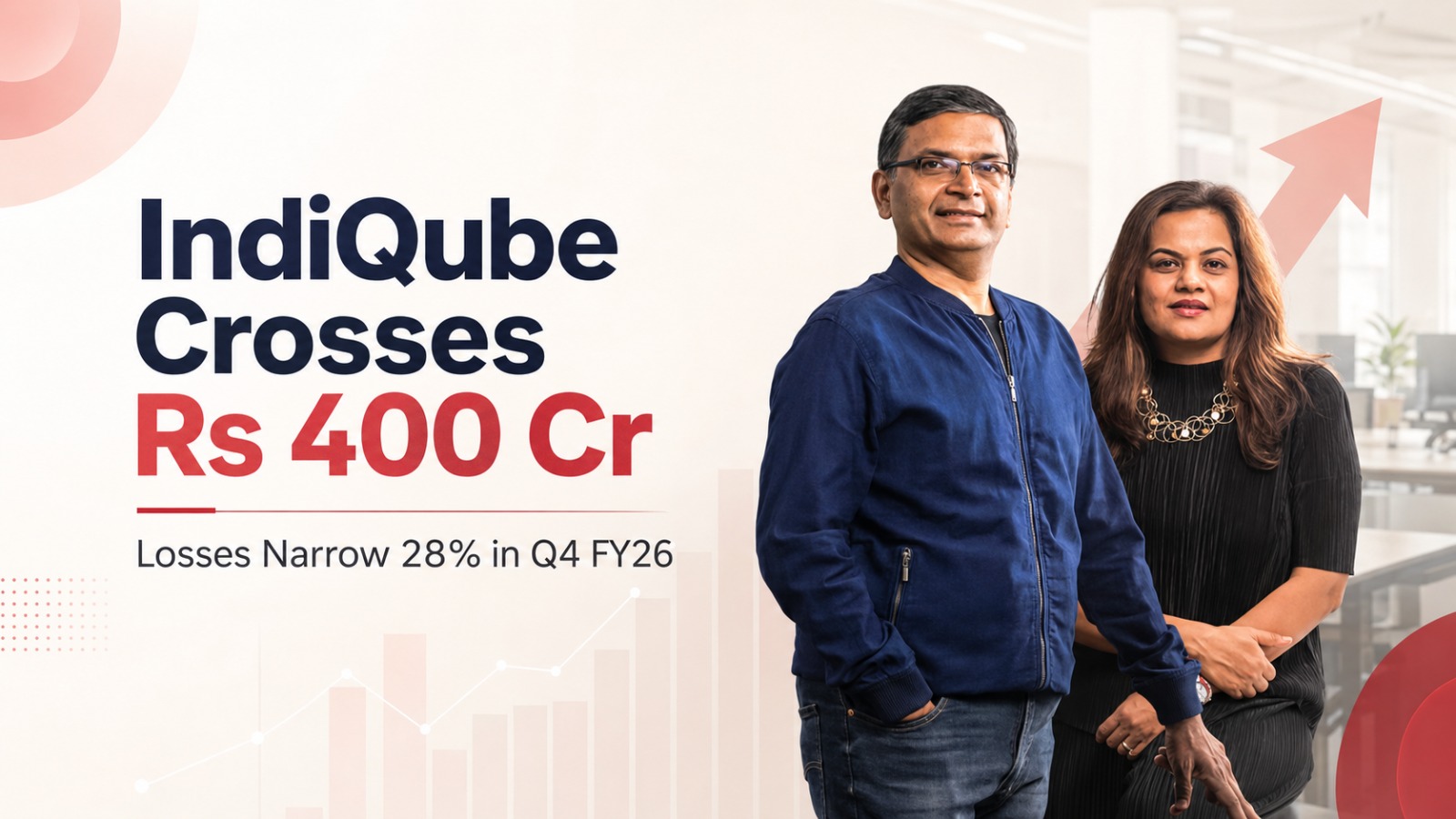
Bengaluru-based workspace solutions company IndiQube founded by Meghna Agarwal and Rishi Das closed Q4 FY26 with a stronger top line and a smaller loss, signalling improving operating leverage even as depreciation and finance costs continued to weigh on the business.
IndiQube’s quarterly revenue from operations crossed the Rs 400 crore mark in Q4 FY26, rising 35.2% year-on-year to Rs 401.5 crore from Rs 296.9 crore in the same quarter last year.
The growth came at a time when managed office and flexible workspace operators are being closely watched for two things: how quickly they can scale occupancy-led revenue and whether that scale is beginning to soften losses. In IndiQube’s case, the March quarter showed progress on both fronts.
The company reported a loss of Rs 22.7 crore in Q4 FY26, compared with Rs 31.3 crore in Q4 FY25. That translates to a 27.7% reduction in losses on a year-on-year basis. The improvement was driven by higher revenue, better operating leverage and stronger occupancy levels.
IndiQube also recorded Rs 24.2 crore in non-operating income during the quarter, adding support to its overall income base.
Revenue growth outpaces loss pressure
For the full financial year FY26, IndiQube’s revenue from operations grew 37% to Rs 1,450.8 crore. The annual performance shows that the company’s growth was not limited to one quarter, but part of a wider expansion cycle across its workspace portfolio.
The sharper revenue base becomes important because IndiQube operates in a cost-heavy business. Managed office companies typically need to invest upfront in leases, fit-outs, facilities and operations before full occupancy benefits start reflecting in earnings.
Depreciation and amortisation remained the company’s largest cost head, rising 35.8% to Rs 177 crore in Q4 FY26. Finance costs also increased 30.8% to Rs 119.2 crore, while employee benefit expenses stood at Rs 24.2 crore for the quarter.
Overall expenses rose 29% year-on-year to Rs 449.6 crore in Q4 FY26. Even with that increase, revenue growth was strong enough to help narrow the company’s loss compared with the same quarter last year.
Expansion continues across cities
IndiQube continued to expand its physical footprint during FY26. As of March 2026, the company operated 130 centres across 17 cities and managed 9.66 million square feet of workspace.
That scale places the company among the larger managed workspace operators in India’s listed market conversation. The key question now is whether this expansion can keep converting into higher occupancy,
stronger revenue per centre and better margins over the coming quarters.
The Q4 numbers suggest that the company is beginning to benefit from operating leverage, but costs remain significant. Depreciation, amortisation and finance costs together form a heavy burden, which means profitability will depend on how efficiently IndiQube fills and monetises its growing workspace base.
Full-year loss also narrows for Indiqube
For FY26, IndiQube’s losses narrowed 23.8% to Rs 106.3 crore from Rs 139.6 crore in FY25. This annual improvement gives the quarter’s performance a stronger context, showing that the reduction in losses was not an isolated result.
Still, the company remains in the red. Its next phase will likely be judged on whether revenue growth can continue without a proportional rise in expenses.
For investors and market watchers, the trend is now clear: IndiQube is scaling fast, but the road to sustained profitability will depend on tighter cost absorption and steady demand for its workspace offerings.
At the time of reporting, IndiQube’s share price stood at Rs 173.52, giving the company a valuation of about Rs 3,773 crore.
IndiQube’s Q4 FY26 performance reflects a company in transition. The growth engine is working, the losses are narrowing, and the footprint is expanding. But the business still carries the financial weight of a capital-intensive operating model.
The coming quarters will show whether IndiQube can turn its larger base into a cleaner profitability story. For now, the company has delivered a quarter where revenue growth did more than just expand the headline number. It also helped reduce losses, which is the metric that may matter most in the next leg of its market journey.
Also Read: Cockroach Janta Party: How a Meme Protest Turned Into Gen Z’s Political Case Study