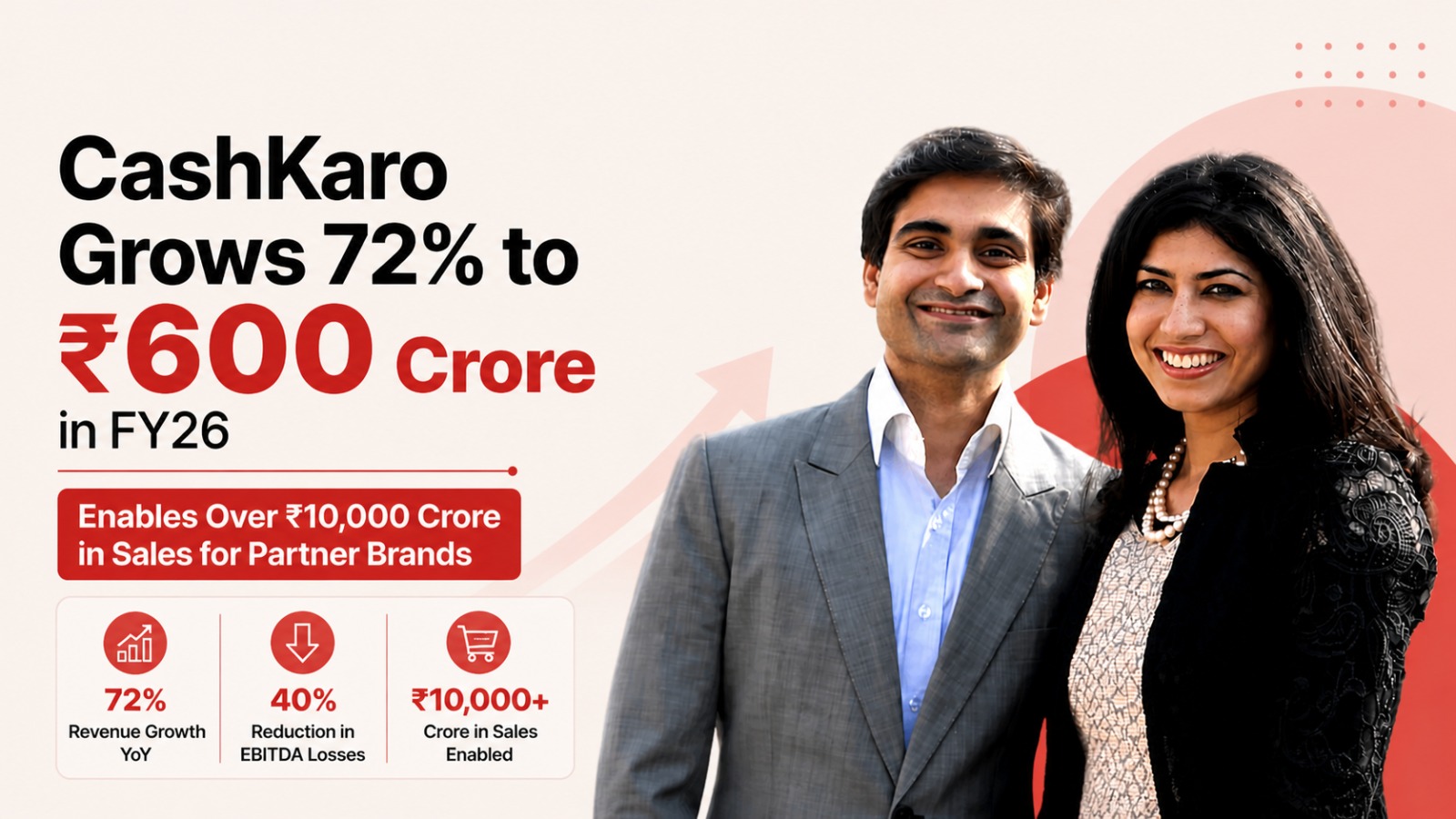
CashKaro has reported a sharp jump in FY26 revenue, growing 72% year-on-year to Rs 600 crore from Rs 348 crore in FY25, while also cutting EBITDA losses by about 40%, from Rs 29.2 crore to Rs 17.7 crore.
The numbers point to a larger shift in India’s online shopping market. Cashback is no longer sitting at the edge of e-commerce as a small saving tool. For many consumers, especially as spending becomes more value-conscious, it is becoming part of the buying decision itself.
CashKaro said it enabled more than Rs 10,000 crore in sales for partner brands during the year. What stands out is that this growth did not come from a matching rise in marketing spend. Marketing expenditure for CashKaro and EarnKaro rose only 7.6%, suggesting better customer acquisition efficiency and stronger conversion.
The company also said employee and infrastructure costs remained stable, helped by investments in AI and automation. That allowed revenue growth to move faster than cost growth, improving operating leverage.
Another important marker is user payouts. CashKaro said it has paid more than Rs 2,000 crore in real cashback to users so far. Unlike points or closed-wallet rewards, the cashback can be transferred to a bank account or through UPI, which gives the platform a clearer value proposition for shoppers.
Co-founder Swati Bhargava said the company is unit economics positive on every transaction and highlighted the role of network effects in its business. She also pointed to EarnKaro, CashKaro’s affiliate marketing platform, as a key part of the company’s India-focused expansion.
EarnKaro allows users, including students, homemakers, micro-influencers and creators, to share deals and earn through affiliate links. The platform has built traction across Telegram, Instagram, Facebook, YouTube and WhatsApp. Swati Bhargava said EarnKaro has an 80% market share on Telegram and enables influencers to earn up to Rs 40 lakh a month.
For brands, the appeal lies in performance-led spending. Rohan Bhargava, co-founder of CashKaro and EarnKaro, said many brands are shifting budgets from Google and Meta to affiliate-led models as customer acquisition costs rise. He said brands are seeing 4x to 10x better returns through affiliate models because CashKaro charges for sales, not traffic.
This is the heart of CashKaro’s pitch: brands pay commission only when a sale happens, users get a part of that commission as cashback, and the platform sits between value-seeking shoppers and brands looking for measurable growth.
The company is now positioning itself around three connected trends: cashback-led shopping, creator-led commerce and AI-backed efficiency. Its latest numbers show a business trying to move from high-growth spending to more disciplined, sales-led scaling.
For India’s e-commerce market, the story is also about consumer behaviour. Online shoppers are no longer looking only for festive discounts or coupon codes. They are increasingly comparing total savings, cashback, payment offers and deal discovery before completing a purchase.
That gives platforms like CashKaro room to grow, especially beyond metro markets, where savings-led shopping can play an even stronger role.
The company’s FY26 performance suggests that cashback in India is moving from a promotional hook to a more structured layer of digital commerce.
Also Read: Ananya Birla and the New RCB Era