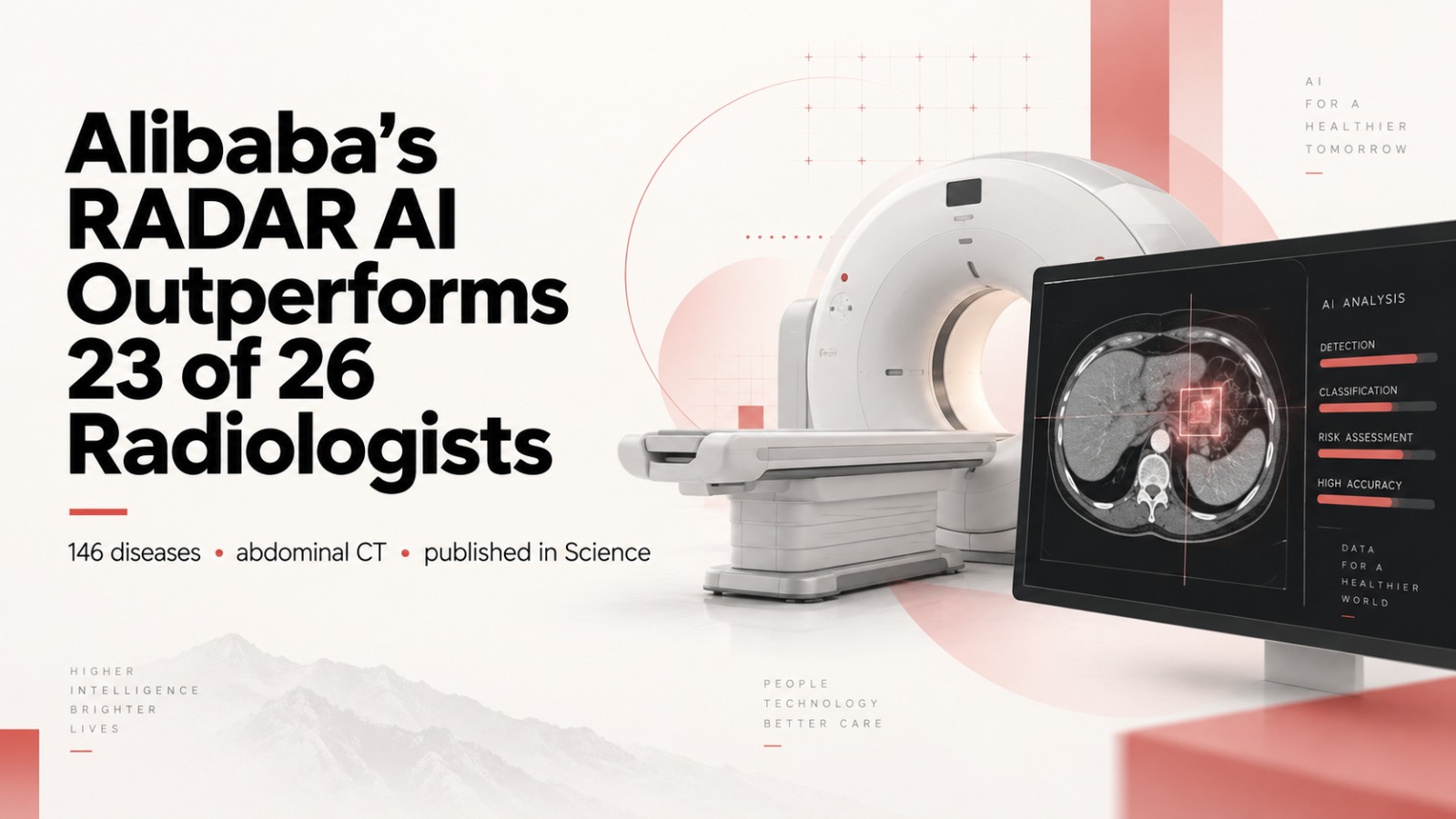
RADAR AI: The generalist medical AI can screen a single contrast-enhanced abdominal CT for 146 diseases across 18 organs. In testing, it also helped radiologists improve disease detection while cutting reading time by more than 30%.
Alibaba’s DAMO Academy has developed a radiology AI system that takes a markedly broader approach to medical imaging than models designed around a single condition.
Called DAMO RADAR, the system can examine one contrast-enhanced abdominal CT study for 146 diseases across 18 organs. In a formal reader study, its average diagnostic accuracy was higher than that of 23 out of 26 specialist radiologists who participated in the comparison. The work was published in Science on September 18, 2026.
What makes the project particularly notable is the scale and structure of its training. RADAR was trained on 420,000 contrast-enhanced abdominal CT examinations, which were turned into roughly 15 million anatomy-aware image-text pairs. Rather than relying on newly created manual labels for every scan, the training process used radiology reports that were already available in participating hospitals.
That design allowed the researchers to build one system capable of handling a much wider set of findings within abdominal CT imaging.
One CT scan, 146 disease categories
Much of radiology AI has been built around narrowly defined tasks, such as identifying a particular abnormality or assessing one part of an image.
RADAR takes a different route.
The model separates a CT volume into individual anatomical regions, including structures such as the liver, kidneys, spleen, bowel and pancreas. Information from each anatomical region is then matched with the relevant language in the corresponding radiology report.
This organ-level alignment is intended to give the model a more precise link between what appears in a particular part of the scan and what the radiologist described in the report.
The system also uses an adaptive contrastive approach designed to handle variations in the way different radiologists describe the same clinical finding.
In external testing across eight independent clinical centres and approximately 40,000 real-world examinations, RADAR recorded a mean AUC of 0.913 across the findings that were evaluated. AUC is commonly used to measure how effectively a diagnostic system distinguishes positive cases from negative ones.
The strongest result may be what happened when doctors used the AI
The comparison with 26 radiologists is likely to attract the most attention, but the results involving doctors working alongside RADAR may have greater practical significance.
When radiologists used the model as a second reader, disease-detection sensitivity increased by about 10 percentage points. At the same time, the average time needed to read a case fell by more than 30%.
The study also found that junior radiologists using RADAR reached diagnostic accuracy levels comparable with more experienced colleagues working without AI assistance.
Those findings position RADAR less as an immediate substitute for a radiologist and more as a system that could potentially support human interpretation of complex CT examinations.
The distinction matters because the model remains limited to a tightly defined type of imaging.
RADAR AI does not work across every type of medical scan
Despite its breadth within abdominal imaging, RADAR is not a universal radiology system.
The current model has been trained and validated specifically on contrast-enhanced abdominal CT examinations.
Its published validation does not cover non-contrast abdominal CT scans, paediatric imaging, brain MRI, chest X-rays or other body regions. Different CT contrast phases also fall outside the validated scope described in the publication.
There is another important limitation.
The model’s 420,000 training examinations came from clinical centres in China, with much of the data originating in Zhejiang Province. Although researchers tested RADAR across eight clinical centres, the available validation cited in the report does not establish its performance across non-Asian patient populations.
That means the headline accuracy figures should not automatically be assumed to apply identically to every hospital or patient population.
No FDA clearance yet
RADAR also remains a research system rather than an approved diagnostic product in the United States.
The model does not have US FDA clearance for clinical deployment. The report further notes that prospective real-world outcome data from a registered clinical trial had not yet been published.
That regulatory gap separates an impressive research result from something hospitals could immediately place into routine diagnostic use.
For institutions outside China, local validation would also be necessary before drawing conclusions about performance in different patient populations and healthcare environments.
Alibaba has made the technology available for research
DAMO Academy has released RADAR’s code through GitHub and Hugging Face under an Apache 2.0 licence.
The model weights are distributed separately under CC BY-NC-SA 4.0, which allows non-commercial research use while requiring a separate arrangement for commercial deployment.
That release gives hospitals and research groups an opportunity to examine the system directly rather than relying only on published benchmark results.
For now, RADAR’s significance lies in what it demonstrates technically: one CT model can be trained to recognise a far broader range of abnormalities than the single-task systems that have defined much of medical imaging AI.
Its next test will be outside the controlled boundaries of the current research, including validation in more diverse patient populations, prospective clinical evidence and the regulatory process required before routine diagnostic deployment.
Also Read: How to Start a YouTube Channel With Just a Smartphone: A Beginner’s Guide