


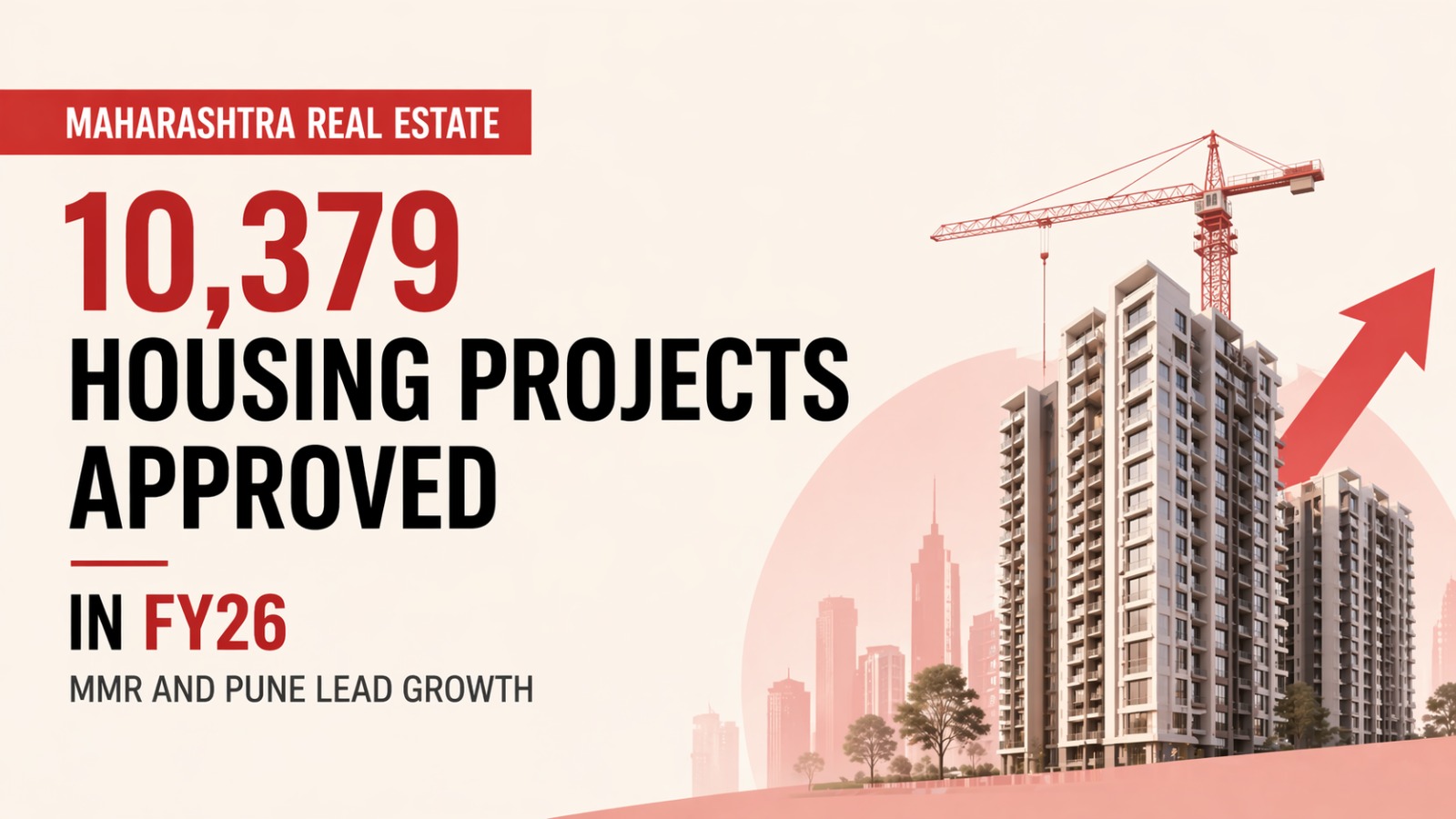
Maharashtra’s housing market has entered FY2026 with a strong approval pipeline, as the Maharashtra Real Estate Regulatory Authority cleared 10,379 housing projects during the year. The approvals signal continued demand in the state’s urban property markets, led mainly by the Mumbai Metropolitan Region and Pune.
The numbers also show how regulatory scrutiny is becoming central to real estate activity in the state. Of the total approvals, 4,204 projects received registration numbers, 2,488 projects went through corrections, and 3,687 projects were granted timeline extensions after developers submitted revised plans.
Under the Real Estate (Regulation and Development) Act, 2016, developers are required to register projects and seek approval for major changes or delays. This makes the approval process important not just for builders, but also for homebuyers tracking delivery timelines and project status.
Region-wise, the Mumbai Metropolitan Region led with 5,494 approved projects, followed by Pune with 3,566 projects. Vidarbha recorded 563 approvals, Khandesh 520, and Marathwada 203.
At the district level, Pune topped the chart with 3,150 projects. Thane followed with 1,714 projects, while Mumbai Suburban stood close behind with 1,696 projects. Raigad, Palghar, Nagpur and Nashik also featured among the key contributors.
The data points to a clear pattern. Maharashtra’s real estate growth continues to be concentrated around high-demand urban belts, especially Pune and the Mumbai Metropolitan Region. These markets remain central to the state’s housing story because of job creation, migration, infrastructure development and sustained buyer interest.
MahaRERA’s approval framework also puts pressure on developers to remain accountable. Builders must declare project completion deadlines at the time of registration. If a project misses its deadline without regulatory approval, it can be treated as “lapsed,” which may affect its progress and buyer confidence.
For homebuyers, this matters because project registration, correction approvals and extension records provide a clearer trail of compliance. For developers, it means planning, finance and delivery timelines are now more tightly linked with regulatory checks.
The FY26 approvals suggest that Maharashtra’s housing market is not slowing down in terms of project activity. But the bigger story is not just the number of approvals. It is the growing role of transparent compliance in a sector where delays and uncertainty have long shaped buyer concerns.
Also Read: Who Owns Your Team Now? IPL’s Latest Ownership Breakdown