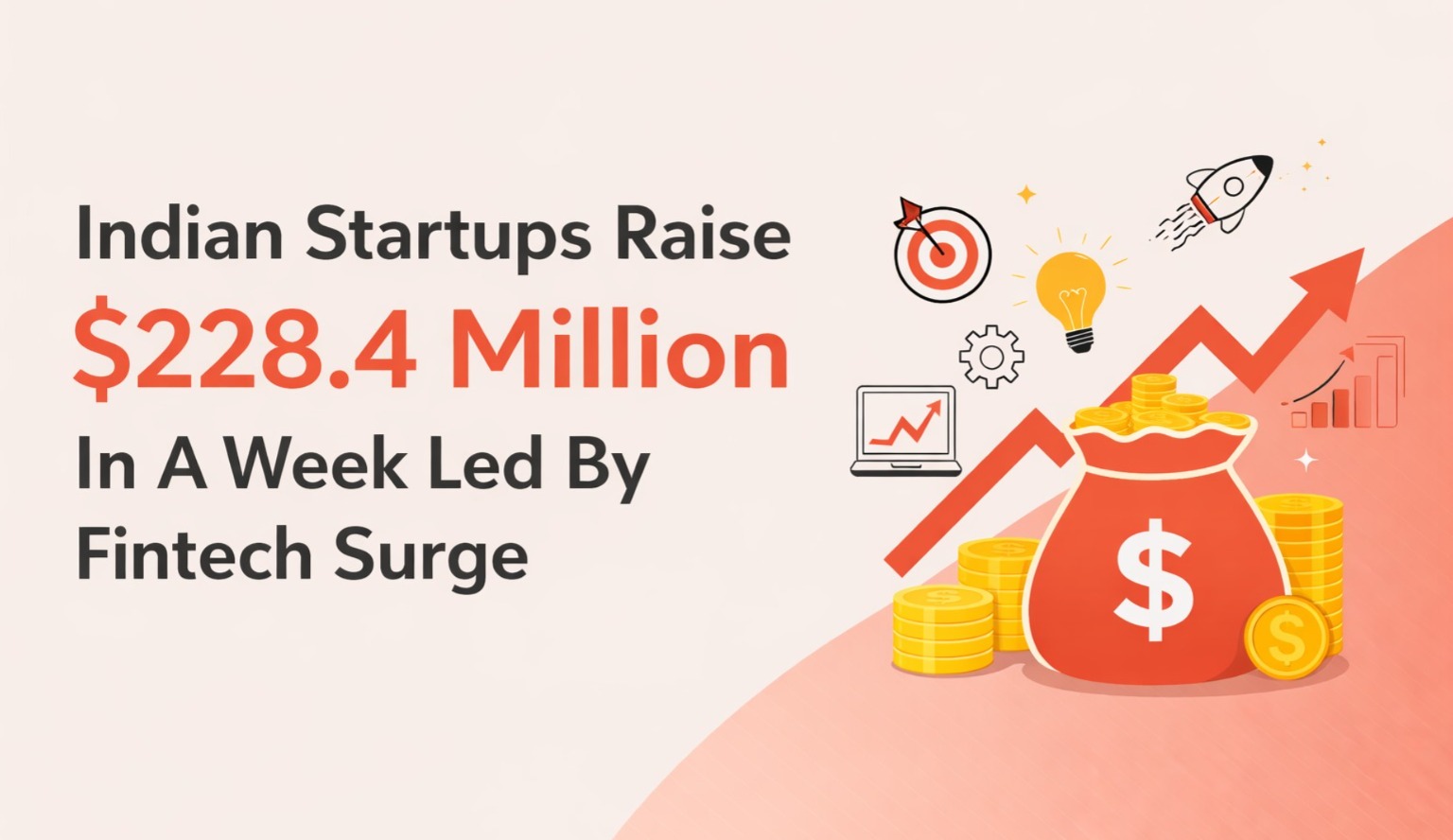
India’s startup funding market delivered a stronger week, with 21 Indian startups raising a combined $228.4 million between March 16 and March 20. The total marks an 11 percent rise over the previous week’s $206.5 million, even though the number of deals slipped from 22 to 21.
That shift matters. It suggests the market is not necessarily seeing more activity, but larger and more decisive bets. Investors appear to be writing fewer cheques, but putting more money behind companies they believe can scale.
The biggest round of the week went to Neo Group, which raised $53.4 million. Ecofy followed with $42 million, while travel-tech player Atlys secured $36 million in a Series C round. Assiduus also featured among the largest deals with a $25 million raise.
Beyond the headline rounds, the week’s deal list showed a wide spread across sectors. Aerchain raised $13 million, Burger Singh brought in $8.8 million, OfficeBanao secured $7.7 million, and VerbaFlo added $7 million. The range of companies funded through the week points to a startup ecosystem that is broadening rather than clustering around a single trend.
Fintech, however, was clearly the strongest theme.
With Neo Group and Ecofy leading the charge, fintech emerged as the top-funded sector by value during the week. Ecommerce recorded the highest number of deals at four, but attracted only $3.9 million in total. The contrast shows where investor conviction currently sits: transaction-heavy consumer businesses may still be active, but larger pools of capital are moving towards financial services and related platforms.
Early-stage funding also held firm. Seed-stage investments rose 12 percent to $12.9 million from $11.5 million a week earlier. Startups such as VerbaFlo, Mave Health and AGNIT Semiconductors were among those drawing early backing, reflecting continued interest in AI, healthcare and semiconductors.
On the investor side, Peak XV Partners stood out as the most active backer during the week, participating in deals involving Atlys, BambooBox and Grapevine. In a market where investor behaviour is watched closely, repeated activity from a major firm often serves as a signal that quality opportunities are still emerging across stages.
There was movement beyond private funding as well. MakeMyTrip is reportedly planning an India IPO more than 16 years after its Nasdaq listing, while Travelstack Tech, the parent of FabHotels, has received SEBI approval for its public issue, including a ₹250 crore fresh issue and an offer-for-sale component. PhonePe, meanwhile, has paused its IPO plans amid market volatility, with the timeline now likely shifting to at least June 2026.
Fresh capital formation also added to the week’s momentum. Celesta Capital is planning a ₹2,000 crore deeptech-focused fund targeting Series A and B startups. Former Peak XV leaders have also launched Ambition Capital with a $250 million fund focused on early-stage investments. These moves suggest that while near-term caution remains, long-term appetite for Indian startup opportunities is still intact.
The week also saw a number of strategic developments outside fundraising. Nazara is set to acquire stakes in Spanish firms Bluetile Games and BestPlay Systems for over $100 million.
L’Oréal is reportedly in talks to acquire a majority stake in Innovist, potentially valuing the company between $350 million and $450 million. KKR is investing up to $310 million in electric mobility platforms PMI Electro Mobility and Allfleet, while upGrad has signed a term sheet to acquire Unacademy.
Taken together, the week presents a more mature picture of the startup market. Funding is still flowing, but with greater selectivity. Big rounds are being reserved for businesses with clearer scale, stronger positioning or sectoral relevance. Early-stage capital remains available, but it is increasingly moving towards technology-led ideas with longer-term potential.
For India’s startup ecosystem, this was not just a good week on paper. It was a sign that investor confidence, though more disciplined than before, remains very much alive.
Also Read: Have You Bought Noice Without Knowing It’s Swiggy’s?