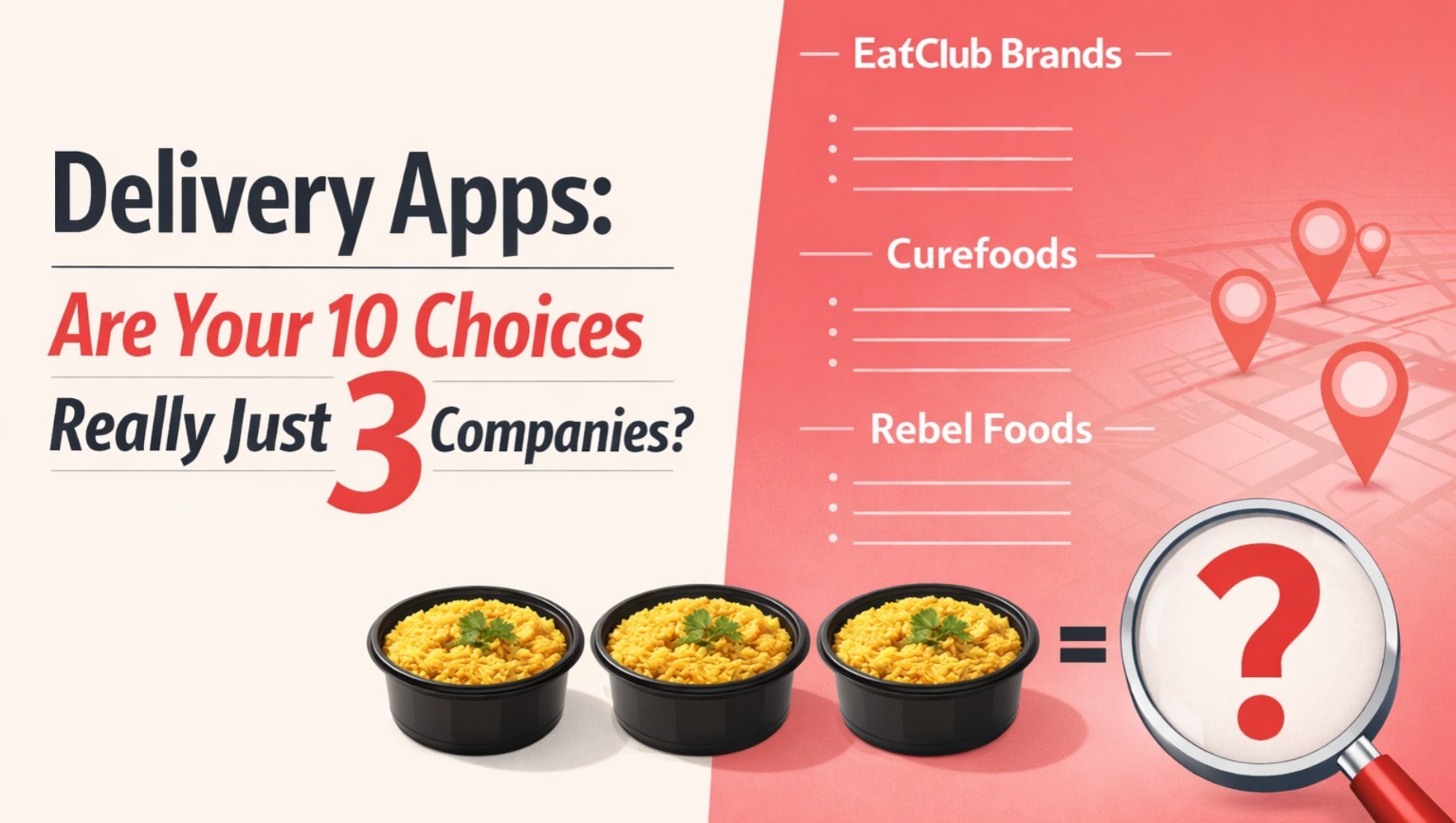
What looks like abundance on a food delivery app does not always translate into real choice.
That is the concern raised by LinkedIn user Shreyas Patel in a post that has struck a chord with many users of food delivery platforms. His experience began with something simple: ordering khichdi from multiple restaurants listed on Swiggy. What arrived, he wrote, felt less like a wide culinary selection and more like repetition disguised as variety.
“I ordered khichdi from 10 different restaurants on Swiggy. Guess what arrived? The same khichdi. Multiple times over,” Patel wrote, adding that the dishes often came with similar taste profiles and, in some cases, even similar packaging.
At first glance, the listings appeared to represent different restaurants. They carried different names, different logos and different brand identities on the app. But Patel’s central claim was that several of these storefronts were, in fact, operated by the same parent companies, a strategy he described through the term “brand proliferation.”
That phrase may sound corporate, but the customer experience he described was far more direct: the feeling that the app offered many options, while the real number of independent choices was far smaller.
The khichdi search that raised bigger questions
Patel says he was browsing khichdi options on Swiggy and noticed that, among the first 10 results, the genuine diversity of choice may have been limited to only two or three companies. The rest, according to his post, were multiple brands run by the same parent groups.
He cited three examples from his own search:
EatClub Brands (formerly Box8)
Box8 · NH1 Bowls · The Ghee Khichdi Project · WeFit · Daily Kitchen
Curefoods (EatFit’s parent)
EatFit · HRX by EatFit · Great Indian Khichdi · Ghar Ka Khaana by EatFit · Honest Bowl
Rebel Foods
The Good Bowl · LunchBox · Veg Meals by LunchBox · Big Bowl
Based on these examples, Patel argued that users searching for a single dish may believe they are comparing many restaurants, while in practice they may be choosing among a much smaller set of parent operators.
That gap between perceived choice and actual ownership is at the heart of the issue.
Smart business strategy, uncomfortable customer experience
From a business point of view, the logic is easy to understand. Multiple brand identities can help a company target different audiences, cuisine preferences and price points. One brand may sound indulgent, another healthy, another home-style. On a crowded marketplace, that kind of positioning can improve visibility.
But Patel’s post highlights the other side of the equation: what may be efficient brand strategy for a company can feel misleading to a customer if the product, kitchen origin or service experience is not meaningfully different.
His point was not framed as a legal accusation. It was framed as a trust issue.
If a user searches for khichdi and sees 10 listings, the natural assumption is that these represent 10 competing sellers. If many of those listings lead back to a handful of parent firms, the marketplace can begin to feel less open than it appears.
Patel summed up that frustration with a line that blended humour and criticism: “Smart from a business lens. Feels unfair from a customer’s.”
The platform problem is not only about food
What makes the post notable is that it speaks to a broader platform-era tension. Digital marketplaces are built on the promise of discovery, comparison and choice. Customers trust search results because they believe they are seeing a fair spread of options.
But when one company can occupy multiple slots in the same search result through different brand names, that perception starts to shift. The issue is no longer just about one bowl of khichdi. It becomes a question of whether visibility on a marketplace reflects open competition or sophisticated shelf domination.
Patel used satire to make that point sharper. “By that logic, job seekers should apply to the same company from 4 different CVs and see who gets called,” he wrote.
This is because the joke works in such a way that it acknowledges the asymmetry. A business can multiply itself through branding architecture. However, the consumer has no idea how many choices are still available to them on the page.
In marketplace businesses, trust is not built only through delivery times, discounts or app design. It is also built through clarity.
Customers do not necessarily object to the existence of multi-brand food companies. In fact, many such companies openly operate portfolios of brands. The discomfort begins when the presentation of those brands gives the impression of competition that may not fully exist at the consumer-facing level.
That distinction matters because food ordering is often driven by quick decisions. Users scan names, prices, ratings and cuisines in seconds. Very few stop to investigate parent-company structures before placing an order. If several listings are effectively variations of the same operator, customers may feel they have been nudged into a narrower funnel than they realised.
Patel’s post therefore taps into a larger question facing app-based marketplaces: how much transparency is enough?
A conversation the platforms cannot ignore
The post does not claim that multi-brand operations are hidden in a formal sense, nor does it offer evidence of policy violations. What it does do is raise a simple and uncomfortable consumer question: should users be able to more easily see when multiple restaurant brands belong to the same parent company?
That question matters because the credibility of food delivery platforms rests heavily on user confidence. If customers begin to suspect that search pages create an illusion of variety, that confidence can erode quickly.
In categories like khichdi, where the meal itself is simple, familiar and easy to compare, such overlaps may be easier to spot. In other categories, consumers may never notice at all.
Either way, Patel’s post brings attention to something many users may have experienced without fully naming: the strange feeling that several “different” options on an app do not feel different enough.
More than a viral Delivery App complaint
What gives the post weight is that it is not written as outrage for outrage’s sake. It reads as an observation from an everyday user who discovered that convenience can sometimes come wrapped in sameness.
And that is what makes the post more than a complaint about food delivery. It is a reminder that in platform commerce, presentation matters as much as product. A marketplace does not just sell meals; it sells the idea of informed choice.
When that idea starts to wobble, even a bowl of khichdi can spark a bigger debate.
For now, Patel’s post leaves behind a question that is likely to resonate with many users: when food apps show a long list of options, how many of those options are truly different and how many are simply different masks on the same business?
That question may not change what arrives at the door tonight. But it does change how customers may look at the app tomorrow.
Also Read: Have You Bought Noice Without Knowing It’s Swiggy’s?