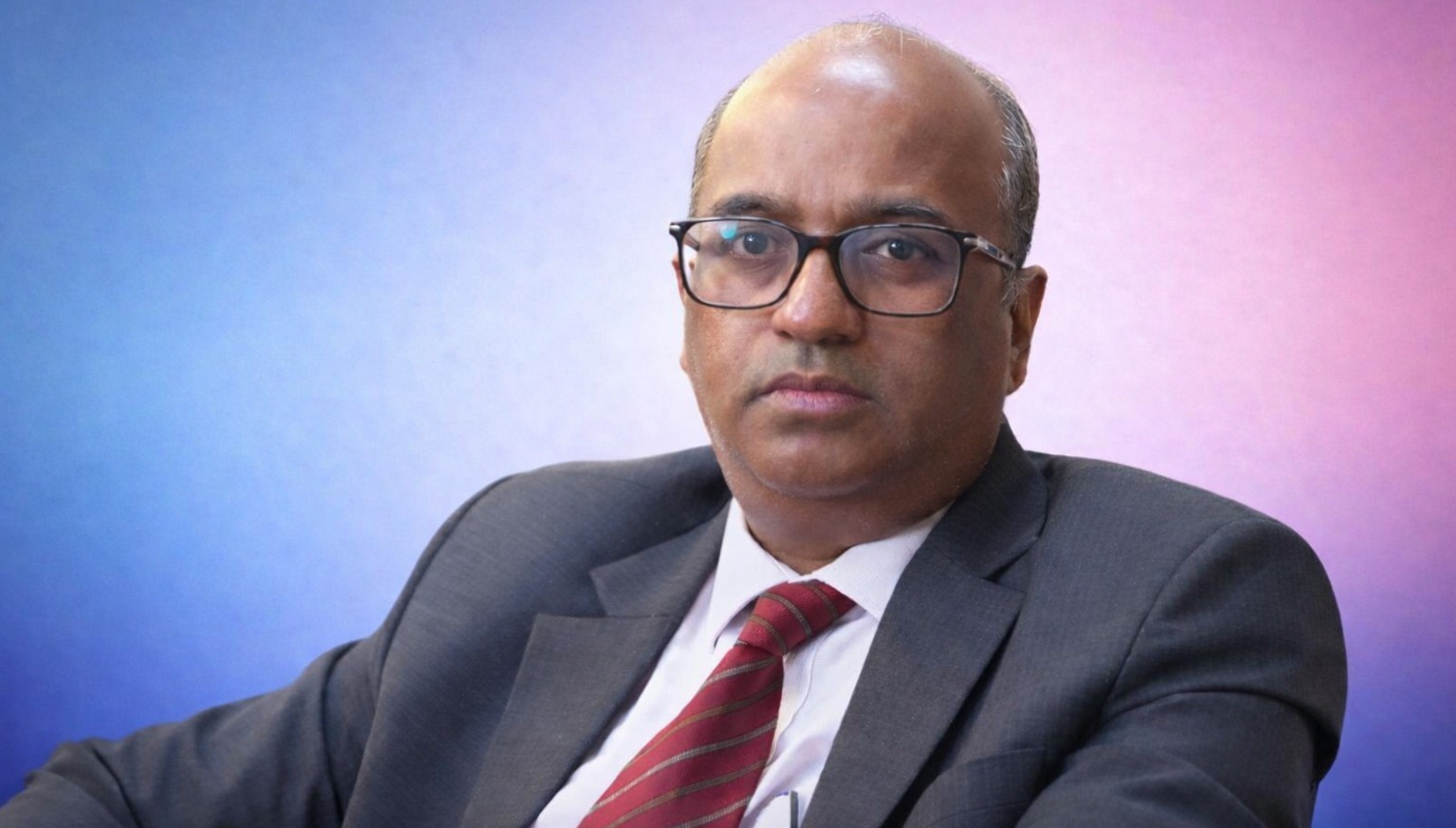
India’s AI push doesn’t have a single face. It has committees, consultations, procurement files, and long meetings where policy meets processors. But if there is one official repeatedly turning up at the centre of those conversations, about compute, Indian-language access, safer AI, and the state’s own dependence on foreign platforms, it is Abhishek Singh, the Additional Secretary in the Ministry of Electronics and Information Technology (MeitY) and CEO of the IndiaAI Mission.
His pitch is deceptively simple: India has already built the rails of governance through digital public infrastructure. The next step, he argues, is to make those rails intelligent and usable for everyone, not just the smartphone-fluent.
At the Mint All About AI Tech4Good Awards in Mumbai, Singh framed the moment as urgent: India’s use of AI is rising faster than its ability to build domestic systems . In the same breath, he flagged a deeper anxiety increasingly shared across governments worldwide, that foreign AI platforms may be training on local data at scale, shaping tools that citizens could one day rely on for essential services.
From “roads, schools and hospitals” to algorithms
Singh’s public profile today is that of a technology administrator. But his career, by his own telling, was shaped by classic district governance: building roads, schools and hospitals, and handling crisis situations such as droughts and communal riots . That grounding matters because the IndiaAI Mission he is steering is not positioned as a lab experiment, it is pitched as an upgrade to how the Indian state delivers services.
Singh is a 1995-batch IAS officer with over two decades of experience . He is also an IIT-Kanpur alumnus, a detail that often travels with him in tech circles, where engineering pedigree still signals comfort with the language of systems.
He says he has been working on AI initiatives since 2018, and that an AI strategy was approved in 2019 . When the IndiaAI Mission was launched in 2024, he described it as a moment when “the pieces” finally began to come together.
The job: build the missing middle of India’s AI ecosystem
In Singh’s framing, India’s national AI strategy is not only about innovation headlines. It is meant to build a workforce and use AI for public services, value creation, startup support and jobs.
But he also acknowledges the gaps, some structural, some painfully practical. In a consultative process, working groups involving academia, researchers, startups and entrepreneurs mapped the shortages: compute capacity, the lack of Indian foundation models, the need for dataset platforms, support for skilling and startups, applications, and tools for safe and trusted AI.
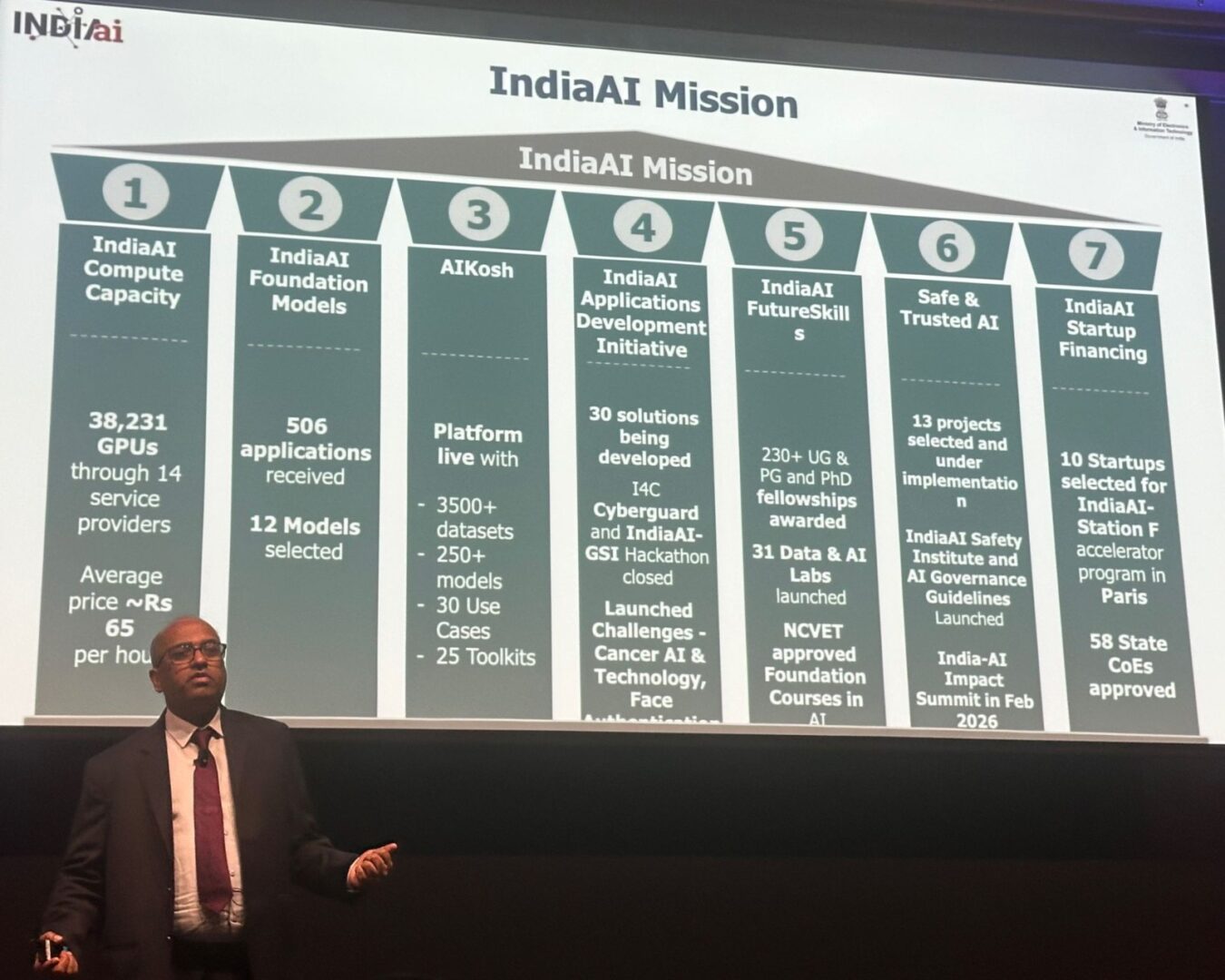
Those findings fed into what Singh calls a seven-pillar approach, shaped through consultations with key stakeholders . Another articulation of that framework came at the Nvidia AI Summit in Mumbai, where he presented a roadmap centred on making “AI in India, for India,” with priorities spanning infrastructure, data accessibility, skills, and safety.
The strategic logic is straightforward: without affordable compute, usable datasets, and Indian models that work in Indian contexts, India risks becoming a large user market for other countries’ AI-powerful in demand, weak in sovereignty.
The “AI layer” for Digital Public Infrastructure
Where Singh’s pitch turns distinctly governance-first is his focus on Digital Public Infrastructure (DPI), the stack that has come to define India’s modern welfare and service delivery.
At the Nvidia AI Summit, he argued AI could make India’s DPI “significantly more efficient,” estimating a potential 50-60% increase in effectiveness . The claim is bold, but the underlying point is sharper: AI, if deployed thoughtfully, could help public systems reach more citizens while lowering barriers to access.
He repeatedly returns to the last-mile problem, less as a slogan, more as a design constraint. At the Tech4Good Awards, he said India’s DPI has reshaped governance, but now needs an AI layer to reach the last mile . The aim, he added, is to ensure AI makes services accessible in every Indian language, with the government push anchored in a voice-driven approach .
Bhashini as a case study in “citizen-centred AI”
If you want a single example that captures Singh’s preferred model of public AI, it is Project Bhashini.
He cites it as a way to eliminate language and digital literacy barriers by enabling access to government services through voice commands in regional languages . The idea is not to force citizens to learn interfaces; it is to make interfaces learn citizens, an approach that fits India’s diversity and the reality that digital adoption is uneven.
The emphasis is also philosophical. In this view, the most important AI “feature” is not novelty; it is inclusion. Bhashini, as described in the roadmap, is meant to empower millions to use services without needing advanced digital skills or access to specific platforms .
A global seat and a Global South argument
Singh’s work is not limited to domestic plumbing. He has also been involved in India’s positioning in global AI governance.
He collaborated on securing approvals for India to chair the Global Partnership on Artificial Intelligence (GPAI), and India was chosen to take over as the council chair in November 2022 . At the Nvidia summit, he highlighted India’s role in expanding GPAI’s membership from 29 to 44 countries in partnership with the OECD.
The underlying argument is about democratising access, compute, datasets, algorithms, for researchers and entrepreneurs, particularly in the Global South. It is also a way of signalling that India wants to shape responsible AI rules, not merely comply with them.
The hard part: data that exists, but can’t be used
One of the most revealing parts of Singh’s public remarks is what he treats as a bottleneck: data quality and usability.
Even with large datasets accumulated through digital infrastructure projects , he notes that much of India’s data remains not AI-compatible due to inconsistent standards and limited accessibility. The mission, therefore, is tasked with improving data usability and accessibility to power AI applications tailored to Indian needs.
In government terms, that is an unglamorous mandate. In AI terms, it is foundational. Without clean, usable data, the push for homegrown models and trusted systems stays aspirational.
A view of jobs that avoids panic and demands skill
Singh’s communication about employment attempts to tread this line. On one hand, he talks about outside estimates of the value that AI could create and scale up employment in numbers in 2035. On the other hand, his more pointed observation is cultural: The power of AI, he says, is not in displacing people, but in enabling people who know AI to be exceptional.
It is a framing that places responsibility back on institutions, universities, companies, government skilling systems, to ensure capability is broadly distributed, not concentrated in a few firms and cities.
Abhishek Singh: The man behind the mission and the mission behind the man
Abhishek Singh is not a technologist-in-chief in the Silicon Valley mould. His power is administrative: aligning ministries, building consensus, and translating an emerging technology into procurement, policy, and platforms.
But the story that emerges from his remarks is consistent. India’s AI moment, he suggests, will not be decided only by who builds the smartest chatbot. It will be decided by whether AI can be made safe, trusted, multilingual, and genuinely useful at population scale, especially inside public systems.
The IndiaAI Mission, as he envisions it, is an effort to make the benefits of AI a public resource, a kind of mechanism whereby they can shift the paradigm from AI as a “private benefit” to a “public capability”, build capacity, reduce dependence, make digital governance less like a “portal” experience, more like a “conversation” or “voice first, language first, citizen first.”
But this is precisely why, in this overcrowded policy landscape full of committees and buzz-phrases, the work of Singh is so significant, he is attempting one of the most difficult things that governments ever try in technology, and that is making it work for everyone.
Also Read: Loopie raises Rs 7.2 crore to build premium baby gear brand