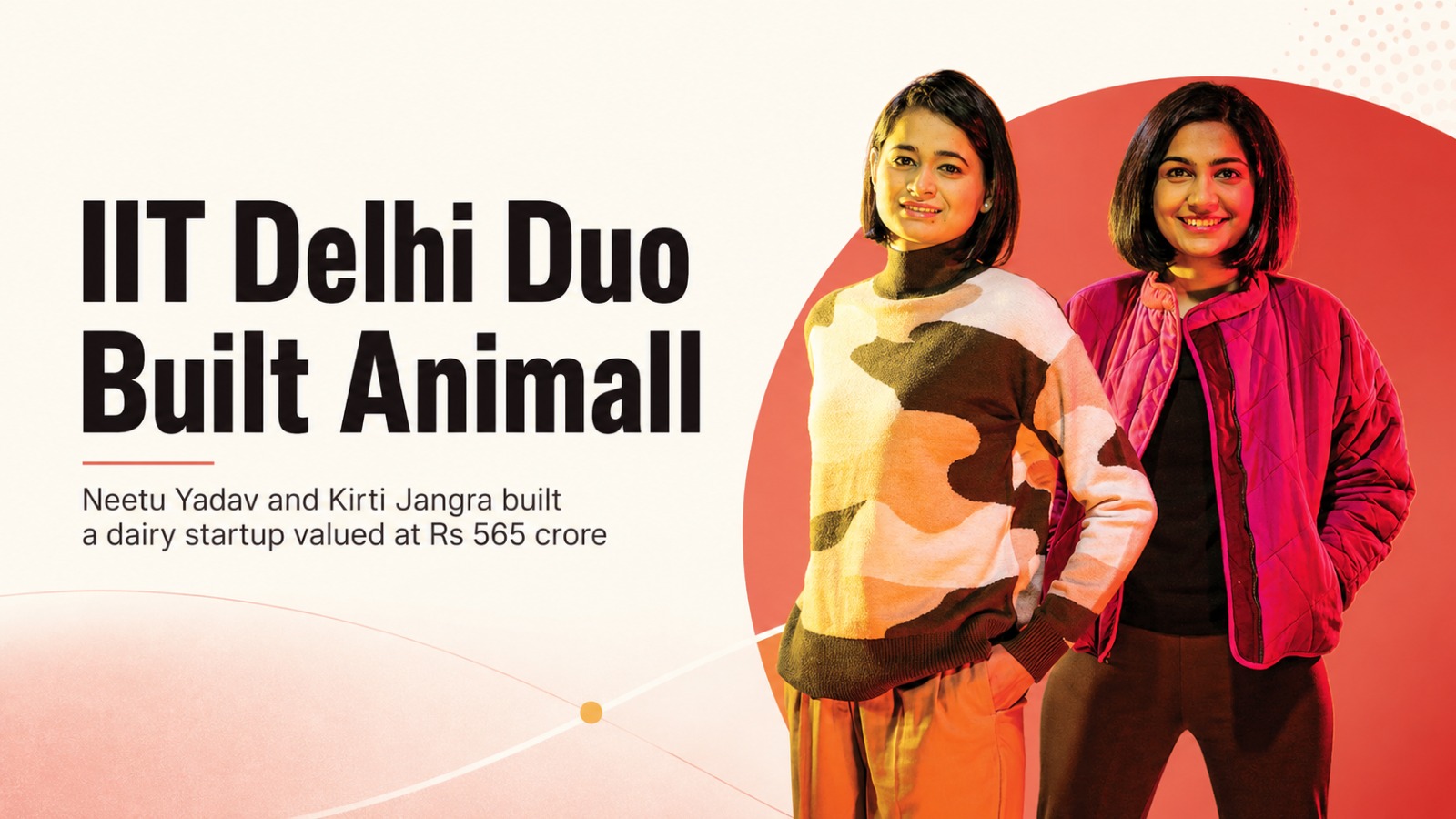
For Neetu Yadav and Kirti Jangra, the idea behind Animall began with a problem that rarely finds space in conventional startup conversations.
Dairy farmers looking to buy or sell cattle often depended on local traders, personal contacts and word-of-mouth networks. Finding the right buyer, securing a reasonable price and accessing dependable information could be difficult.
Yadav and Jangra believed technology could make that process simpler.
The two IIT Delhi civil engineering graduates, who were also college roommates, began exploring the dairy and livestock sector after starting their professional careers. Their early discussions eventually took shape as a weekend project in 2019. That project became Animall, a digital platform designed to connect cattle buyers and sellers.
A friendship that developed into a business idea
Yadav and Jangra first met while studying civil engineering at IIT Delhi. During college, they became close friends and shared an interest in building something meaningful.
After graduating, both entered the workforce, but the ambition to create a venture of their own remained.
In 2019, they turned their attention to India’s dairy and livestock economy. They noticed that cattle transactions were still largely organised through traditional networks and local markets. Farmers could struggle to locate suitable buyers, negotiate fair prices or obtain reliable details about animals available for sale.
Instead of treating these difficulties as unavoidable features of rural trade, the founders saw an opportunity to improve how the market worked.
That observation became the starting point for Animall.
Taking cattle trading online
Animall was created as an online marketplace where farmers could list cattle for sale and search for animals they wanted to purchase.
The platform attempted to bring more choice and easier access to a market that had traditionally relied on traders and personal recommendations. Rather than depending entirely on nearby contacts, users could connect with buyers and sellers through a technology-based service.
The company later expanded beyond cattle listings. Its offerings grew to include services connected with animal healthcare, artificial insemination and other forms of support for dairy farmers.
The wider purpose was straightforward: make useful technology available to rural communities and help farmers make better decisions about an important part of their livelihood.
From a weekend project to a funded startup
Animall began on a modest scale, but the idea gained momentum as more farmers started using the platform.
Its growth also reflected a broader change in India’s digital economy. Technology-led services were no longer being built only for urban consumers. Farmers and rural businesses were increasingly becoming users of digital products created to address everyday commercial problems.
Over time, Animall raised money from investors and expanded its operations. The company was reported to have reached a valuation of around Rs 565 crore following its funding rounds.
The valuation remains a reported figure, but it indicates the level of investor interest the business attracted while working in a sector often overlooked by mainstream consumer technology companies.
Engineering skills applied beyond engineering
Neither founder followed the most obvious path associated with a civil engineering degree.
Their academic training was not directly connected to cattle trading or dairy services. However, the problem-solving approach developed during their time at IIT Delhi helped them examine an unfamiliar sector, identify a practical gap and work towards a technology-led solution.
Their journey shows how technical education can be applied outside a graduate’s original field of study. It also underlines a simple feature of entrepreneurship: a business idea does not always begin with a new invention. Sometimes, it begins with a familiar problem that has not yet been solved in a convenient way.
Animall’s story is therefore not only about the growth of one startup. It is also about the gradual arrival of digital tools in markets where trust, local relationships and physical access have long shaped how business is conducted.
By focusing on cattle transactions and related dairy services, Yadav and Jangra built their venture around the daily realities of rural livelihoods. What started as a weekend experiment became a platform seeking to make one of India’s oldest trading systems easier to navigate.