For most online retailers, a delayed package is an inconvenience. For a company shipping frozen meat, fresh pet food or refrigerated groceries, a delay can destroy the product and, with it, a customer’s confidence. That difference sits at the heart of Grip, the logistics company founded by Juan Camilo Meisel.
Since launching in 2022, Grip has built its business around the operational difficulties of moving temperature-sensitive products directly to consumers. The company now ships close to 100,000 boxes a week and operates five facilities across the United States. Its revenue is projected to exceed $100 million this year, according to a person close to the company cited in the original reporting.
The growth has not come from making cold-chain logistics simpler. It has come from confronting how complicated it actually is.
A logistics problem Meisel knew from the inside
Meisel’s connection with the distribution business began long before Grip.
Growing up in Colombia, he spent time in a warehouse operated by his family, whose distribution business has been running for more than a century and across four generations. He worked alongside his father, packing orders and learning how goods moved through a logistics operation.
Even before attending college in the United States, Meisel had tried building an e-commerce business of his own. The platform grew to roughly 30,000 SKUs and delivered into remote areas of Colombia, but he eventually closed it, concluding that the market infrastructure was not yet ready for what he was trying to build.
His move to Boston was initially supposed to help him learn more about American e-commerce before taking that experience home.
Instead, it led him deeper into the industry.
After searching for Boston e-commerce startups, Meisel connected with the founder behind what would become ButcherBox and joined the business. During his first five years there, the company scaled to roughly half a billion dollars in annual revenue.
But the experience also exposed an operational contradiction.
Even at significant scale, Meisel found that logistics, fulfillment and operations remained heavily manual. Businesses selling perishable products were dealing with spoilage, expensive fulfillment and limited data-driven decision-making. Other operators in the sector began approaching him with the same problems.
That repetition suggested the problem was bigger than one company.
It became the opening for Grip.
Why shipping frozen products is different
Traditional cold storage is largely designed around controlled commercial environments. Products move in refrigerated or frozen trucks to retailers, restaurants or other distribution points.
Direct-to-consumer shipping breaks that controlled chain.
Once a package containing dry ice or gel packs leaves the fulfillment network, the product has to survive the remainder of the journey inside a box. A failure can mean more than a refund. For a consumer ordering food online, receiving a product in poor condition can quickly erode trust in the brand.
Grip initially approached the problem through technology.
Its first product focused on logistics and fulfillment decisions for refrigerated and frozen direct-to-consumer shipments. The company worked with customers from an early stage, developing its systems alongside the businesses using them.
One of the more specific changes came at the individual package level.
Grip introduced a system for determining how much refrigerant each box requires. The calculation can take into account temperature conditions during the journey, carrier performance, product type and expected transit time. Instead of treating every shipment identically, the aim is to make packaging and fulfillment decisions according to the characteristics of that particular order.
That technology, however, exposed another limitation.
Software could only change so much if the underlying warehouse infrastructure remained outside Grip’s control.
Six months in, Grip made a bigger bet
About six months after starting the company, Grip decided to enter the cold-storage business itself.
For Meisel, owning infrastructure became necessary if the company wanted to make larger changes to how orders were fulfilled rather than simply adding software on top of existing systems. That decision transformed Grip from a technology-focused operation into a business combining logistics software with physical fulfillment capacity.
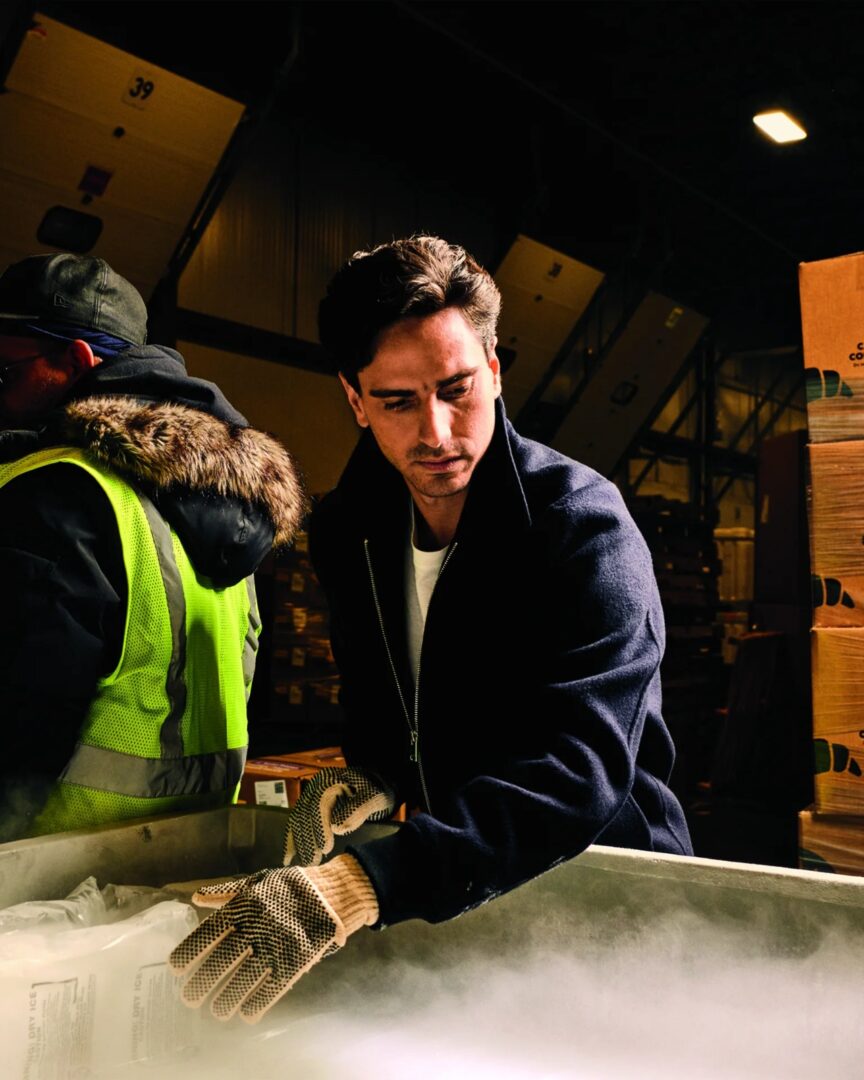
The network has since expanded to five facilities: one each in the Northeast, Florida, Texas, Michigan and Nevada.
According to Meisel, that footprint allows Grip to reach 80 percent of the U.S. population within 24 hours and the remaining 20 percent within 48 hours.
Its customer base includes businesses such as pet-food companies Maev and Smalls, while Meisel also points to categories including human-grade pet food, meat, groceries, frozen coffee and frozen pastries as examples of the broader refrigerated and frozen direct-to-consumer market.
Nearly 100,000 boxes a week changes the problem again
Grip’s current challenge is different from the one it faced at launch.
The question is no longer whether businesses need better cold-chain infrastructure. It is how quickly Grip can expand its own systems while transaction volumes rise.
The company is now handling close to 100,000 boxes every week. Meisel said Grip is also moving quickly on internal product development involving AI and using improved analytics to make more decisions for customers.
His description of the situation is revealing: the business is growing quickly enough that the company itself is working to keep pace.
That creates a notable reversal.
Grip was created because established fulfillment systems were struggling to keep up with a changing form of commerce. Four years after its launch, keeping up with the demand flowing through Grip has become one of the company’s own central challenges.
Its position in the 2026 Inc. 5000 reflects the pace of that expansion. Grip is listed at No. 6, with a 29,398 percent growth figure shown for 2026.
In Meisel’s case, the cycle is almost complete because he has been at the receiving end before in his family’s warehouse when he would pack boxes and currently running a company that is responsible for delivering tens of thousands of orders weekly.
The product may arrive inside a cardboard box, but Grip’s real business is everything required to make sure what is inside that box survives the trip.
Also Read: Sara Tendulkar’s Marriage Wishlist May Surprise You