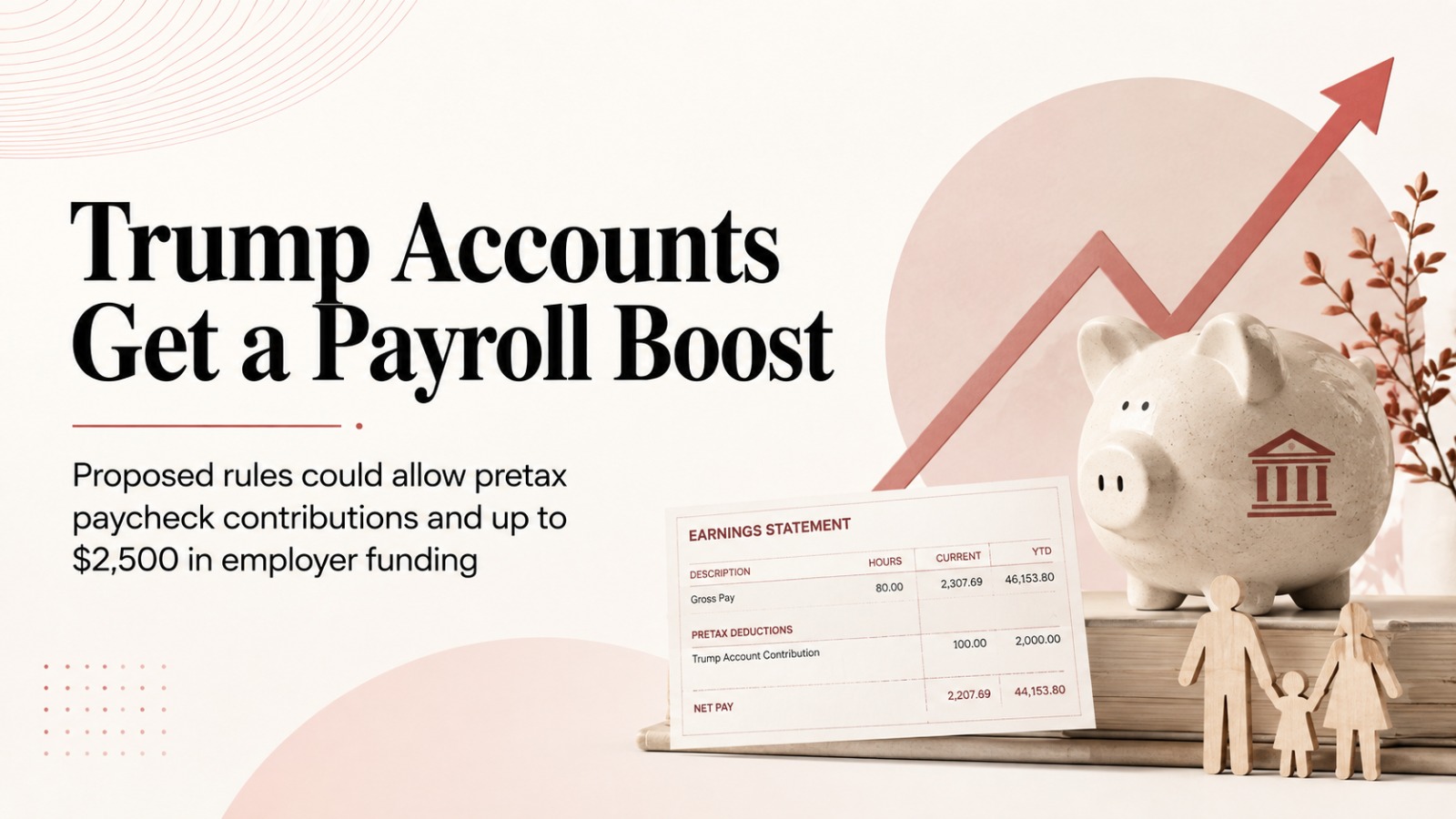
The U.S. Treasury Department and Internal Revenue Service are moving to make Donald Trump Accounts more closely connected to the workplace, proposing rules that would allow employees to fund their children’s accounts with pretax money taken directly from their paychecks.
The proposal also lays out how employers could contribute to the accounts without those payments being included in an employee’s gross income. Employers would be permitted to contribute up to $2,500 a year for an employee’s dependents, according to the Treasury guidance.
The shift could give companies a clearer path to add Trump Account contributions to employee benefit programs. Until now, employer enthusiasm appeared limited. An April Mercer poll of nearly 350 U.S. employers found that only around 4% expected to introduce a Trump Account contribution program in 2026 or 2027, while two-thirds had already decided against making contributions.
That contrast is important. Treasury is not simply expanding the ways families can put money into the accounts. It is also trying to remove some of the administrative uncertainty that may have kept employers on the sidelines.
Payroll deductions could become a new route for parents
Under the proposed framework, companies could allow workers to send pretax dollars directly from their paycheck into the Trump Accounts of dependent children.
Treasury Secretary Scott Bessent said the guidance is intended to help families build the accounts by giving employers the ability to contribute tax-free and allowing employees to make pretax contributions themselves.
That would make Trump Accounts more closely resemble workplace-linked savings benefits in the way contributions are handled, although the rules governing the accounts remain distinct.
The regulations are still proposed, rather than final. Treasury and the IRS issued a notice of proposed rulemaking, with the plan subject to public comments and a hearing scheduled for October before final rules can be issued.
That distinction matters for employers considering whether to build payroll or matching programs around the accounts.
Employers can contribute up to $2,500 within the annual limit
Trump Accounts, also known as 530A accounts, are available to U.S. children under the age of 18 who have a Social Security number.
Once an account is established, parents, guardians, grandparents and others can contribute up to $5,000 annually until the year before the beneficiary turns 18.
Employer contributions count toward that overall annual ceiling and can total as much as $2,500 per worker each year.
The proposed payroll mechanism therefore does not create a separate unlimited pool of workplace contributions. Instead, it gives families and employers another method of funding an account within the existing contribution framework.
More than 50 companies have committed to contributions
Employer participation is already beginning to take shape.
Treasury said more than 50 companies had committed to making Trump Account contributions for employees as of Tuesday, with some businesses offering to match the government’s $1,000 initial contribution available to eligible children.
Melissa Elbert, a partner of wealth solutions at Aon, said the latest guidance gives employers a clearer view of the administrative and compliance framework and could encourage more companies to consider participating.
That could become the next test for the program: whether regulatory clarity is enough to turn early corporate commitments into a broader employee benefit.
The Mercer survey suggests Treasury still has considerable ground to cover. With only about 4% of surveyed employers previously expecting to launch contribution programs and two-thirds saying they would not participate, employer adoption was far from widespread before the new guidance arrived.
About 7 million children have already been signed up
The workplace proposals arrive as enrollment in Trump Accounts builds.
Bessent said roughly 7 million children had been signed up as of remarks delivered at a July 27 meeting of the Financial Literacy and Education Commission.
Children born between 2025 and 2028 can receive a one-time $1,000 Treasury deposit under a pilot program intended to begin their long-term savings.
The combination of that government deposit, private family contributions and possible employer payments gives the accounts several potential funding channels.
The most consequential development in the latest proposal, however, may be the paycheck itself. If the rules are finalized and employers choose to participate, parents could fund a child’s account as part of their regular payroll process rather than relying solely on separate after-paycheck contributions.
For companies, the question now moves from whether Trump Accounts can be incorporated into employee benefits to whether enough employers see value in doing so.
Also Read: Sara Tendulkar’s Marriage Wishlist May Surprise You