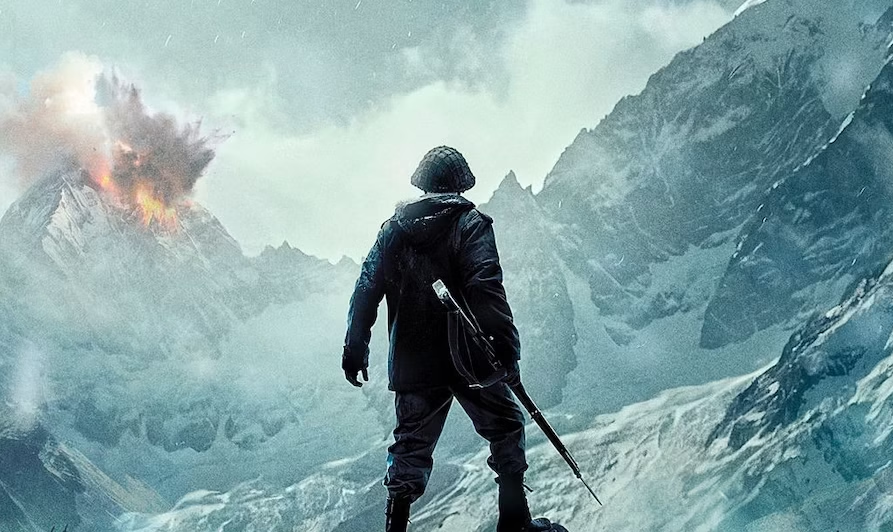
Nearly a week after the latest round of protests and petitions, the controversy around Farhan Akhtar’s war film 120 Bahadur has settled into a quieter but determined confrontation. The movie, based on the 1962 Battle of Rezang La, is not just a film release for the Ahir community of south Haryana and neighbouring regions, it has become a test case for what they see as long-denied recognition of their soldiers’ sacrifice.
120 Bahadur: From street protests to a call for boycott
Over the past few days, the agitation has moved through two distinct phases.
In the first, community leaders gathered near the Kherki Daula toll plaza in Gurgaon in a large panchayat that doubled as a dharna. Men sat cross-legged under a shamiana, passing around hookahs as speaker after speaker took the mic to denounce 120 Bahadur and demand that its title be changed.
Leaders of the Sanyukt Ahir Regiment Morcha and affiliated groups accused the filmmakers of not adequately crediting the “balidan (sacrifice)” of nearly 120 Ahir soldiers of the 13 Kumaon Regiment who defended Rezang La during the 1962 India-China war.
According to them, the film’s trailer, released earlier this month, did not sufficiently reflect that the martyrs at Rezang La were Ahir soldiers, even though the film claims to be based on true historical events.
At that panchayat, speakers urged the community to paste “Boycott 120 Bahadur” posters and warned that they would not allow the film to run in theatres if their demands were ignored. They also announced plans to file FIRs against Farhan Akhtar and others associated with the film, and to seek interventions from MPs and MLAs in districts where the Ahir community has a significant presence.
Court nod for release and a fresh legal strategy
Even as protests grew, the legal battle was already underway.
Representatives of the Ahir community, including Sanyukt Ahir Regiment Morcha members and others who identify themselves as relatives of soldiers who fought at Rezang La, had approached both the Punjab and Haryana High Court and the Delhi High Court against the film.
They argued that 120 Bahadur distorts historical facts and demanded that its title be changed.
On Wednesday, the Delhi High Court cleared the way for the movie’s release, closing a plea that had challenged the Central Board of Film Certification (CBFC) clearance. This followed an affidavit from the filmmakers and the CBFC, in which they assured the court that the film would display the names of all 120 Ahir soldiers who laid down their lives in the Rezang La battle.
That assurance did not fully placate the protesting groups. A day later, members of the community reiterated their opposition, but crucially, they modified their approach.
On Thursday, leaders of the Morcha announced that they were calling for a boycott of 120 Bahadur and asked people not to watch the film. At the same time, they made it clear that they would not disrupt screenings or carry out violent protests at cinema halls. Instead, they said they would continue their fight in a “peaceful and legal manner” and move court again with a fresh petition.
What exactly are the objections?
While the agitation is being widely described as a “boycott call”, community leaders repeat three specific grievances:
- Objection to the title: Leaders say the title 120 Bahadur is too generic and fails to clearly signal that the story is about the Ahir soldiers of Rezang La. They argue that the battle and the regiment that fought it, is deeply woven into Ahir identity and local folklore, and that any cinematic retelling must reflect that explicitly.
- Alleged misrepresentation and under-crediting: Protesters allege that the film, especially as suggested by the trailer, does not do justice to the historical record of nearly 120 Ahir soldiers of the 13 Kumaon Regiment who defended Rezang La against overwhelming Chinese forces. They say the narrative appears to “promote a few people and one community” instead of acknowledging the specific contribution of Ahirs.
- Insufficient consultation with families of martyrs: The Morcha has demanded that descendants of Ahir soldiers who fought in 1962 be invited for the film’s screening and that no-objection certificates be taken from them. They argue that since the film markets itself as being based on true events, the families of those who actually fought must have a say in how that story is told.
A battle that lives on in local memory
Much of the intensity around 120 Bahadur stems from the place Rezang La holds in the Ahir belt of south Haryana.
Leaders repeatedly describe the Rezang La stand as a “historical and inspiring fight” waged by soldiers from their region against numerically superior Chinese forces. These stories, they say, have been passed down as folklore across villages, shaping local pride and identity.
The decision to call for a boycott is therefore framed not as opposition to cinema itself, but as part of a longer struggle for “due recognition” of the Ahir contribution to the 1962 war. “We are fighting for the due recognition of the contribution of the brave soldiers of the region,” one Morcha leader said, stressing that the agitation would continue through legal channels.
From ‘won’t let it run’ to ‘won’t disrupt screenings’
Read together, the two recent phases of the protest show a subtle shift in tactics.
At the panchayat near Kherki Daula, some leaders used sharp language, telling the gathering that they would “not let [the film] run in theatres” and urging the community to stay united against what they described as a “money-making venture” that the public should avoid in its current form.
After the Delhi High Court’s order and the affidavit promising to display the names of all 120 Ahir soldiers, the tone of the leadership publicly moved towards a more restrained line: a clear boycott call, but coupled with an assurance that screenings would not be forcibly disrupted and that the fight would remain “peaceful and legal”.
This evolution reflects two pressures at once, a need to keep the community mobilised and assertive about its history, and a recognition that any attempt to physically block screenings would invite legal action and wider public backlash.
From today’s vantage point, almost a week after the latest protests and court developments, the picture is clearer:
- The film has judicial clearance to be released, following the producers’ commitment to name all 120 Ahir soldiers in the Rezang La sequence.
- The Ahir community’s organised groups remain firmly opposed to the film’s title and what they see as its framing of history, and they are urging people to stay away from 120 Bahadur.
- Their strategy has shifted from talk of stopping the film from running to a mix of social boycott, fresh legal petitions, and planned FIRs against the filmmakers.
For now, the boycott call places the decision squarely in the hands of audiences. The Ahir community’s leadership is betting that moral pressure, historical pride and legal arguments will together succeed where direct confrontation with cinema halls could not.
Also Read: Samantha Ruth Prabhu Partners with Zoy to Make Period Care Smarter & Cleaner