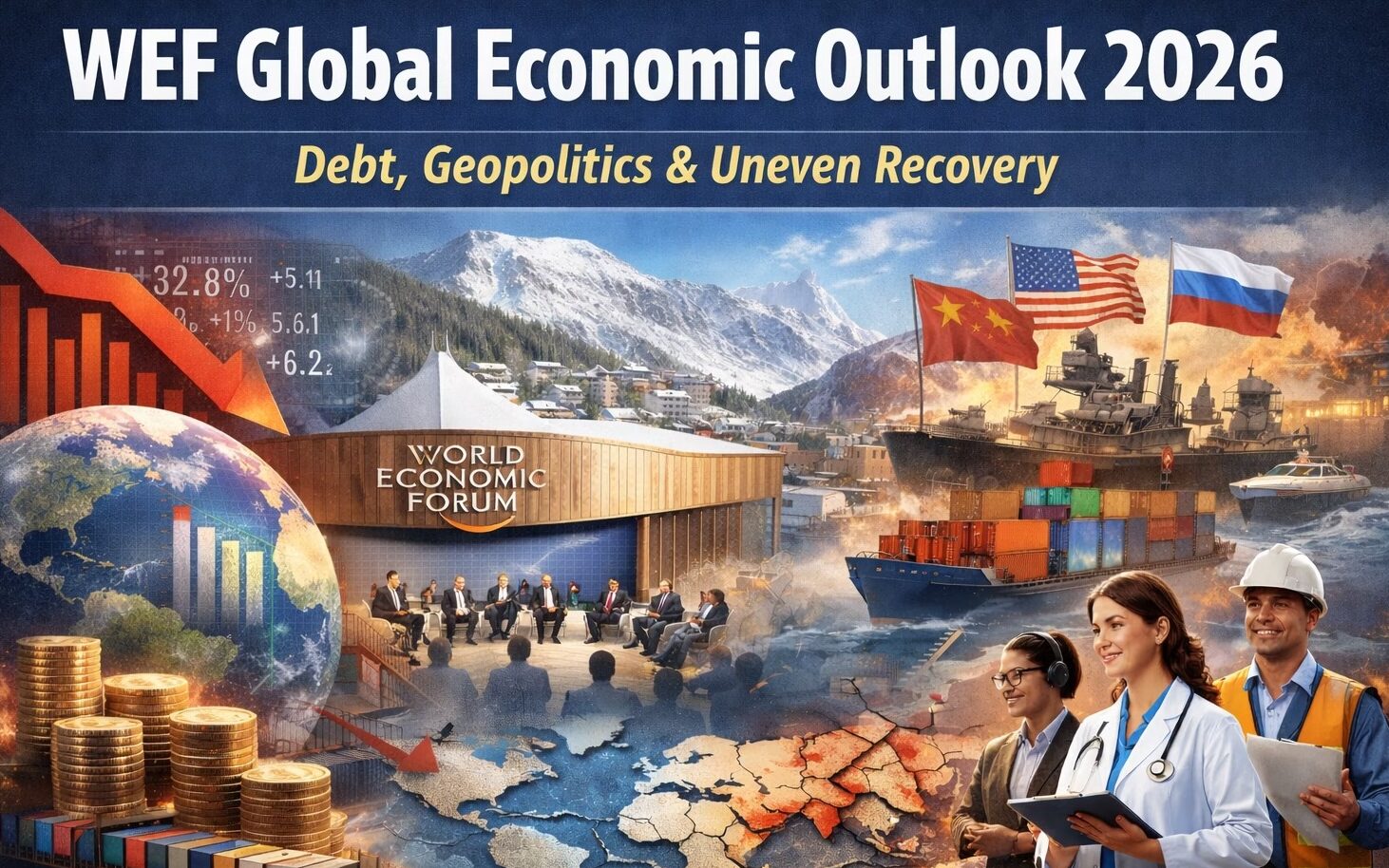
The WEF Global Economic Outlook 2026 is a pessimistic and more complicated vision of the entire global economy, which warns that the economic situation is likely to deteriorate throughout 2026. The chief economists involved in the judgment note the growing debt obligations, chronic geopolitics, and unsound international trade relations as major factors influencing an environment of slower and more uncertain growth. Although the expectations are not as bleak as those made at the end of 2025, it still highlights the fact that the world recovery is not yet stable and smooth.
According to the evaluation carried out by surveys and expert analysis on behalf of the World Economic Forum, it can be concluded that the global economy passes through the period of adaptation, but not collapse. The growth is projected to proceed but at a low rate with drastic differences between regions and sectors.
The Growth Momentum of the World Economy Is Wearing Out, WEF
The WEF Global Economic Outlook 2026 states that, due to long, tight financial conditions, economic momentum is being held back. Investment appetite and consumer spending in most of the advanced economies have been slowed down by high interest rates, which have been introduced to check the inflation. The manufacturing business is faced with low global demand and the prevalent occurrence of supply chain disruption. The emerging economies, on the other hand, are experiencing volatile capital flows and increased cost of servicing their debts, which is limiting their policy choices.
Also Read: Maruti Suzuki Commits Rs 35,000 Crore for New Mega Manufacturing Plant in Gujarat
Debt Overhang Turns into a Structural Risk.
One of the key issues that is being raised in the WEF Global Economic Outlook 2026 is the size of the public and private debts that the world has been accumulating over the last several years. The widened fiscal space that governments used to cope with the series of global shocks over the years is being compelled to shrink. This is a burden of debt that is limiting their investment in infrastructure, social protection, and long-term development priority. Economists caution that in the absence of proper management of debt, the vulnerabilities may become more pronounced, and this may cause more financial stress in the developed and developing economies.
Geopolitical Tensions Reshape Global Trade
Geopolitical uncertainty continues to weigh heavily on the global economic landscape. The WEF Global Economic Outlook 2026 emphasizes that trade tensions, regional conflicts, and strategic rivalries are reshaping global economic relations. As countries prioritize economic security and resilience, protectionist policies and industrial subsidies have become more widespread. These trends are fragmenting global trade networks, raising costs for businesses, and weakening confidence among investors.
Resilience Prevents a Sharper Downturn
Despite these headwinds, the WEF Global Economic Outlook 2026 does not foresee a dramatic global downturn. The services sector remains a key source of strength, supported by digitalization, tourism recovery, and sustained consumer demand in several regions. Large emerging economies, particularly in South Asia, continue to play an important role in sustaining global growth. This resilience explains why the current outlook is less negative than assessments made toward the end of 2025.
Looking ahead, the WEF Global Economic Outlook 2026 underscores the importance of prudent economic management in the coming year. Governments are urged to pursue sustainable debt strategies, rebuild trust in multilateral trade systems, and support productivity-enhancing investment. The success of these efforts will determine whether 2026 becomes a year of stabilization or one marked by prolonged uncertainty.
In essence, the WEF Global Economic Outlook 2026 delivers a clear message: the global economy is slowing, but it is not without strength. The year ahead will test the capacity of policymakers and institutions to manage risk, cooperate across borders, and lay the groundwork for more resilient and inclusive growth.
Also Read: DGCA Slaps ₹22.2 Crore Penalty on IndiGo Over December Flight Disruptions