Florida Primary 2026: Byron Donalds and David Jolly are headed for a sharply contrasting governor’s race, while Angie Nixon’s victory over Alex Vindman delivered one of Florida’s clearest surprises of primary night.
Florida voters have settled the names on some of the state’s most closely watched November ballots. What they have not settled is the bigger question hanging over the state: how much can Tuesday night’s primary numbers really tell us about the general election?
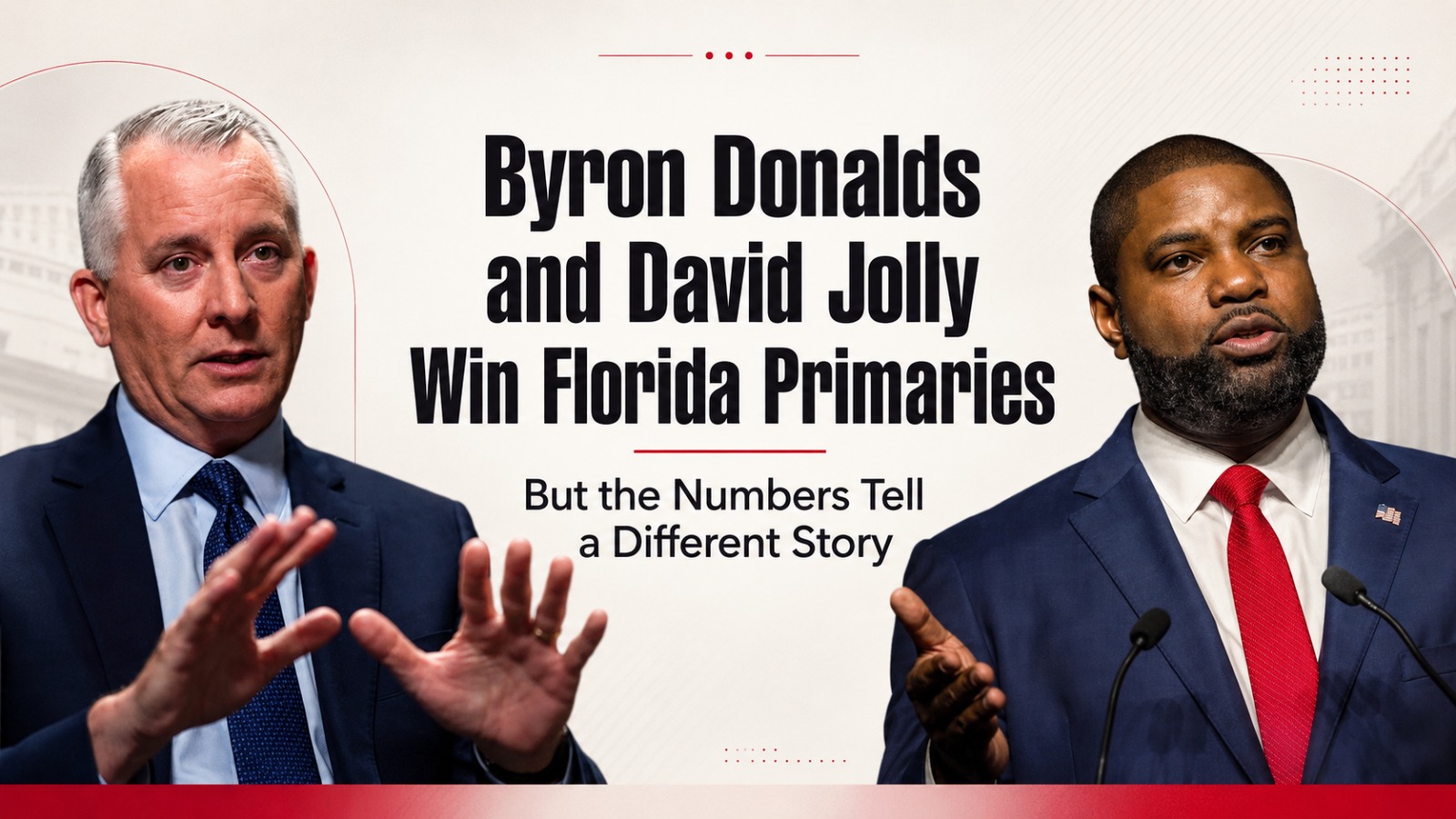
Republican Rep. Byron Donalds won his party’s nomination for governor with 47.8% of the vote, while former Republican congressman David Jolly captured the Democratic nomination with 61%. In the Democratic special primary for the U.S. Senate, state Rep. Angie Nixon defeated Alex Vindman 56% to 44%, adding an upset to a night already filled with political contrasts.
Those three numbers tell three different stories.
Donalds emerged with a decisive lead over his Republican rivals but without a majority. Jolly, who switched parties only last year, won nearly two-thirds of a Democratic electorate. Nixon defeated a nationally known opponent who had heavily outspent her.
But there is one important piece of context before treating those percentages as a preview of November.
Florida uses closed partisan primaries. Registered Republicans vote in the Republican primary, registered Democrats vote in the Democratic primary, and unaffiliated voters do not participate in choosing partisan nominees. Donalds’ 47.8% and Jolly’s 61% therefore came from two different pools of voters, not from the same statewide electorate.
That distinction makes Tuesday’s results more useful as a measure of each candidate’s standing inside his own party than as a forecast of their head-to-head contest.
Donalds won comfortably, but the 47.8% matters
Donalds entered the Republican primary with major advantages, including President Donald Trump’s endorsement, substantial financial resources and a crowded opposition field.
With 99% of the expected vote counted in the NBC News tally, Donalds had 809,109 votes, or 47.8%. Lt. Gov. Jay Collins was a distant second with 425,879 votes and 25.2%, while James Fishback had 177,329 votes and 10.5%.
There is no ambiguity about who won. The more interesting detail is that Donalds still finished below 50%.
CNN’s election coverage singled out that result, noting that his combination of Trump’s endorsement, money and a divided field had given him significant advantages going into the primary.
Donalds himself appeared to acknowledge that an endorsement alone cannot carry a campaign. After his victory, he described Trump’s support as important while arguing that a candidate still had to win voters rather than simply rely on presidential backing. He also called for Republicans to unite after the primary.
His campaign has promised tax cuts, changes to Florida’s insurance regulations aimed at lowering consumer costs and greater price transparency from healthcare providers.
November could also carry historic significance. Donalds would become Florida’s first Black governor if elected.
Jolly’s 61% is striking for a different reason
Jolly’s route to the Democratic nomination is unusual.
He is a former Republican member of Congress who switched parties last year. Yet Democratic primary voters gave him a commanding victory.
With 99% of the expected vote in, Jolly had 758,277 votes, or 61%. Dayna Foster followed with 188,108 votes and 15.1%, while Dotie Joseph had 119,041 votes and 9.6%.
The closed-primary system makes that result particularly notable. Jolly did not win his nomination by drawing unaffiliated voters into a Democratic contest. He persuaded registered Democratic primary voters to nominate a politician who had previously represented the other party.
Jolly has not tried to erase that political history.
His victory-night message combined an embrace of capitalism and lean government with an argument that government still has responsibilities in areas such as education and housing. He has also presented his opposition to political “culture wars” through the language of limited government rather than as a rejection of his previous political identity.
That creates an unusual general-election contrast. Donalds enters November closely identified with the contemporary Republican coalition and backed by Trump. Jolly enters it as a Democrat openly carrying parts of his former Republican identity with him.
It is also the second consecutive Florida governor’s election in which Democrats have nominated a former Republican. Four years ago, the party nominated former Gov. Charlie Crist, who lost to Ron DeSantis by nearly 20 percentage points.
Jolly will now attempt something Florida Democrats have not achieved this century: winning the governor’s office.
Angie Nixon delivered the night’s clearest upset
If the governor primaries established November’s main matchup, the Democratic Senate result provided the night’s surprise.
Nixon defeated Vindman 56% to 44%. CNN’s tally showed Nixon with 701,294 votes to Vindman’s 550,589 with 99% of the estimated vote counted.
The result becomes more striking when the campaign’s financial imbalance is considered. Nixon was heavily outspent by Vindman, according to Associated Press reporting.
Vindman brought national recognition from his military career and his role as a National Security Council official who became a key witness in Trump’s first impeachment inquiry. Nixon, a state representative and democratic socialist, nevertheless won by roughly 12 percentage points.
She will face Republican Sen. Ashley Moody in November in the special election to complete the final two years of Marco Rubio’s Senate term.
The historical hurdle is significant. Florida voters have not elected a Democrat to the U.S. Senate since 2012. Nixon would also become the state’s first Black U.S. senator if she wins the general election.
Vindman quickly backed his former opponent after the result, saying Nixon had run a strong campaign and that he would support her against Moody.
The rest of the Florida ballot carried its own messages
Tuesday was not simply a night when one ideological faction swept through every contest.
Longtime Democratic Rep. Debbie Wasserman Schultz won the nomination in Florida’s redrawn 20th Congressional District, defeating a field that included former Rep. Sheila Cherfilus-McCormick. Several of her Black opponents had argued that the plurality-Black district should be represented by a Black lawmaker, while Wasserman Schultz campaigned on her congressional experience dating to 2005.
Republican Rep. Cory Mills, meanwhile, lost his primary in the 7th Congressional District to former television news reporter Ryan Elijah. The district, stretching from outside Orlando toward Daytona Beach, leans Republican.
Together, the races resist a single tidy interpretation of Florida’s primary electorate.
A Trump-backed Republican won the governor nomination but remained below 50%. A former Republican won a Democratic governor primary with 61%. A democratic socialist defeated a better-funded, nationally recognized Senate rival. One veteran Democratic incumbent survived a complicated redistricting contest, while a Republican House incumbent was removed by his own party’s voters.
What changes now?
Ron DeSantis cannot seek a third consecutive term, leaving Florida with an open governor’s race and two nominees offering very different political arguments.
Donalds now has to consolidate Republicans who split their primary votes among multiple candidates while taking his economic and insurance message to a broader electorate.
Jolly has to determine whether the cross-partisan identity that Democratic primary voters accepted can work beyond the primary electorate.
Nixon faces an even steeper statewide test against Moody in a state where Democrats have gone more than a decade without winning a U.S. Senate election.
Tuesday answered who gets to run.
Whether Donalds can turn Republican advantage into a majority coalition, whether Jolly can make political reinvention an asset rather than a liability, and whether Nixon’s underdog primary victory can survive the very different electorate that votes in November.