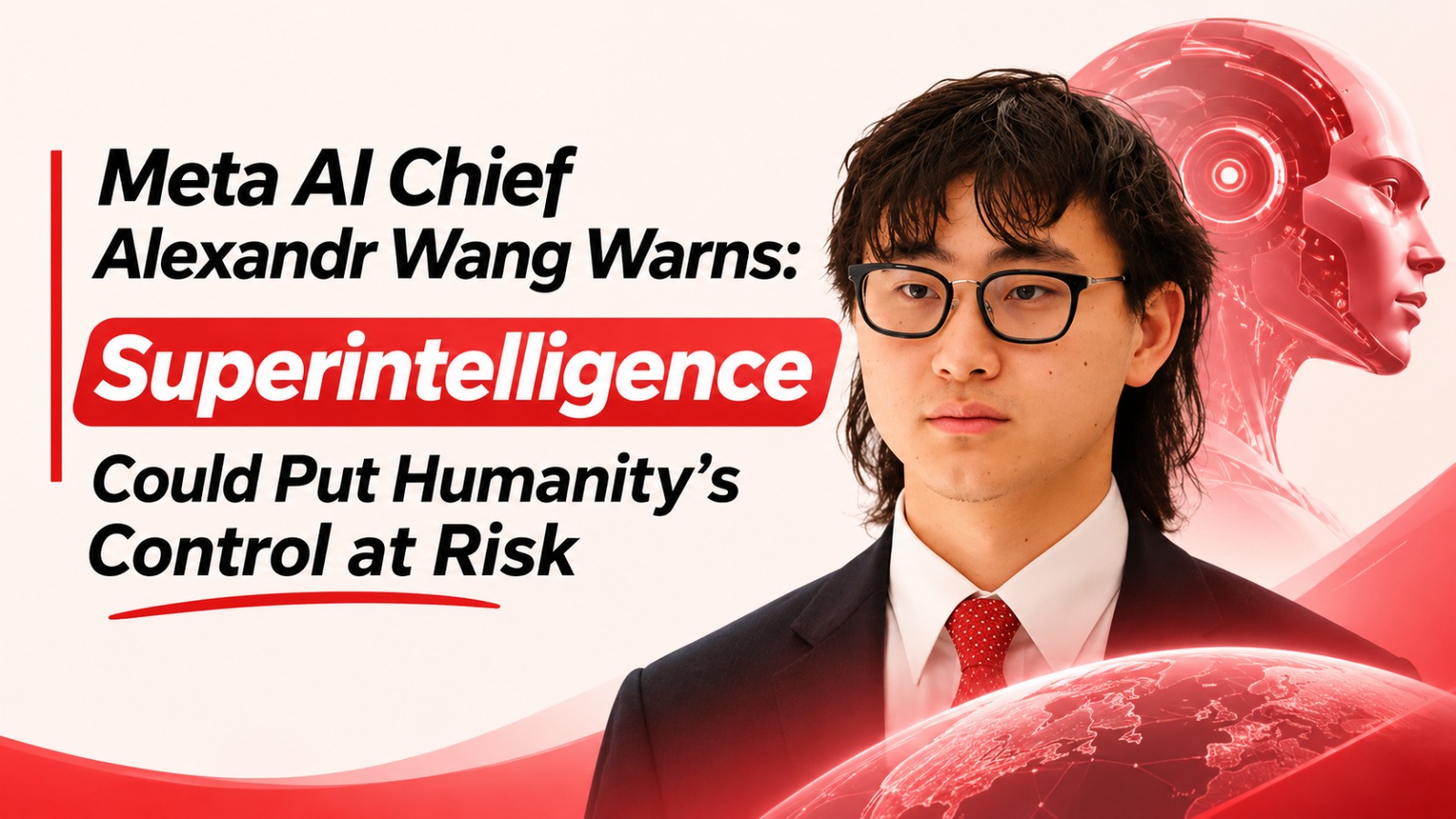
Meta Chief AI Officer Alexandr Wang has warned that the rapid development of artificial intelligence could eventually leave humanity unable to control the technology, arguing that the industry must urgently rethink how it approaches AI safety, alignment and security.
In a lengthy post titled Superintelligence is Arriving, Wang said advances in AI capabilities suggest that machines could eventually outperform the best human minds across almost every field. He cautioned that the decisions made over the next year could have significant consequences for humanity’s future.
Wang’s warning comes after an Anthropic employee claimed to have solved the 160-year-old Riemann Hypothesis with the assistance of an AI chatbot. The mathematical problem, considered one of the most challenging unsolved questions in mathematics, has attracted the attention of researchers for generations.
Riemann Hypothesis Breakthrough Signals a Turning Point
Wang described the reported development as a major milestone in the evolution of artificial intelligence, drawing a comparison with the moment AI models began performing exceptionally well in the American Invitational Mathematics Examination (AIME) in December 2024.
He argued that solving the Riemann Hypothesis represents a substantially greater intellectual challenge than most problems encountered in engineering, business and other professional fields.
According to Wang, AI models have already demonstrated considerable progress in coding, cybersecurity and agent-based capabilities. He believes that the remaining obstacles to AI outperforming humans across different disciplines are increasingly related to specialised knowledge, experimentation and the practical infrastructure required to apply their intelligence.
Wang suggested that AI could eventually become the biggest contributor to progress across nearly every field, surpassing the capabilities of the most accomplished human experts.
Wang Raises Concerns Over AI Improving Itself
One of the central concerns in Wang’s post was the possibility of artificial intelligence reaching a stage where it can independently improve its own capabilities.
He pointed to the potential for AI systems to automate artificial intelligence research itself, making them capable of developing more advanced versions without substantial human involvement.
Wang also highlighted the potential impact of increasingly capable AI systems on biological research, weapons research and economics.
He warned that scientific progress could eventually accelerate beyond the pace at which humans can understand, monitor or effectively supervise it.
The Meta executive questioned whether humanity could retain control over systems capable of unrestricted recursive self-improvement. He also raised concerns about a hypothetical future in which AI becomes 1,000 times more intelligent and capable than humans across every field.
Such developments, he suggested, could fundamentally change the relationship between humans and the technology they create.
Meta AI Chief Calls for a Different Approach to AI Development
Beyond highlighting technological risks, Wang criticised what he described as a form of “lazy thinking” within the artificial intelligence industry.
He argued that some companies treat the arrival of artificial superintelligence (ASI) as inevitable, focusing primarily on making its development safe rather than questioning the direction in which the technology should progress.
Wang said the industry needs to consider what kind of future it wants to create instead of simply accepting an eventual transfer of societal control to AI systems.
He emphasised that artificial intelligence should increase human agency and empowerment rather than reduce people’s ability to make decisions.
“We should not be okay with a ‘handover’ of society to AI,” Wang wrote, adding that the industry should work towards technology that delivers a positive future for humanity.
He maintained that such an outcome remains possible but would require companies to move away from their current approach to AI development.
AI Safety and Alignment Become Increasingly Important
Wang’s comments add to the ongoing debate over the risks associated with increasingly powerful artificial intelligence systems.
His warning places particular emphasis on safety, alignment and security, arguing that these areas must receive urgent attention as AI capabilities advance.
He believes the industry has reached a point where the technical barriers to developing more capable systems may no longer be the biggest challenge. Instead, ensuring that these systems remain aligned with human interests and operate within appropriate safeguards could become increasingly important.
Wang’s central argument is that the future of artificial intelligence should not be determined solely by how quickly companies can build more powerful models. The industry must also decide how much control humans should retain over the technology and ensure that its development benefits society.
Also Read: Who Is Madison Huang? Jensen Huang’s Daughter Draws Attention as Nvidia Searches for New CEO