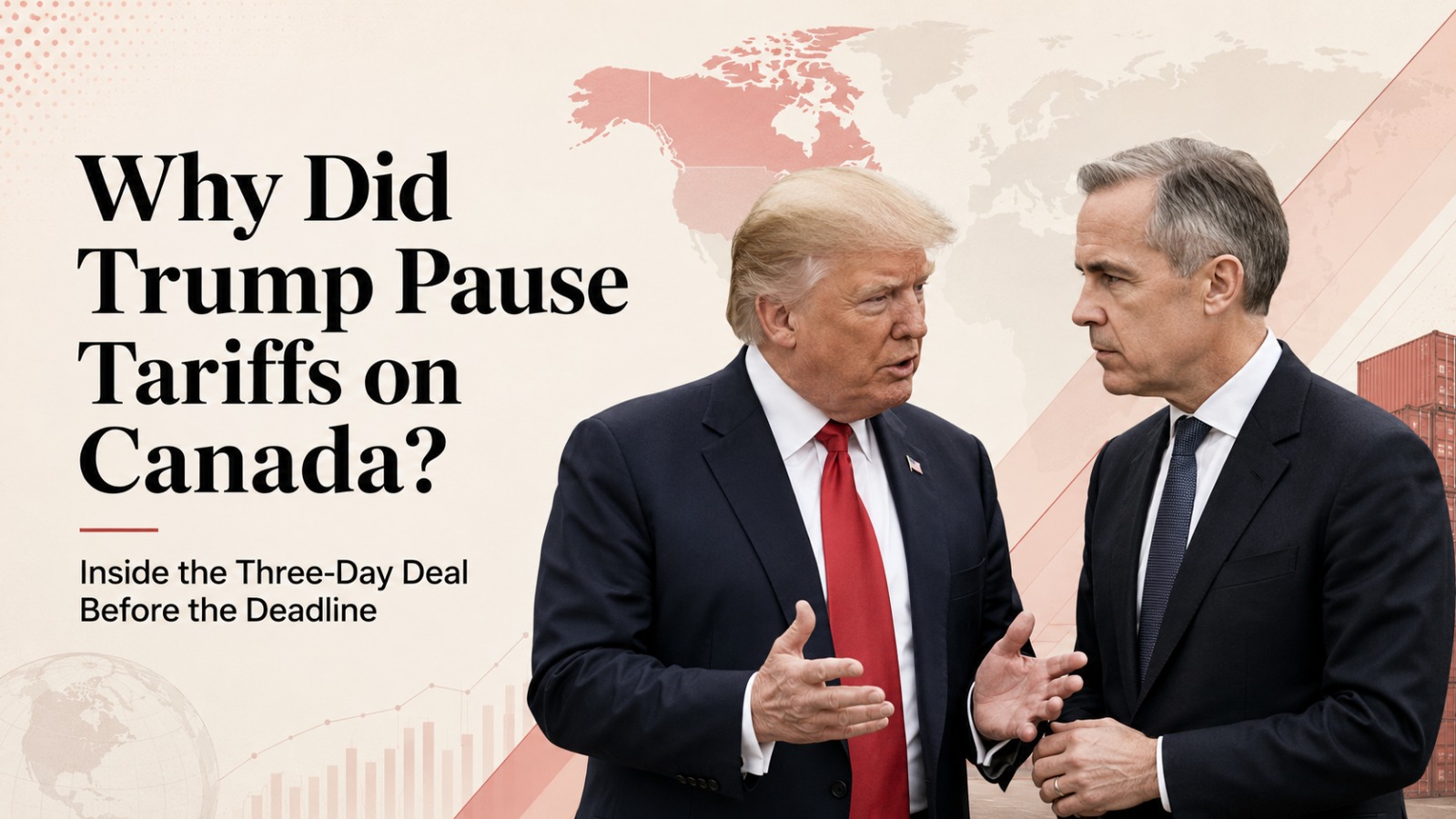
Donald Trump’s decision to pause a threatened 50 percent tariff on Canadian goods came down to a last-minute breakthrough, but not a finished trade agreement.
The US president announced the three-day delay shortly before the tariffs were due to take effect at midnight, after talks with Canadian Prime Minister Mark Carney produced what Trump described as a deal “subject to finalization of documents”. Carney later confirmed that Washington had agreed to suspend the tariffs until August 22.
That distinction is important. Trump did not permanently withdraw the tariffs. The pause gives Washington and Ottawa a narrow window to complete the paperwork and settle the outstanding issues behind an increasingly tense trade dispute.
So, why did Donald Trump pause the tariffs?
The clearest answer is that the two sides made enough progress in negotiations to prevent the 50 percent duty from taking effect immediately.
Trump and Carney had held talks after weeks of difficult negotiations, and the temporary reprieve followed those discussions. Carney said “substantial progress” had been made, but acknowledged there was still “important work” to complete.
Neither government, however, disclosed the full terms of the understanding that triggered the pause. That means it would be premature to describe the three-day extension as a completed trade deal.
For now, it is better understood as extra negotiating time secured just before the deadline.
$20.2 billion in Canadian exports were facing the tariff
The economic stakes were significant.
The proposed 50 percent duty would have covered about $20.2 billion worth of Canadian exports, including electronics, industrial machinery, furniture, dairy products and wine.
For Canadian exporters, even a three-day delay offers immediate relief. Canada sends approximately 70 percent of its exports to the United States, making the US market far more important to Canadian businesses than any other single destination. The United States, by comparison, sends about 30 percent of its exports to Canada.
That dependence helps explain why Ottawa had been pressing for a breakthrough before the tariff deadline.
Keystone XL unexpectedly entered the picture
One of the more unusual elements surrounding the pause is the return of the Keystone XL Pipeline to the conversation.
Trump appeared to connect progress in the trade talks with his long-standing interest in reviving the project. Keystone XL was designed to transport roughly 830,000 barrels of crude oil per day from Alberta to Nebraska.
Former US President Joe Biden revoked a key permit for the US section of the pipeline in 2021, effectively stopping the project. Trump has now suggested it could return, writing that the pipeline “may be awoken from the grave”.
What remains unclear is whether Keystone XL is actually part of the emerging trade agreement or simply one of the issues Trump wants included in the wider negotiations.
Neither Trump nor Carney has released enough detail to establish that the tariff pause was granted specifically in exchange for movement on the pipeline.
The dispute goes beyond one tariff
The confrontation between Washington and Ottawa has been building around several trade grievances.
Trump announced the latest tariffs using Section 338 of the Tariff Act of 1930, citing what Washington called Canada’s “discriminatory treatment” of American automobiles, dairy products and alcoholic beverages. The move was notable because the proposed duties would also have affected goods that otherwise qualify for duty-free treatment under the United States-Mexico-Canada Agreement.
Alcohol has become one of the most visible areas of retaliation.
Eight of Canada’s 10 provinces have blocked sales of US-made alcoholic beverages since early last year in response to Trump’s earlier trade measures. Washington has pointed to those restrictions when explaining its latest tariff threat.
Canada’s supply management system has also become a sticking point. The system sets production and import quotas for dairy, eggs and poultry, and Canadian provincial leaders have shown reluctance to make concessions over it.
Carney has little room for an easy compromise
The challenge for Carney is not simply reaching an agreement with Trump.
Any deal must also navigate political pressure inside Canada, including provincial governments and a public mood that has hardened during the trade dispute.
A July poll by Nanos Research found that 69 percent of Canadians surveyed said they were unlikely to purchase US alcohol even if government bans were removed. Another poll from the Angus Reid Institute found 48 percent of respondents held an unfavourable view of Americans, compared with 45 percent who had a positive impression.
Canadian officials have spent weeks in Washington trying to persuade the Trump administration to abandon the tariffs in exchange for trade concessions. Carney himself has described the negotiations at different points as “nasty”, “delicate” and “intense”.
That backdrop makes the three-day extension significant, but also fragile.
What happens on August 22?
The next deadline is now August 22.
Unless Washington and Ottawa finalise their agreement before then, the underlying tariff threat remains unresolved. The documents still have to be completed, the precise concessions have not been publicly disclosed, and neither government has provided a detailed account of what each side has agreed to.
So why did Trump pause the tariffs?
Because the negotiations moved far enough to justify giving both sides more time, but not far enough to end the dispute.
For Canadian exporters, the immediate threat has been delayed. For Trump and Carney, the harder task now is turning a three-day reprieve into an agreement that can survive beyond the next deadline.
Also Read: Butterfly Learnings Raises Rs 65 Cr in Pre-Series B Led by Inflexor Ventures