Every country has its own currency, and this currency plays a central role in daily life, trade, and economic stability. People earn, spend, save, and invest using their national currency. However, when currencies are compared globally, their values can differ widely. Some currencies are worth much more than others when exchanged, which often leads to confusion about what makes a currency strong and which one actually dominates the world economy.
Why Some Currencies Are Worth More Than Others
The value of a currency is shaped by several economic and policy-related factors. These include government monetary policies, the amount of money in circulation, foreign exchange reserves, economic stability, and global demand for that currency. A country that carefully controls its currency supply and maintains strong reserves often sees a higher exchange value. In contrast, countries with higher money circulation or inflation may have currencies with lower exchange values.
It is important to understand that a higher exchange value does not automatically mean a country has a stronger or larger economy. Currency value and economic power are related, but they are not the same thing.
Also Read: DGCA Slaps ₹22.2 Crore Penalty on IndiGo Over December Flight Disruptions
The Global Image of the US Dollar
When people think about global currency, the US dollar usually comes to mind first. It is widely used in international trade, foreign exchange reserves, and global financial markets. The dollar appears frequently in movies, business deals, and cross-border transactions, which adds to its visibility and influence.
However, popularity and widespread use do not mean the dollar is the most valuable currency in terms of exchange rate. In fact, several currencies are worth significantly more than the dollar when converted into other currencies, including the Indian rupee.
Kuwaiti Dinar Tops the Global Value Chart
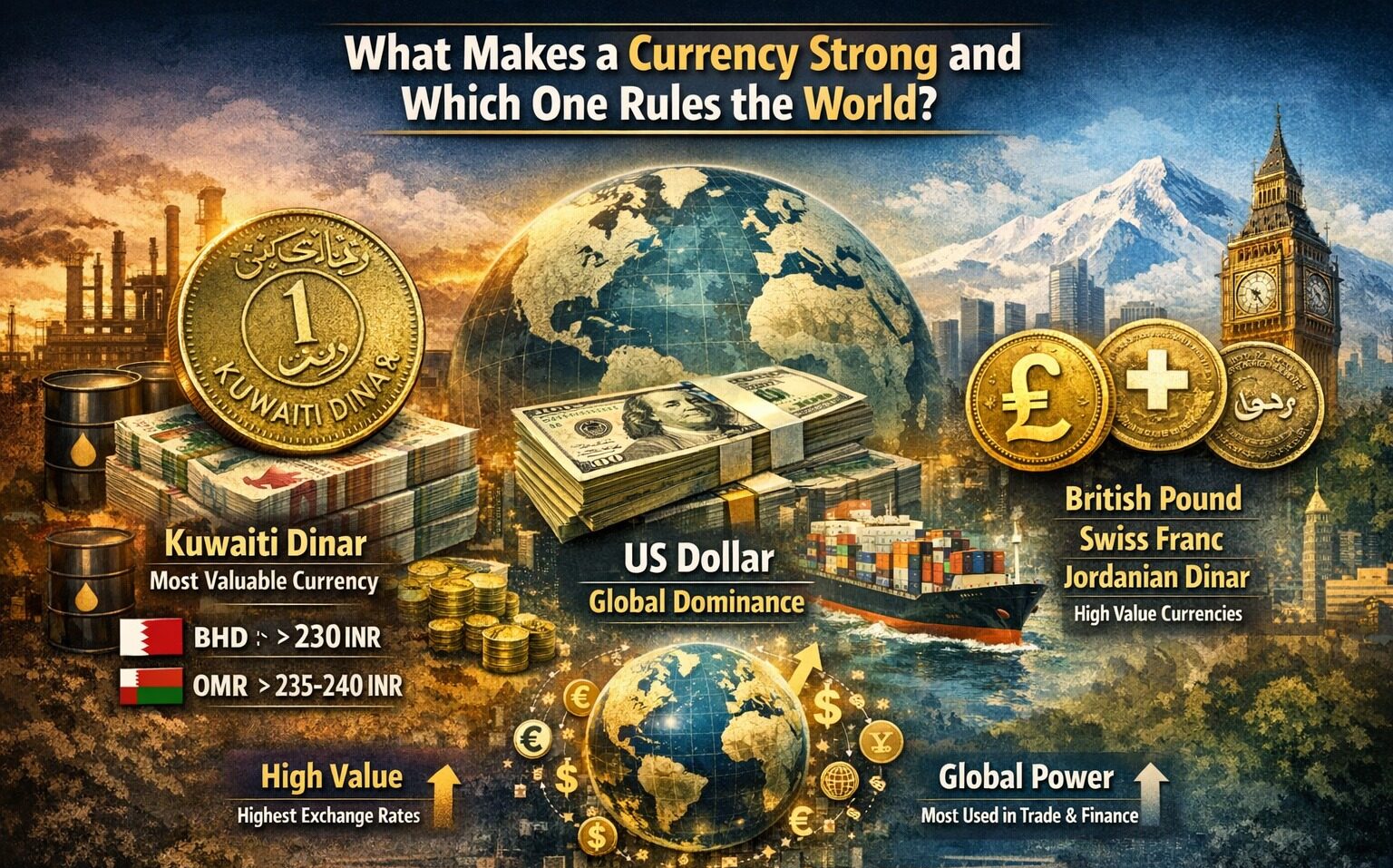
The Kuwaiti Dinar holds the position of the world’s most valuable currency. Its value stands at over 290 Indian rupees per unit, making it the highest among all national currencies. Kuwait’s strong currency value is mainly supported by its vast oil reserves and a tightly controlled currency supply. The country’s economic structure and export strength help maintain this high valuation over time.
Despite Kuwait being a relatively small nation in terms of population, its financial discipline and resource-backed economy play a major role in keeping its currency at the top.
Strong Middle Eastern Currencies Follow Close Behind
After the Kuwaiti Dinar, the Bahraini Dinar and the Omani Rial are among the most valuable currencies in the world. The Bahraini Dinar is worth over 230 Indian rupees, while the Omani Rial trades in the range of approximately 235 to 240 rupees.
Like Kuwait, both Bahrain and Oman benefit from energy resources and careful monetary management. These countries maintain stable exchange rates and limit excessive currency circulation, which supports higher individual currency values.
European Currencies That Outvalue the Dollar
Several well-known European currencies also hold higher exchange values than the US dollar. The British Pound, the Swiss Franc, and the Jordanian Dinar are all worth more than the dollar in direct exchange terms. These currencies are supported by stable financial systems, long-standing institutions, and consistent monetary policies.
However, their higher exchange value should not be mistaken for global dominance. While they are strong in valuation, their international usage is more limited compared to the dollar.
High Value vs Global Power
A crucial distinction in understanding currencies is the difference between exchange value and global influence. A high-value currency means that one unit exchanges for more of another currency. Global power, on the other hand, depends on how widely a currency is used in trade, reserves, and international transactions.
In this area, the US dollar continues to lead. It remains the most widely used currency in global trade and finance, even though its exchange value is lower than several others.
The Bigger Picture of Currency Strength
Currency strength is not defined by a single factor. While some currencies command high exchange values due to controlled supply and resource-backed economies, others dominate because of widespread acceptance and trust. Understanding this difference helps explain why the world’s most valuable currency and the world’s most influential currency are not the same.
In the global financial system, both value and usage matter, but they serve very different purposes.