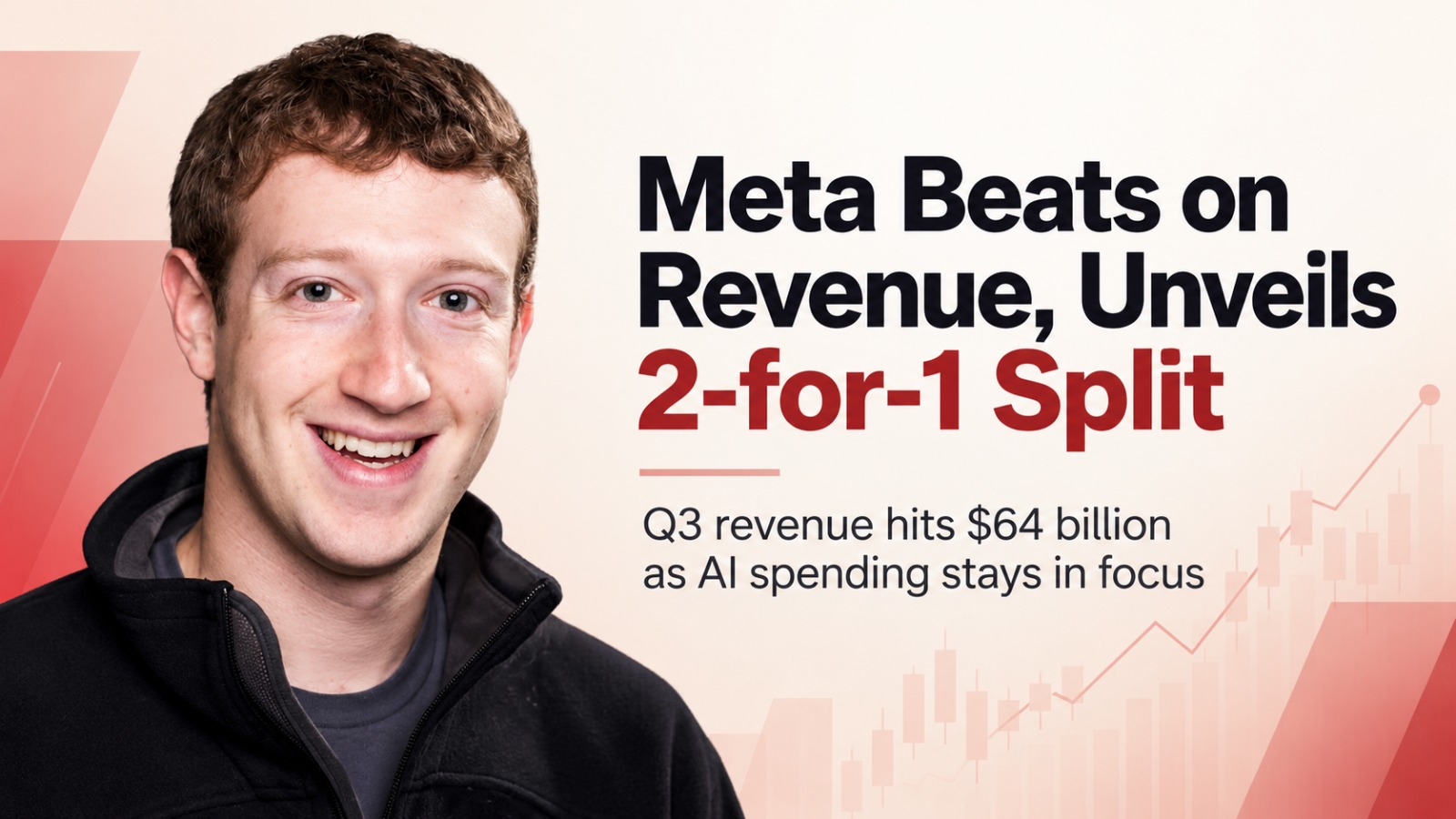
Meta Q3 Earnings 2026: Meta beats Wall Street’s revenue forecast as Mark Zuckerberg outlines an ambitious AI expansion, with its Muse assistant reaching 10 million users in the US and Canada and annual capital spending projected at up to $145 billion.
Meta Platforms delivered record quarterly revenue and announced an unusual stock split on Wednesday, October 21, with a new class of shares that will give investors additional ownership without additional voting power.
The Facebook and Instagram parent reported third-quarter revenue of $64 billion, beating analysts’ expectations of $63.3 billion. The results came as Meta increased the lower end of its annual capital expenditure forecast, signalling continued heavy investment in artificial intelligence.
Most surprising of all is the fact that the company has chosen to create non-voting Class C shares for current shareholders, as part of the strategy to further its growth into the field of artificial intelligence while maintaining Zuckerberg’s control over his company.
Meta’s stock split comes with a catch for shareholders
Meta’s proposed 2-for-1 arrangement will introduce a new class of shares rather than simply increasing the number of existing shares.
Under the plan, holders of Meta’s Class A shares will receive one non-voting Class C share for each share they own. The new shares are expected to begin trading in late January 2027.
The additional shares will not carry voting rights. Investors will receive more shares, but the arrangement will not give them greater influence over corporate decisions.
For Meta, the structure offers a way to raise capital for its growing AI ambitions without weakening Zuckerberg’s control.
Meta Q3 earnings: Revenue beats estimates despite legal charges
Meta’s third-quarter revenue reached a record $64 billion, compared with $51.2 billion in the same period last year.
The company reported generally accepted accounting principles (GAAP) earnings of $3.83 per share, above analysts’ expectations of $3.56.
However, legal expenses associated with its teen mental health settlement weighed heavily on reported earnings. Without that charge, earnings would have reached $7.40 per share.
Meta had reported earnings of $1.05 per share in the corresponding quarter last year.
The market initially welcomed the results, with Meta shares rising more than 3% following the announcement.
AI spending could reach $145 billion in 2026
Meta also revised its capital expenditure guidance for 2026, narrowing its projected spending range to $135 billion to $145 billion, compared with its previous estimate of $130 billion to $145 billion.
The adjustment raises the minimum amount Meta expects to invest by $5 billion, reinforcing the scale of its commitment to AI infrastructure.
Zuckerberg described personal superintelligence as the company’s guiding ambition, arguing that advanced AI should eventually become accessible to billions of people.
He presented the strategy as a long-term technology investment rather than a project driven solely by immediate financial returns.
Meta Muse gains 10 million users, with shopping emerging as its biggest use
Beyond spending projections, Meta offered an early look at how its AI investments could translate into consumer activity.
Zuckerberg said 10 million people across the United States and Canada had set up Meta’s Muse AI application. The company is working to improve computing efficiency before expanding the service globally, with an eventual ambition to reach more than one billion users.
Shopping has emerged as Muse’s most common use case, with an average purchase value exceeding $200.
Personal productivity and connections to other digital services are also among its leading applications.
Meta believes the financial opportunity could extend beyond its existing social media platforms. Zuckerberg said revenue per user from Muse could eventually exceed that generated by the company’s established applications.
He also projected that Muse’s computing cost efficiency could improve tenfold over the next year, potentially supporting profitability as the service expands.
Instagram engagement rises as Threads challenges X
Meta’s established platforms continued to show stronger engagement during the quarter.
Chief Financial Officer Susan Li said global time spent per Instagram user reached an all-time high in the third quarter. Facebook Reels also recorded peak engagement levels in the United States and worldwide.
Meanwhile, time spent on Threads increased 20% from a year earlier.
Zuckerberg also claimed that Threads had overtaken Elon Musk’s X in monthly active users, although the figures needed to independently compare the two platforms were not provided in the reported remarks.
Li attributed improvements in Meta’s advertising business partly to its continued investment in predictive AI models, which help the company better understand user preferences and deliver more relevant advertisements.
She also identified enterprise AI as an emerging business opportunity, with Meta expanding offerings including Muse API, Muse Code and business agents.
Reality Labs losses expected to fall to around $15 billion
Meta’s AI priorities are also influencing how it approaches its virtual reality business.
Zuckerberg said the company expects Reality Labs’ operating loss to decline to approximately $15 billion next year, with a longer-term goal of moving towards profitability.
The company is adjusting the pace of virtual reality headset releases while directing greater attention towards personal superintelligence.
Muse is expected to become a central part of Meta’s smart glasses experience, making AI assistance an increasingly important element of the company’s hardware strategy.
What Meta’s earnings mean for investors
Meta’s latest earnings highlight a company attempting to finance its next major technology shift while continuing to generate substantial revenue from its established advertising business.
The record $64 billion quarter demonstrates the strength of its existing operations, while the revised spending forecast shows how much capital the company is prepared to commit to AI.
The stock split adds another dimension. By issuing non-voting shares, Meta can create additional financing flexibility without transferring more decision-making power to shareholders.
For investors, the questions now extend beyond revenue and earnings. Meta must demonstrate that its growing investment in AI can eventually produce returns that justify the expenditure.
Muse’s early adoption, its role in shopping and the company’s plans for smart glasses offer indications of where those returns might emerge. However, the scale and profitability of those opportunities remain uncertain.
With the new Class C shares expected to start trading in January 2027, Meta’s latest results mark an important moment in both its financial strategy and its ambitions for AI.
Also Read: Meta VR Glasses: All About Price, Weight, Features, Launch Date and Muse Charm